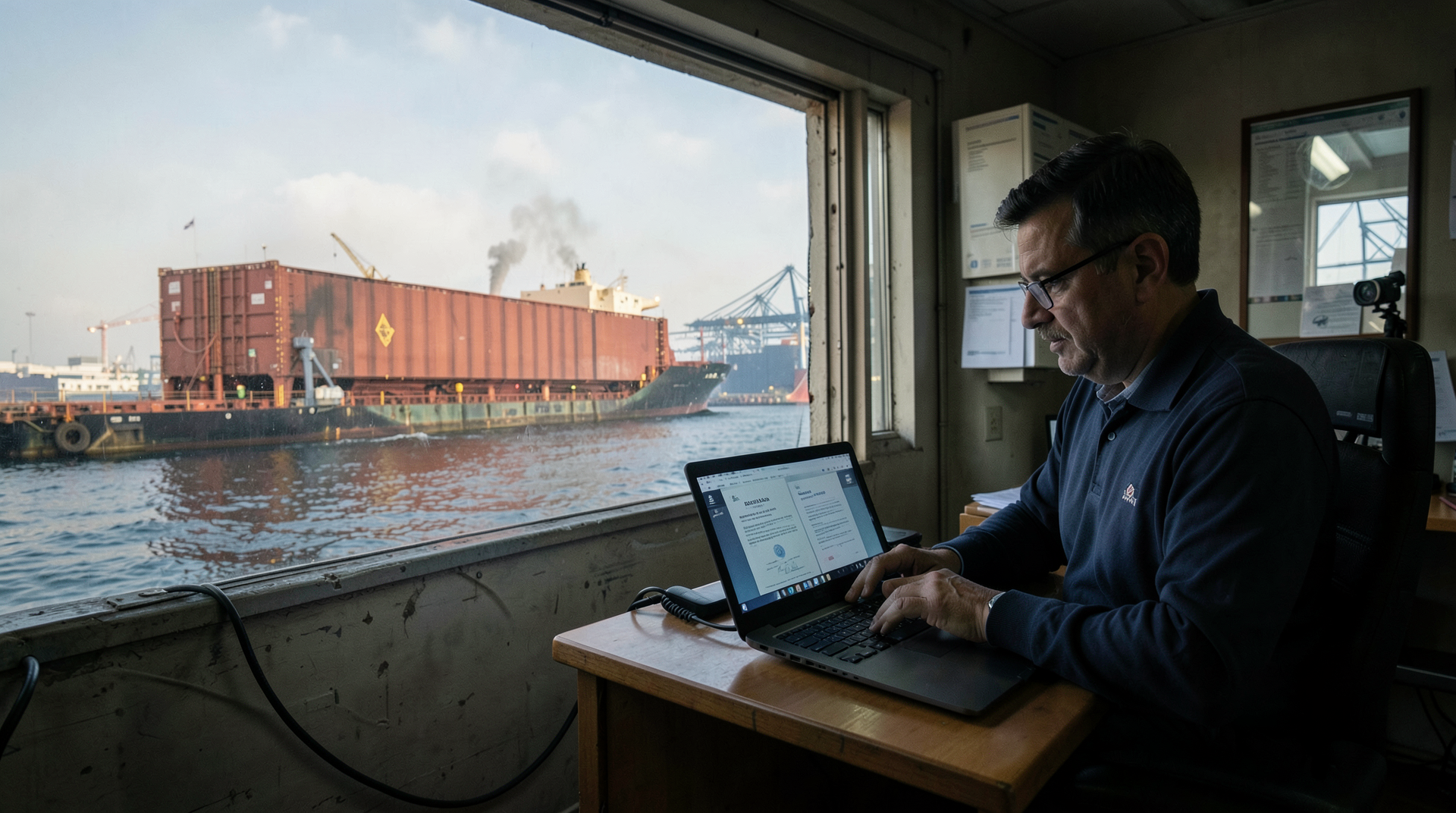
The Strait of Hormuz now has a form problem. Iran's Persian Gulf Strait Authority, described by Windward as a new transit-toll mechanism with declarations, permits, payments, and transit documentation, has moved the dispute from the bridge of a tanker to the desk of the compliance officer. [1]
Monday's paper said Iran had tried to make the Hormuz toll insurable and payable. That was the right first frame, because the insurance wrapper mattered if shipowners, insurers, and ports used it. Tuesday's harder fact is that OFAC had already told the maritime chain to ask whether safe-passage fees were paid to Iran, and to treat the answer as sanctions exposure rather than nautical gossip. [2]
The paper's Hormuz position has been deliberately unfashionable. Summit language matters less than documents, operating behavior, and market prices. Iran's paperwork does not prove recognized control of the Strait. It does something more practical. It gives every counterparty a question it cannot comfortably avoid: did this vessel coordinate with Tehran, and did it pay for passage. [1] [2]
That is why the paperwork is more important than the slogan around it. X can convert the PGSA launch into a simple proof of sovereignty. Mainstream coverage can divide the matter into shipping, sanctions, insurance, and oil-price beats. Neither habit is enough. The transit documentation is not sovereignty. It is also not a press release. It is a compliance artifact, and compliance artifacts travel.
They travel with charter parties, bills of lading, insurance binders, port-state checks, financing documents, reinsurance questions, and due-diligence questionnaires. A ship does not enter the global economy as a dramatic image of a hull in blue water. It enters as a packet. Iran is trying to insert its own paper into that packet. [1]
Windward's account gave the mechanism its operating shape: the PGSA process asks ship operators to file a declaration, coordinate transit, receive a permit, make a payment, and obtain transit paperwork. The value of that sequence is not legal elegance. It is repeatability. A repeated process becomes easier to price, audit, resist, hide, or enforce. [1]
OFAC's alert makes the trap explicit. The agency said it was aware of Iranian threats to shipping and demands for toll payments to receive safe passage through the international Strait of Hormuz. It warned that payments could come in fiat currency, digital assets, offsets, informal swaps, or in-kind transfers, including nominally charitable donations to Iranian-linked accounts. The risk, OFAC said, exists regardless of payment method. [2]
That last sentence kills the romance of the Bitcoin angle. Cryptocurrency can make a payment look modern, difficult to trace, or politically defiant. It cannot make the transaction unsanctioned. OFAC's point is blunt: the route of value does not change the beneficiary. A digital payment to a sanctioned actor is not cleansed by being digital. [2]
SAFETY4SEA's account of the same alert put the maritime consequence in plainer trade language. It said OFAC had reinforced sanctions risks tied to payments allegedly required for passage through Hormuz and to trade involving Iranian crude, and that payments to Iran or the Islamic Revolutionary Guard Corps for safe passage were not authorized for US persons. [3]
The phrase "US persons" can sound narrow until the shipping chain appears. US banks finance non-US ships. US insurers and reinsurers touch foreign cargo. US-dollar payments move through correspondent banks. US-owned or controlled foreign entities can sit inside otherwise foreign commercial groups. OFAC also warned that non-US persons can face secondary-sanctions exposure for transactions with Iran's government or the IRGC, including restrictions on access to the US financial system. [2]
That makes PGSA paperwork a disclosure problem. The maritime service provider does not need to decide whether Iran morally owns the Strait. It needs to decide whether the ship in front of it paid Iran. OFAC specifically encouraged maritime service providers to conduct enhanced due diligence on vessels attempting to transit Hormuz, review red flags including voyage planning or actual transits through Iranian territorial waters, and ask counterparties who they coordinated with and whether safe-passage fees were or will be paid. [2]
The question sounds bureaucratic. It is explosive. If a ship says no and later PGSA documentation appears, the service provider has a false statement in its file. If a ship says yes, the service provider has a sanctions question. If a ship refuses to answer, the service provider has a risk decision. If the paperwork is forged, the market has a new fraud problem. Every branch of the decision tree gives Iran's paperwork commercial gravity. [2]
This is the difference between a tollbooth and a compliance regime. A tollbooth stops a vehicle. A compliance regime makes other people stop it for you. Iran may lack the recognized legal authority to levy passage charges in an international strait, and it may lack the balance sheet to make Hormuz Safe credible insurance. But if enough private actors treat missing paperwork as a risk, or present PGSA documentation as a sanctions flag, Tehran has changed the behavior of the chain without winning the law. [1] [2]
That is not a victory to overstate. It may be theater. It may be a website and a slogan, never a working maritime system. The paper's rule cuts against hype as much as complacency. If no shipowner files, no insurer accepts, no port asks, no lender screens, and no regulator issues follow-up guidance, the PGSA paperwork will remain a propaganda brochure with a maritime font. [1]
But the evidence now points to a more serious threshold than Monday's oil-price relief suggested. OFAC did not tell the industry merely to ignore Iran's demand. It told service providers to ask about coordination and payments. That turns PGSA from an Iranian claim into an American compliance checklist. Washington may reject the toll; it still requires the market to detect it. [2]
There is a bitter symmetry here. Iran tries to make coercion look like insurance. The United States tries to make rejection look like due diligence. The shipowner in the middle wants the cargo delivered, the lender repaid, the premium recognized, the port call completed, and the crew alive. The paperwork lands on that table not as ideology but as a cost. [1] [2]
Oman remains the missing state. Monday's paper treated Muscat's silence as the boundary on Iran's joint-management claim. That boundary still holds. Nothing in the PGSA paperwork makes Iran's claim bilateral. A form issued by Tehran does not become a shared Strait authority because the form says so. The next official Omani sentence, if it comes, will matter precisely because the private paperwork is trying to fill the public silence.
The commercial ambiguity may be the point. If Iran cannot win open recognition, it can try to win conditional behavior. A captain slows. A charterer asks. A bank screens. A port inspector wonders. A sanctions lawyer drafts a clause. The world's most important oil passage becomes less a line on a map than a folder in a risk system. That is how a blockade can persist after the headline says de-escalation.
The oil market is prone to celebrate the first rumor of relief. It should read the paperwork instead. A real reopening would reduce the need for Iranian permission. A real settlement would make safe-passage fees irrelevant. A real maritime agreement would name the authorities, duties, and rules. PGSA points in the opposite direction. It makes permission the product. [1]
There are practical questions the next edition must answer. Has any vessel presented PGSA paperwork. Has any insurer or reinsurer accepted it. Has any bank refused financing after discovering a safe-passage payment. Has any port authority issued a warning. Has Oman said a word. These are small questions, but small questions are where large coercion either becomes routine or fails. [2]
The danger is not that paperwork magically rewrites the law of the sea. The danger is that it rewrites the workflow of shipping. A disputed document can still be operational if enough people must account for it. Tuesday's story is therefore not Iran controls Hormuz. It is more unnerving: Iran has put a paper object into the chain, and Washington has told the chain to look for it. [1] [2] [3]
That is how a strait becomes a sanctions problem. Not through one dramatic closure, not through one tanker burning in television light, but through a form that asks who paid, who knew, who insured, who cleared, and who touched the money. The first honest answer may matter more than the next speech from any capital.
-- YOSEF STERN, Jerusalem