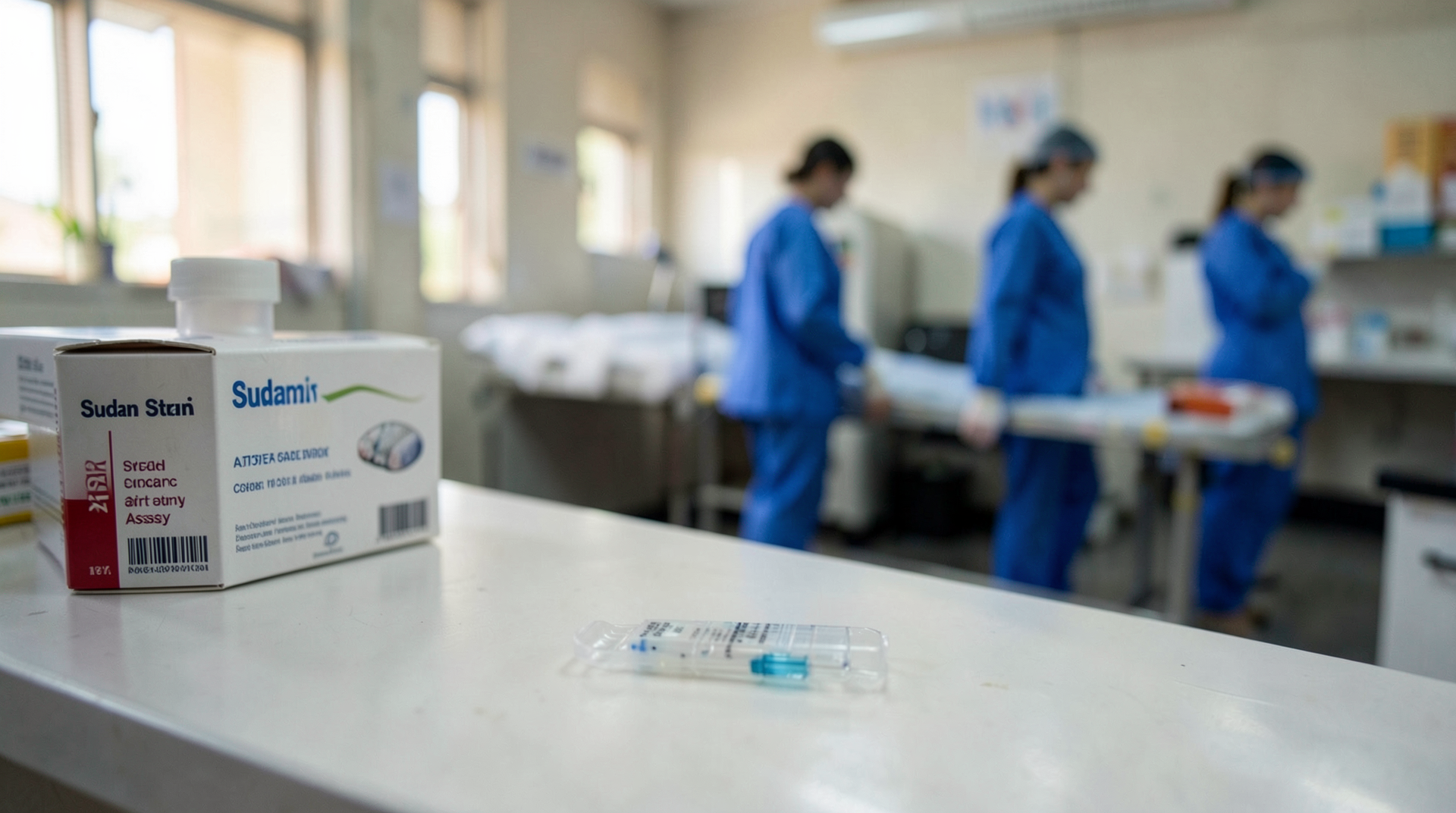
The first patient died on April 24. The World Health Organization did not declare a Public Health Emergency of International Concern until May 17. The reason for the gap is not a delay in the field; it is a cartridge. The PCR assays that ran on the first samples from Ituri Province were calibrated for the Sudan strain of Ebola. The outbreak in Bunia, Rwampara, and Mongbwalu is Bundibugyo. Three weeks of negative tests produced three weeks of open-casket funerals before anyone had a count to declare. [1]
The paper's May 19 lead on measles elimination as a count, not a slogan argued that the front page of a health story belongs to the denominator. Today's denominator is 8 lab-confirmed cases and 246 suspected cases and at least 80 suspected deaths in Ituri, plus two confirmed cases and one death in Kampala among travelers from the Democratic Republic of the Congo. [1] Africa CDC briefed the BBC on Tuesday with an updated count of roughly 100 deaths and more than 390 suspected cases. [4] At least four healthcare workers in the Ituri chain have died with viral hemorrhagic fever symptoms. There is no approved vaccine for the Bundibugyo subtype. There is no approved therapeutic for the Bundibugyo subtype. Case fatality for prior Bundibugyo outbreaks has run between 25 and 50 percent.
WHO's PHEIC statement included an unambiguous line: "no country should close borders." [1] On Monday, the day after the declaration, the United States Centers for Disease Control and Prevention invoked a Title 42 order barring entry of all non-US citizens who have been in the DRC, South Sudan, or Uganda in the previous 21 days, for 30 days. [2][3] The CDC placed the DRC under a Level 4 travel advisory. CBS News reported that the State Department did not directly respond to questions about whether prior cuts to USAID had affected the cartridge-procurement chain or the surveillance posture in eastern DRC. [5] The institutional contradiction is now the same week as the institutional silence.
The cartridge story has a procurement geometry, and the geometry is the operational lead of this outbreak. Ebola PCR assays are strain-specific: a cartridge that runs for the Sudan strain will return a negative result on a Bundibugyo sample taken from a febrile patient whose blood is in fact loaded with viral particles. The Sudan-strain assays were the cartridges in the Bunia laboratory inventory in late April, and Reuters reported that the first confirmed death dates to April 24 — the gap from that death to the May 15 declaration window covers three full weeks. [1] The CIDRAP analysis published Monday traced the spread mechanism through the period of negative tests: open-casket funeral practices in the Ituri towns produced exposure chains the surveillance system had no reason to interrupt, because the surveillance system thought the cause of death was something else. [4]
Capt. Satish K. Pillai is the named US Incident Manager for the CDC Ebola Response. The CDC's May 17 press transcript is the public-record artifact. [2] Pillai's transcript stops short of describing the cartridge mismatch as the operational lead, but the timing is now public. The Title 42 order CDC issued the next day reads as a border-closure document. WHO's PHEIC language is the opposite document. The Africa CDC briefing — a counter-document — explicitly pushed back on the Title 42 framing without disputing the surveillance failure that preceded it.
The American case is the photogenic one. Dr. Peter Stafford, an American Christian-mission doctor at Nyankunde Hospital in Bunia, tested positive late last week and is being air-evacuated to Germany. Six other Americans are also being evacuated, according to the CBS update Monday. [5] The Stafford case is also the day's second piece in this edition — a feature, not the lead — because Stafford carries the institutional gap by name rather than by function. The lead's protagonist is the cartridge.
What changes with a PHEIC declaration. International Health Regulations move from advisory to binding for state parties; WHO can recommend (but not impose) measures including screening, contact tracing, and travel-related precautions. PHEIC is not a quarantine instrument; it is a coordination instrument. The most important thing a PHEIC does is unlock funding and force partner-country alignment on standardized response. CDC's Title 42 order departs from that alignment on the same day the alignment was supposed to begin. WHO has not, as of edition close, formally objected to the CDC order. The Africa CDC pushback is the most public form of objection so far. [4]
The vaccine question is the cruelest piece. The Ervebo vaccine, the rVSV-ZEBOV product that has been used to substantial effect in Zaire-strain Ebola outbreaks since 2019, does not work against Bundibugyo. The Sabin Vaccine Institute's MVA-BN-Filo and Janssen Ad26.ZEBOV regimens are also Zaire-strain products. There is no approved Bundibugyo-specific vaccine. There is no approved Bundibugyo-specific therapeutic. The monoclonal antibody cocktails — Inmazeb and Ebanga — that are licensed for Ebola virus disease are licensed for Zaire-strain disease only. A clinician working a Bundibugyo case in Bunia today has supportive care and isolation. That is the toolkit. [4]
The 21-day prior-travel lookback in the CDC's Title 42 order is the calendar version of the cartridge failure. Twenty-one days is the outer edge of Ebola's incubation window; it is also, within a few days, the gap between Stafford's likely exposure and the WHO declaration, and the gap between the first April 24 death and the moment the surveillance system saw an outbreak it could declare. The bureaucratic instrument and the clinical instrument were running on different clocks. The instrument that is supposed to align them — the lab cartridge — was running on the wrong one.
Memorial Day is Monday. The CDC's Title 42 order covers travel from three African countries, not from the rest of the world; the AAA forecast for the holiday weekend is 45.1 million Americans traveling 50 miles or more, the largest projection on record. The screening lookback in the order will affect a small fraction of those travelers — but the lookback's existence is the institutional contradiction made portable. WHO says no border closures. CDC has closed a 21-day travel window. The two statements share neither author nor evidentiary base.
The paper has been making a denominator argument all spring. Measles elimination is a count. The PAHO November review is the calendar checkpoint. Bangladesh's measles thread — the May 19 paper's parent service map argument — turns on a procurement failure that has produced no parent-facing artifact. The Bundibugyo outbreak is the same argument from a different province. The denominator is 8 confirmed, 246 suspected, ~100 dead, 4 healthcare worker deaths, zero Bundibugyo vaccines, 30 days of Title 42, and a 21-day lookback. The artifact is the cartridge. The contradiction is the order. The institutional gap, today, has the most ordinary face the gap can have: a small plastic consumable that the procurement system in eastern DRC had stocked for the wrong strain. [4]
Some of the unresolved questions belong on tomorrow's front page. Who manufactured the Sudan-strain cartridges that landed in the Bunia laboratory inventory, and on what procurement timeline? Did the prior administration's USAID cuts affect the supply chain that produced the wrong-strain stocking decision? CBS's State Department non-response is the smallest possible answer to that question. [5] Will WHO formally object to the CDC's Title 42 order, or will the contradiction stand as the new normal? What is the actual case-fatality rate trajectory as Africa CDC moves from its present 100-death, 390-suspected count toward a lab-confirmed denominator?
The Washington Examiner's coverage emphasized the lawfulness of the Title 42 instrument and the political safety of the 30-day window. [6] The USA Today service explainer ran the symptoms, the transmission routes, and the consumer-facing risk picture. [7] The WSB-TV piece named Stafford and his mission affiliation. [8] CIDRAP did the operational work: cartridge, funeral, declaration timing. [4] The PHEIC text and the CDC press transcript are the documents under all of it. [1][2]
The gap between an outbreak's first death and an outbreak's first declaration is normally measured in laboratory turnaround time, sample logistics, and surveillance reach. This outbreak's three-week gap was none of those things. It was a small printed serial number on a box of assays.
-- NORA WHITFIELD, Chicago