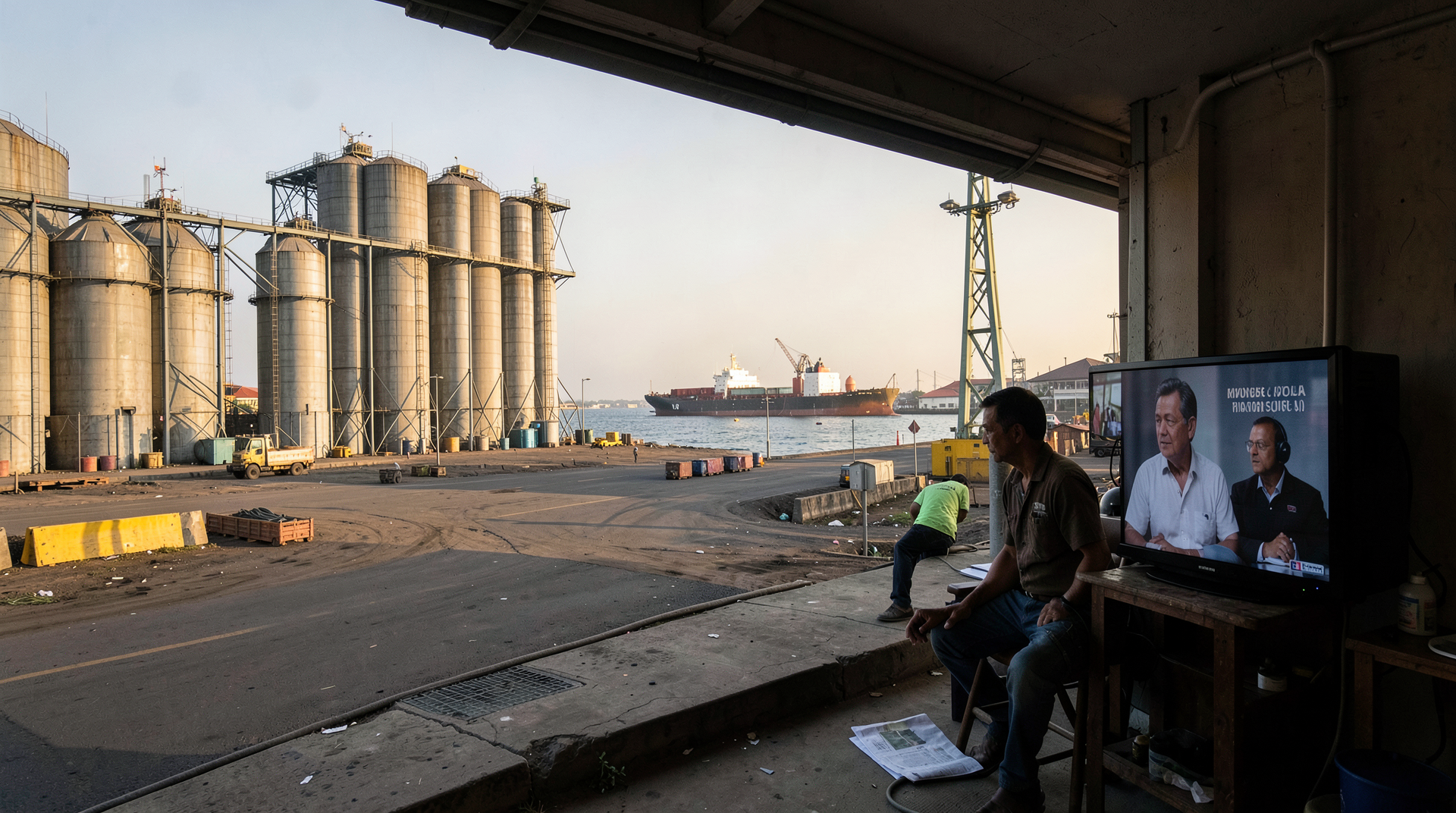
UK Foreign Secretary Yvette Cooper, speaking ahead of a London partnerships conference, said the world is "sleepwalking into a global food crisis" because the Hormuz blockade has frozen fertiliser shipments at the spring planting window. [1] The World Food Programme estimates that 45 million more people could fall into acute food insecurity if the war does not end by mid-2026. [1] The line appeared on ABC News' Iran live blog at 8:23 AM EDT Tuesday as "UK warns of looming food security crisis if Strait of Hormuz doesn't reopen soon." [2] President Trump, in his Tuesday remarks on the same conflict, called the economic effects "peanuts." [3]
The paper's IEA oil report piece from May 19 argued that a waiver rumor is not a reopening — that demand data and stock draws keep price relief separate from operating relief. The stock-draw companion made the same case from the inventory side. Cooper's statement is the second-order extension. The operating system continues; the fertiliser layer of that operating system was the part that needed an MSM voice. Cooper supplied one. The supply-chain accounts on X have been making the argument since March. The gap between when supply-chain Twitter started writing it and when a Western foreign minister said it in MSM language is itself the news.
The fertiliser-shipping logic is short. Roughly a third of global urea, ammonia, and potash flows move through Persian Gulf and Indian Ocean lanes. Iran and Qatar are major urea exporters; Saudi Arabia and the UAE host substantial petrochemical fertilizer capacity; the Strait is the choke that connects those exporters to global routes. The spring-planting window for the 2026-27 cycle in sub-Saharan Africa, South Asia, and parts of the Mediterranean basin has not slipped because of a shortage of nitrogen molecules; it has slipped because of shipping, insurance, and finance friction that has accumulated around Hormuz transits. The Cooper statement names the consequence. The mechanism behind the consequence is the Hormuz monetization regime the paper's cable major traces today.
The WFP 45-million estimate is a marginal number, not a total. WFP's standing baseline for acute food insecurity sat at approximately 343 million people at the start of 2026. The 45 million is the additional caseload Cooper's statement attributes to the war and to the Hormuz disruption specifically. The estimate runs through the agency's standard country-by-country pipeline; a regional breakdown has not been published as of edition close. The Guardian's Fiona Harvey filing, which carried Cooper's statement in detail, runs the number through the standard WFP framing without naming specific countries. [1] The National, the Abu Dhabi-based outlet, framed the same number as evidence that the world's most fragile food systems are again at the leading edge of someone else's war. [5]
Cooper's frame is also a UK domestic-policy instrument. The UK aid budget has been under sustained downward pressure since the Trump administration's broader USAID cuts in early 2026, and the political case for restoring or defending UK official development assistance commitments runs through specific consequence stories. A "global food crisis" frame — anchored in a 45-million estimate, in a closed strait, and in a spring-planting window — does the political work of an aid-budget defense without requiring an aid-budget specific announcement. The frame is not less true for being instrumentally useful to the Foreign Secretary. It is true and useful.
The simultaneity is the part that matters for the paper's argument. Cooper said this on Monday and Tuesday. The Senate discharged its Iran war-powers resolution on Tuesday afternoon at 50-47. Trump publicly set a "two or three days" deadline on Tuesday morning. Three institutions — a Western foreign ministry, a US legislative chamber, and a US president — produced public-record artifacts on the same calendar. The artifacts run in different directions. Cooper named the consequence the war is producing. The Senate named the war-restraint vote the system has finally permitted. Trump named the deadline by which the war's other deadlines will be reset. None of the three artifacts moves the strait.
The supply-chain accounts on X have been describing the fertiliser layer with specificity since March. The accounts that produced the most actionable reads — agronomy analysts, ag-finance desks, shipping consultants — described the problem in terms of three constraints: insurance availability for ammonia and urea cargoes on Persian Gulf routes; settlement risk for fertilizer cargoes whose nominal payment routes through US correspondent banks; and physical-logistics availability of cable-laying, mine-clearance, and bunkering capacity at affected ports. The Hormuz Safe and PGSA monetization layers the paper has been tracking sit at the intersection of those three constraints. The Cooper statement does not name the layers. It names the outcome.
The OFAC posture that the paper has tracked through the Hormuz certificate counterparty piece runs through the fertilizer market in the same way it runs through oil. A US or US-correlated counterparty handling an Iranian-paperwork-touched fertilizer cargo faces the same diligence obligation that a US-correlated counterparty handling an Iranian-paperwork-touched oil cargo faces. Fertilizer trades are smaller in dollar terms than oil trades, but the diligence cost as a fraction of the trade's economics is similar. The diligence cost cascades onto the planting calendar through delay. Delay at the spring-planting window does not, in agronomic reality, push the planting to summer; it loses the crop.
What is new in Cooper's framing is the explicit attribution. Cooper's statement names Iran, names the Strait of Hormuz, names the spring-planting window, and names the WFP estimate. Each of these elements has appeared in supply-chain X discourse for months. The compression into a single Western foreign-minister statement is the first MSM-grade public artifact of the connection. The Guardian's filing makes the connection load-bearing. [1] The National's filing makes it explicit in different language. [5] The ABC News live-blog item gives the statement its time-stamped political-news weight. [2]
The Trump "peanuts" line, by contrast, is the political-rhetorical denial of the same connection. [3] The Trump statement does not contradict Cooper's facts; it dismisses them as small in proportion to other concerns the administration is foregrounding. The "peanuts" framing produces, however, a specific structural problem for any subsequent administration claim that the Iran war is winding down: if the economic effects are small, the war can continue indefinitely; if the economic effects are large, the war's resolution is urgent. The Trump line and Cooper's line have opposite logical implications for the war's calendar. The two cannot both be true.
The CNN filing on the Hormuz cable layer published Sunday names the platform operators — Google, Microsoft, Meta, Amazon — that the IRGC's cable-toll demand targets. [4] The platform-operator layer is the upstream financial-infrastructure consequence of the same monetization regime that pushes downstream into fertilizer supply through shipping and insurance frictions. Cooper's framing is the downstream end of the same chain. The Cable major and the fertiliser major are, in the editor's table, two sides of the same Hormuz operating-system argument.
What the WFP estimate does not tell us. It does not tell us which countries' acute caseloads are growing fastest. It does not tell us whether the 45 million is concentrated in countries that have already lost the 2026 planting window or in countries whose 2026-27 planting decisions are still being made. The next WFP regional breakdown is the document the paper will be watching. The next G7 finance ministry statement that pairs Cooper's language with a binding commitment is the second document. Neither has been written.
The supply-chain X accounts that have been carrying this story since March did so without the benefit of a Western foreign-minister statement, an MSM front-page filing, or a Senate war-powers vote. They did so on shipping receipts, bills of lading, port-call data, and OFAC general-license bulletins. The accuracy of those accounts has, today, been validated by Cooper's statement. The accuracy is not a vindication; it is a reporting outcome. The accounts were right about the connection. They were also right about the calendar. The Western foreign ministry that said so on Tuesday said so eight to ten weeks late.
Cooper's frame will, in due course, attract criticism. The "sleepwalking" verb is the rhetorical move that opens the criticism — it implies institutional inattention. UK foreign-affairs accounts have already begun framing the line as a self-criticism the Foreign Office cannot afford. The criticism is procedurally fair. The criticism is also late by the same eight to ten weeks. What Cooper said on Tuesday was the truth supply-chain Twitter has been writing in spreadsheets since March. The Foreign Secretary's job was not to discover the truth. It was to say it from her institution. She did so. The question for the next month is what the institution does with the statement.
The institution, on present evidence, will continue to defer to the deadline calendar Trump sets and the diplomatic calendar Pakistan channels. The Hormuz operating system, on present evidence, will continue to charge tolls on the layers it has already monetized. The fertilizer cargoes, on present evidence, will continue to encounter the diligence cost the layered monetization regime imposes. The spring-planting window, on present evidence, will continue to close. The 45-million caseload, on present evidence, will continue to compound.
Cooper said it in MSM language on Tuesday. The supply-chain accounts on X said it first.
-- DARA OSEI, London