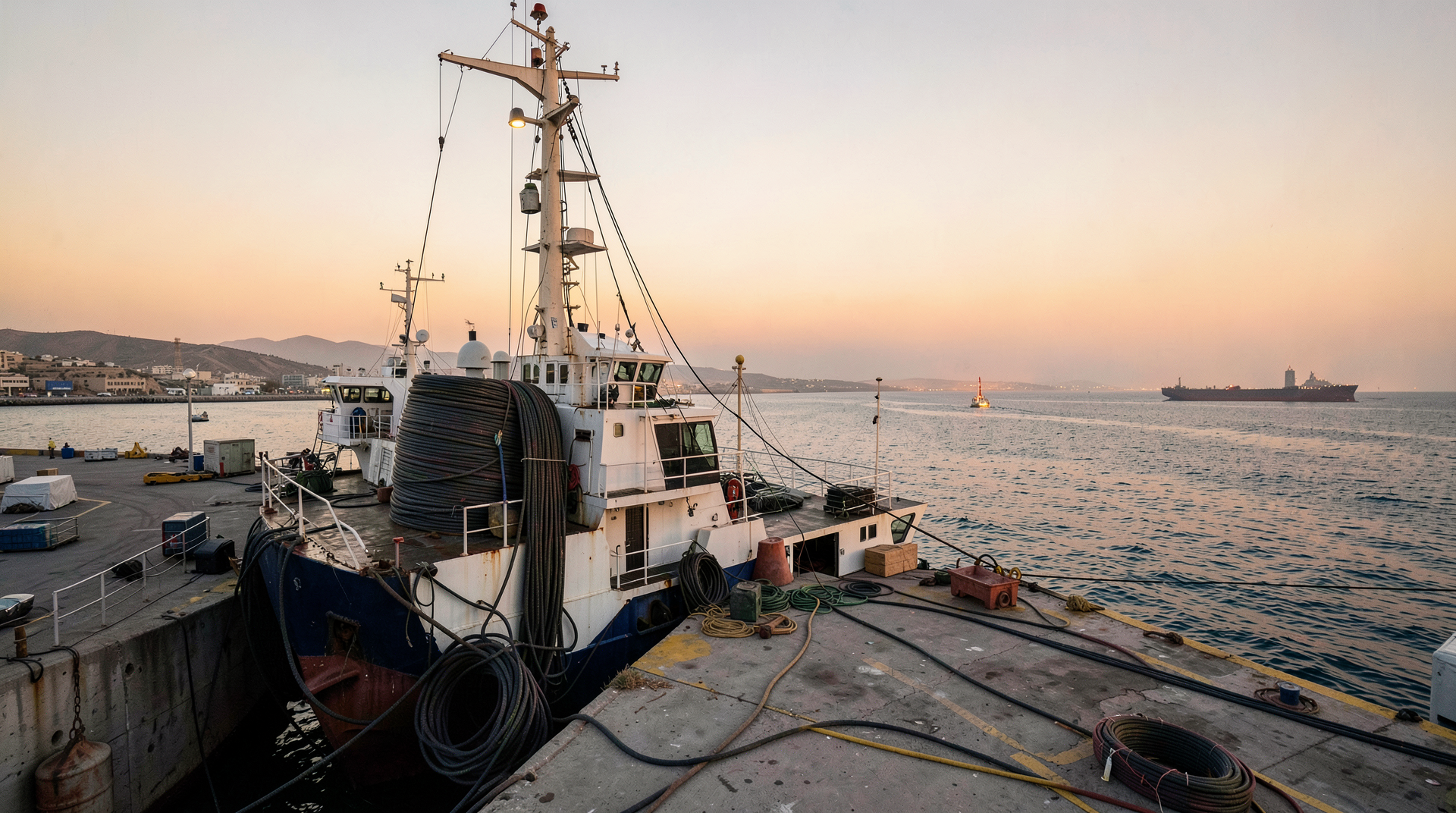
Ebrahim Zolfaghari, spokesperson for Iran's military command center, wrote on X this week that Iran "will impose tolls on internet cables" crossing the Strait of Hormuz. Iran International reported the post Tuesday; CNN had pulled the broader pattern into a Sunday filing that named Google, Microsoft, Meta, and Amazon as the eventual counterparties for the cable layer of the same monetization regime Iran has built around oil cargoes and transit certificates. [1][2] Six weeks earlier, Alcatel Submarine Networks — the Nokia-owned cable-laying company that carries out the majority of repair work in the Gulf — issued force majeure notices and paused subsea repairs across the region, leaving stranded cable-laying vessels and an open question about who, in any given week, is actually permitted to fix the fiber under the strait. [3]
The paper has made a Hormuz-as-compliance-regime argument twice this week. The May 19 lead — Iran turned its Hormuz paperwork into a sanctions problem — placed the Pakistan-Gulf Shipping Authority transit certificate at the center of OFAC due diligence for shipowners, insurers, banks, and ports. The companion piece — OFAC made the Hormuz certificate a counterparty question — extended that frame to the financial chain. Today's third layer is data. The point is not that there is a new product line; the point is that the same monetization model now runs across three substrates at once.
Layer one is oil cargo. Hormuz Safe is the insurance platform, payable in bitcoin, that Tehran has been quietly marketing to operators whose cargoes might want a non-Western coverage option for transit through the strait. Layer two is transit. The PGSA transit certificate is the document the maritime chain has been told to ask about; the paper's prior reporting traced the route by which a certificate from a non-recognized authority moves into the diligence packet of any counterparty that finances, insures, or ports a covered cargo. Layer three, as of this week, is data. The IRGC's cable-toll demand is the data-layer invoice. Iran International's filing this week made clear that the language directs itself at the platform operators whose financial-instrument and information traffic crosses the strait — not at the small cable-repair companies that quietly carry the work. [1]
Alcatel Submarine Networks' force majeure is the most important operational fact in the cable layer. Force majeure pauses the contractual obligation to perform; it does not end the contract. ASN has not, in any public document we have located, named the precise trigger that produced its Gulf-wide pause. The most likely trigger — and the one CNN's filing alluded to — is the security posture around the work itself: a cable-laying vessel sitting idle for hours over a known cable splice is, in a strait with active mining activity, a target of the most ordinary kind. [2][3] The IRGC's toll demand sits in that operational vacuum. The IRGC does not need to cut a cable to extract a payment from a platform operator who needs the cable repaired; it only needs ASN's force majeure to stay in force.
The maritime side of the same week is denser than usual. CBS News reported Tuesday that a US intelligence assessment has identified at least 10 mines currently in the Strait of Hormuz. [4] CENTCOM separately said Tuesday that 88 vessels — up from 85 on Monday — have been redirected as the US blockade of Iranian ports continues. The mine numbers move with US Navy clearance operations; the Iranian-manufactured Maham-3 and Maham-7 limpets are the typology, the Pentagon graphic dated April 23 is the document of record. The "two or three days" deadline President Trump set for talks on Iran sits on the same calendar as the mine count, the redirected-vessel count, the force-majeure pause, and the cable-toll demand. The reopening narrative cannot survive that simultaneity intact.
The maritime experts who track Persian Gulf chokepoint behavior — Yörük Işık on the Bosphorus side, retired Royal Navy commander Tom Sharpe on the doctrine side — frame the layered approach as an "escalate, test, adjust" model imported from Russian undersea-infrastructure tactics in the Baltic and from the Houthis' Red Sea operations. The model does not require a cable cut to extract a toll; it requires only the credible possibility that the next round of repair work will not be done unless someone has paid. The IRGC's public-facing language about cable tolls is the credibility instrument. It does not have to be acted on to do its work. [2]
The counterparties named in CNN's filing — Google, Microsoft, Meta, and Amazon — are not maritime operators. They are platform operators whose financial-instrument and information traffic depends on the working state of fiber that crosses the strait. None of the four companies has publicly acknowledged the cable-toll demand. None of them is likely to. The Iran-sanctions exposure of any acknowledged payment to an IRGC-linked entity would be substantial enough that the more useful corporate posture is silence. The silence has its own information value: it confirms the demand has been received without committing the company to a response on the demand's terms.
What does the paper's position now require. A Hormuz monetization regime that ran on oil cargo insurance and transit certificates has added a layer that runs on the maintenance economy of the cables themselves. The OFAC due-diligence question — "who paid, coordinated, insured, and financed this passage" — extends, on the cable layer, into the analogous question: who paid, coordinated, insured, and financed this repair. The maritime chain has been told to ask. The platform chain has not been told to ask in the same explicit terms, but the law is the same.
Yvette Cooper, the UK Foreign Secretary, said this week that the world is "sleepwalking into a global food crisis" because the Hormuz blockade has frozen fertiliser shipments at the spring planting window. [5] The World Food Programme estimates 45 million more people could fall into acute food insecurity if the war does not end by mid-2026. Cooper's frame is the second-order layer of the same monetization regime: the people who pay tolls do not pay tolls in a vacuum; the supply chains in which the tolls are collected are also supply chains in which fertiliser, food, and inputs to the global south's planting calendar move. The paper's fertiliser-spreadsheet feature carries that part of the regime. The maritime piece, today, is the upstream layer: cables, mines, certificates.
Oman's silence remains the legitimacy boundary. The paper's prior position — that Tehran's paperwork does not become joint Strait authority until Muscat says so — has not moved. The Oman Gas Service has issued no statement on cable jurisdiction. The Oman foreign ministry has issued no statement on cable jurisdiction. The IRGC's cable language does not improve in standing because of a CNN filing; it improves in standing only if Muscat ceases to be silent in the opposite direction.
What is new today is not that Iran has invented a third layer. It is that the third layer is now a public-record demand against named counterparties. The "we will impose tolls" line is not subtle. It is also not negotiable in the form in which it was issued. The platform operators named in CNN's filing have no plausible path to negotiating a public payment regime with the IRGC. What they will pay, if they pay anything, will run through the same opaque set of intermediaries that already handle Iran's oil and transit revenues — the Hormuz Safe family of instruments on the insurance side, the Pakistan channel on the diplomatic side, and the bitcoin-payable platforms on the settlement side.
The standalone briefs and standards in this edition carry the maritime arithmetic — the 10 mines and 88 redirected vessels, the Lebanon ceasefire that has killed 3,000 — as separate pieces. [4] This major's job is to thread the three layers as one product line: oil cargo, transit, data. The first two have been on the front page of the trade press for weeks. The third is now on the front page of CNN. The next ASN service notice, the next IRGC X post, and the next Omani statement (or silence) will tell us whether the layer has stabilized into a permanent feature of the Hormuz operating system or whether it is a one-week test.
The "escalate, test, adjust" framing the maritime experts use is also, plainly, a reporting framing. The IRGC's pattern this week was: escalate (cable-toll language), test (Alcatel force majeure makes the test real), adjust (await counterparty response). If the response is silence — and silence is the likeliest response — the model has succeeded on its own terms. The cable layer of the Hormuz monetization regime is now a working layer.
Wednesday update. A South Korean oil tanker was passing through the Strait of Hormuz on Wednesday morning, South Korea's Foreign Minister Cho Hyun told lawmakers in Seoul. Reuters separately reported, citing shipping data, that two Chinese oil-filled tankers left the strait the same morning. [6] Chinese President Xi Jinping told Vladimir Putin in Beijing on Wednesday that a "comprehensive ceasefire is of utmost urgency," according to Xinhua. [6] None of these is a Hormuz reopening document. A South Korean tanker passage, two Chinese departures, and a Xi-to-Putin sentence about Middle East ceasefire are operational events that the same monetization regime is built to absorb without changing its terms. The PGSA paperwork, the Hormuz Safe insurance product, the IRGC cable-toll demand, and Alcatel's force majeure are all still in place. The Wednesday-morning movements are the test of whether the layered regime makes corridor traffic possible while the toll, the certificate, and the insurance instrument all keep running in the background — not whether the strait is open.
The paper's existing position on Hormuz holds. It now extends one substrate further than before.
-- YOSEF STERN, Jerusalem