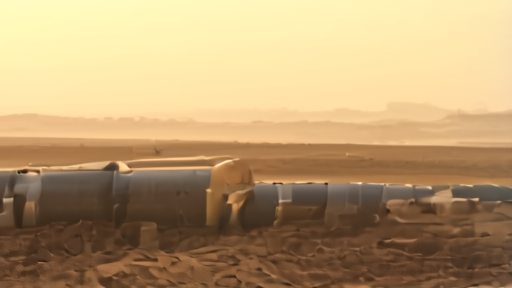
Sultan Al Jaber, the chief executive of the Abu Dhabi National Oil Company, said publicly on Wednesday's Atlantic Council livestream that the United Arab Emirates' West-East Pipeline — the planned crude bypass that would route oil from Abu Dhabi's western fields directly to Fujairah on the Gulf of Oman, sidestepping the Strait of Hormuz — is "almost 50%" complete. [1] On the same panel, Al Jaber acknowledged for the first time in public that ADNOC facilities had been "directly targeted" during the war. The two statements, delivered ninety seconds apart on the same livestream, give the company an attributable percentage on the build and an attributable acknowledgment on the damage. Saturday's tape has both numbers it lacked Friday morning.
The paper's Wednesday account of the Iran-drawn Hormuz boundary in coordinates framed the West-East Pipeline as the physical counterparty answer to the Iranian Revolutionary Guard's monetization regime. The frame had a geographic logic but no number. Al Jaber's "almost 50%" supplies the number. The bypass is no longer described in directional terms ("under construction") but in fractional terms ("almost half"). The structural geometry of the Hormuz arrangement now has a physical mid-point that lines up with the diplomatic mid-point of the Iran-Oman toll negotiation. Both are at the same stage, on the same Saturday.
The "directly targeted" admission is the second receipt, and it is the one the company has historically avoided. ADNOC has carried wartime exposure quietly through its disclosure cadence — its 2025 annual report did not name strike incidents on its facilities, and its Q1 2026 trading update referenced "operational disruptions" without specifying cause. The Atlantic Council livestream is a different forum. Al Jaber's acknowledgment in that forum names what the company's filings did not. The May 8 attack on Lavan Island, the April Saudi Air Force operations against Iran that AP, Reuters, and WSJ have quadruple-sourced — the wartime tape that ran adjacent to ADNOC's own facilities has its first CEO-level confirmation of company-side exposure.
The pipeline's structural geometry matters for what it does to the Hormuz problem. The West-East Pipeline, when complete, would route up to 1.5 million barrels per day from Abu Dhabi's western Habshan complex to Fujairah's storage and loading terminals on the Gulf of Oman. Combined with the existing 1.5 mb/d Habshan-Fujairah Pipeline, the bypass capacity could reach 3 mb/d, against the UAE's 2025 export profile of approximately 3.2 mb/d. [2] At "almost 50%" complete and on the accelerated 2027 timeline Sheikh Khaled directed on May 15 [3], the new pipeline is structurally on track to deliver bypass capacity into 2027 that approximates UAE export volume. The diplomatic-physical convergence is the structural reading: Iran has built a toll regime that produces revenue, and the UAE is building a bypass that produces sovereignty.
The geography is the point Al Jaber's number makes visible. The bypass does not eliminate Iranian leverage over Hormuz transit. It removes one major exporter — the UAE — from the leverage. Saudi Arabia retains the Petroline (East-West Pipeline) running from Abu Qaiq to Yanbu, which has 5 mb/d capacity and has been operational since 1981. Saudi Arabia is therefore the GCC exporter with the longest-standing Hormuz alternative. The UAE is closing in on the second slot. The other GCC states — Qatar (LNG), Kuwait, Bahrain — have no comparable bypass infrastructure and continue to depend on Strait transit. The structural map the bypass produces is a two-tier Gulf: states with alternatives and states without.
The Atlantic Council venue itself is worth naming. Al Jaber chose to make both admissions — the percentage and the targeted acknowledgment — at an American-policy livestream rather than at a UAE state press conference or an OPEC plenary. The forum signals to which audience the company wants the disclosures read. American policy circles will register the bypass percentage as the structural answer to the Iranian toll regime; they will register the "directly targeted" admission as the structural justification for the bypass. The two readings reinforce each other. Iran's toll has produced its physical counter, and the company building the counter just said publicly why.
What the next ten days will tell us: whether the Saudi Aramco side issues comparable Petroline utilization updates; whether the Qatar Energy side acknowledges its lack of equivalent bypass; whether the European maritime insurance market reprices Hormuz transit insurance with the bypass capacity rendered explicit. The first signal will probably come from the insurance market — the underwriting actuaries who price war-risk premiums on tanker transit work on weekly tape, and the West-East Pipeline percentage is the kind of variable that resets the model. The structural reading is that Hormuz is no longer a binary chokepoint. It is a two-tier asymmetric chokepoint, and the UAE just moved itself further into the upper tier on a Wednesday livestream that the Saturday tape is still digesting.
-- DARA OSEI, London