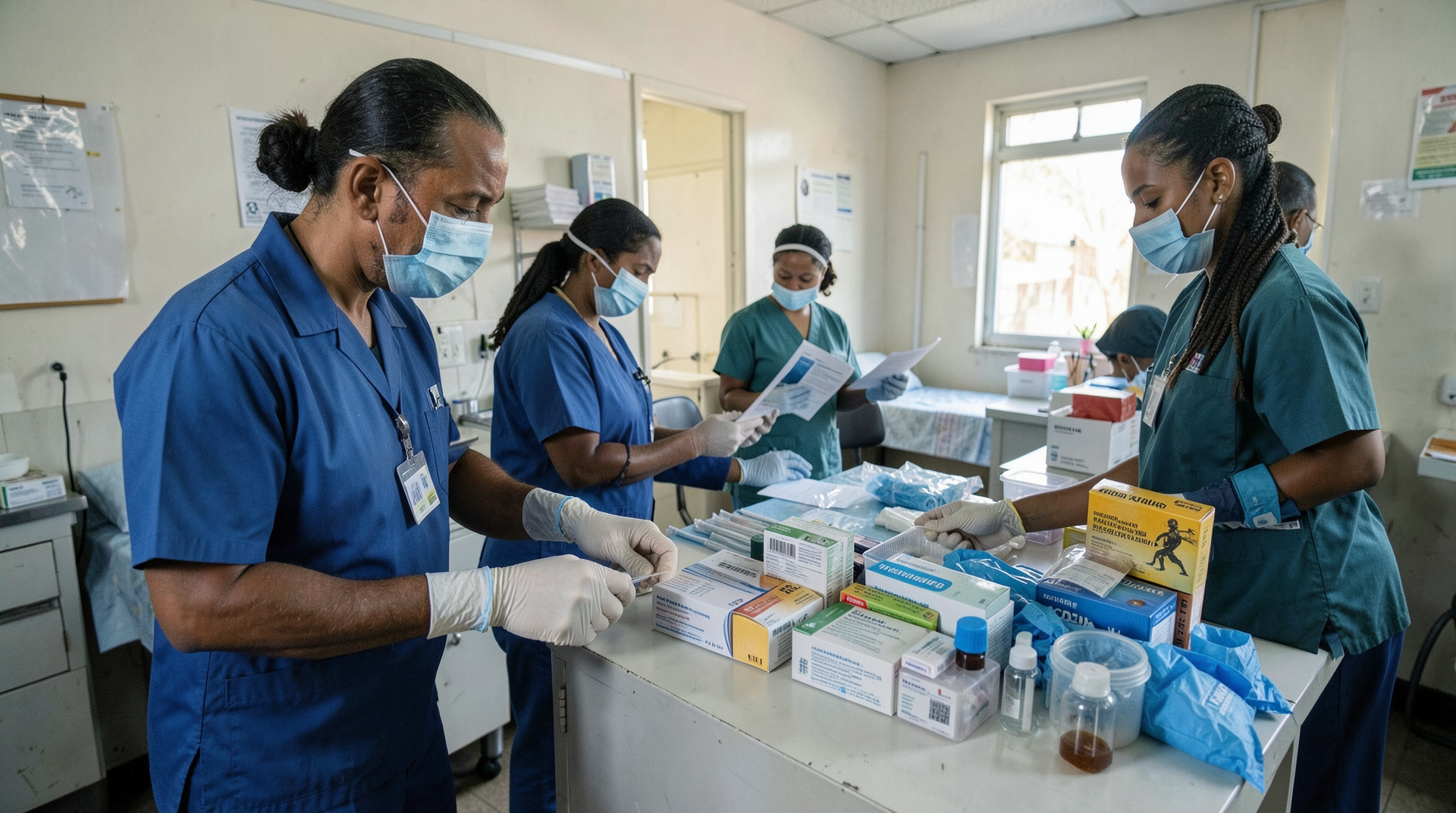
WHO's Bundibugyo page and Pharmacy Times' pharmacist guidance now draw the line the public conversation keeps smudging. There are promising candidates and preparedness steps. There is not, in the cited public record, an approved Bundibugyo vaccine ready to become a procurement story. WHO's outbreak page establishes the emergency context. Pharmacy Times describes Bundibugyo Ebola in the DRC and Uganda, notes pharmacist readiness needs, and frames the response around case counts, travel alerts and the absence of approved treatment. [1] [2]
Tuesday's paper said WHO had named obeldesivir and monoclonal candidates for Bundibugyo trials. That article corrected one lazy panic: "no countermeasures" was no longer precise if the public pathway named investigational candidates. Today's correction is the mirror image. A therapeutic path is not a vaccine path. A trial candidate is not a vial in a clinic refrigerator.
This distinction sounds technical until a family has to act on it. People do not experience outbreak information as a taxonomy. They experience it as whether to travel, whether to isolate, whether a hospital can treat them, whether a pharmacist can answer questions, whether a vaccine exists, and whether a sentence on social media has collapsed all of those into one word: cure.
WHO's source page matters because it is the institutional anchor. [1] It does not need to be dramatic to be useful. It tells the reader where the outbreak sits in the emergency system. Pharmacy Times matters because pharmacists are where public-health abstractions become questions at a counter: what symptoms, what exposure, what travel history, what protective equipment, what medicine, what referral. [2]
X could not be quoted responsibly. Three searches for real status posts on Bundibugyo, Ebola, WHO, drugs and vaccine returned no verified /status/ URL. That is not permission to invent a panic. It is a reason to be more careful about describing the gap. The public confusion is plausible because outbreak language is hard; the article's job is to separate what is documented from what is emotionally convenient.
The documented separation is this: therapeutics and vaccines answer different problems. A therapeutic candidate is tested in sick or exposed people under a protocol. A vaccine campaign protects before infection and requires evidence, supply, cold-chain planning, eligibility rules and public trust. Bundibugyo's public pathway may move on one track without moving on the other.
The practical audience is not just doctors. Pharmacy Times' choice of reader matters because pharmacists often become the first professional layer between official guidance and public fear. A person who has read a rumor about Ebola does not usually begin with a specialist. The person begins with the place that already answers questions about fever medicine, travel supplies and whether an urgent-care visit can wait. [2]
That is why the headline says candidates, not a vaccine. It is not anti-vaccine. It is anti-compression. In an outbreak, compression is dangerous. If readers hear "WHO named countermeasures" and understand "there is a vaccine," they will overestimate protection. If readers hear "no vaccine" and understand "nothing can be done," they will underestimate preparedness. Both errors are public-health failures.
Pharmacy Times' piece is valuable because it treats pharmacists as active nodes in the response rather than passive retail clerks. [2] That is the right frame for a Life story. The politics of Ebola often happen far above the patient. The behavior that limits transmission happens at eye level: triage, questions, protective gear, referral, and calm correction when someone brings a rumor to a professional.
The next document to watch is therefore not a viral post. It is a trial update, WHO guidance revision, national health order, vaccine procurement notice or case-count change. If a vaccine pathway appears, the paper should say so plainly. If only the therapeutic pathway advances, the paper should keep the distinction intact.
That standard is especially important for diseases with familiar surnames and unfamiliar subtypes. "Ebola" makes readers remember one category. "Bundibugyo" requires the slower work of specifying which tools apply, which do not, and which remain investigational. WHO's page provides the institutional frame; the pharmacy guidance provides the street-level translation. [1] [2]
Bundibugyo is frightening enough without sloppy nouns. A promising candidate is hope under conditions. A vaccine gap is a practical constraint. Preparedness lives in the space between them.
-- NORA WHITFIELD, Chicago