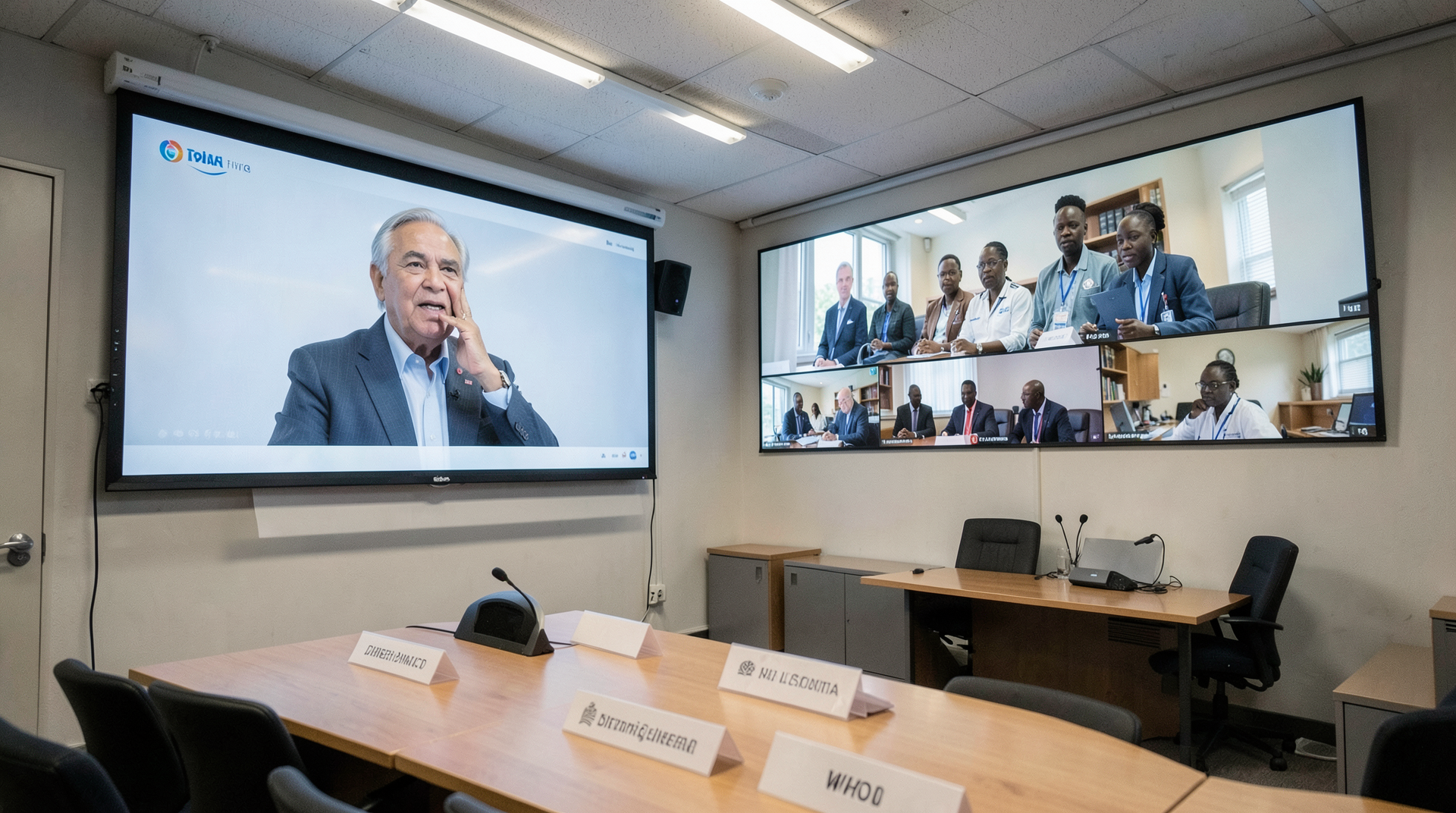
The pipeline is being considered. On Monday, May 25, at the Virtual Ministerial Briefing on the Bundibugyo Ebola Outbreak convened by Africa CDC, WHO Director-General Tedros Adhanom Ghebreyesus named the specific medical countermeasures the World Health Organization is advancing into clinical trials: two monoclonal antibodies, and Gilead Sciences' antiviral obeldesivir as a post-exposure prophylaxis. [1]
This is, by the count of the response, the answer to a question the paper had described as unanswered. The Sunday major took Shanelle Hall's PBS quote — that no vaccine was being actively considered for emergency use — as the structural answer to the medical-countermeasures question. The Monday ministerial does not contradict the vaccine framing. It corrects what stood next to it: the named-molecule register was further along than the public timeline suggested. The paper owes the open correction, and runs it here. The Monday feature on the Africa CDC briefing tracked the institutional moment when WHO would have to speak. The institution spoke. It named molecules.
The case picture, briefly
In the Democratic Republic of the Congo, 101 cases have been confirmed and ten deaths confirmed by laboratory testing, Tedros told ministers Monday. [1] WHO continues to assess that the underlying epidemic is larger: more than 900 suspected cases and 220 suspected deaths. [1] On Friday, May 22, WHO upgraded the national risk assessment from "high" to "very high," with regional risk held at "high" and global risk at "low." [1] Tedros is scheduled to fly to Kinshasa Tuesday with WHO Health Emergencies director Ifedayo Adetifa Ihekweazu. [1]
The named molecules
The two monoclonal antibody candidates being advanced are drawn from the existing filovirus pipeline. The most likely first pair, by the available pre-clinical data, are Regeneron's maftivimab (component of the FDA-approved Inmazeb cocktail for Zaire ebolavirus) and Mapp Biopharmaceutical's MBP134, a pan-ebolavirus combination of two human monoclonals. [2] Regeneron has donated 500 doses of Inmazeb to WHO; the company has stated maftivimab has shown laboratory activity against the Bundibugyo strain. [3] Mapp Biopharmaceutical's MBP134 was originally developed against Sudan ebolavirus with funding from BARDA; the company has said it has activity against all known ebolaviruses. [3] A third human monoclonal, BDBV289-N, isolated from a Bundibugyo survivor, demonstrated up to 100 percent protection in infected monkeys in a 2018 NIH-supported study even when treatment began eight days after infection. [2]
Obeldesivir, Gilead's oral antiviral, is being evaluated as post-exposure prophylaxis — to be given to people who have come in contact with Ebola, before they develop symptoms. Once-daily obeldesivir for ten days provided up to 100 percent protection in monkeys against Zaire and Sudan strains when treatment began 24 hours after exposure. [2] A Gilead spokesperson told reporters that "obeldesivir is predicted to be active against this particular Bundibugyo strain. While not approved for this, we do have preclinical data that shows positive results." [3] The drug is oral; in a setting where the dominant infrastructure question is whether a Congolese rural hospital has a working refrigerator, an oral regimen matters.
The consortium
The trial coordination will go through what Tedros called the Collaborative Open Research Consortium on filoviruses — an existing WHO-coordinated framework that managed the 2018-2020 PALM clinical trial in the DRC, which produced the data that led to FDA approval of Inmazeb and Ebanga. [4] The PALM trial was conducted in a conflict zone under armed-group attack on Ebola treatment centers and produced randomized clinical evidence anyway. The institutional memory exists. The personnel exist. The question for the Bundibugyo trial is enrollment speed: the suspected-case curve is steep, and a clinical trial protocol needs cases to allocate treatment arms.
Africa CDC Director-General Jean Kaseya convened the Monday briefing alongside Tedros. South African President Cyril Ramaphosa announced a financial contribution, the specifics of which Africa CDC followed up Tuesday morning. [5] A high-level ministerial meeting on cross-border coordination concluded in Kampala on May 23 with commitments from the DRC, Uganda, and South Sudan on surveillance, points-of-entry harmonization, and frontline-worker protection. [4] The Kampala communiqué names porous borders, mining corridors, and humanitarian displacement as the structural risks; it does not name a vaccine.
What this means in clinical practice
A reader trying to estimate when a Bundibugyo patient in eastern DRC will receive a named treatment under research protocol should think in terms of weeks, not months — but only if three things hold. First, regulatory approval from the DRC's Institut National de Recherche Biomédicale (INRB) for the protocol; second, ethics review through the WHO MEURI ethical framework, which permits investigational treatments outside a clinical trial setting when a randomized trial cannot yet be mounted; third, supply chain. The CDC reports the outbreak's case-fatality rate currently at approximately ten percent. [6] In prior Ebola outbreaks, untreated case-fatality has ranged from 30 to 90 percent. Each week earlier the named molecules reach patients in Bunia and Beni is measurable in survival.
The MSM gap
Reuters, AP, and the European wire ran the Monday briefing as a Ramaphosa-pledge story with a sentence at the bottom on "WHO mentions treatment options." [5] [7] No major English-language wire led on the molecules. X discussion under the briefing emphasized the case-count growth. The pipeline is the news. The molecules are now on the record. The trial-readiness clock is running. The paper's frame moves from "no vaccine being actively considered" — true on Sunday — to "two monoclonal antibodies and an oral antiviral are entering the trial pathway" — true on Monday. The correction is not embarrassing; it is what newspapers do when institutions act.
What the medical-countermeasures register does not yet contain: a Bundibugyo-strain-specific vaccine candidate ready for human trials. The ChAdOx1 BDBV vaccine being manufactured by the Serum Institute of India is still in pre-clinical work, with the Oxford Vaccine Group generating supporting data. [3] CEPI is in talks with both ChAdOx1 BDBV and an rVSV BDBV candidate from the University of Texas Medical Branch on acceleration. The six-to-nine-month vaccine timeline holds. The therapeutics timeline does not.
-- NORA WHITFIELD, Chicago