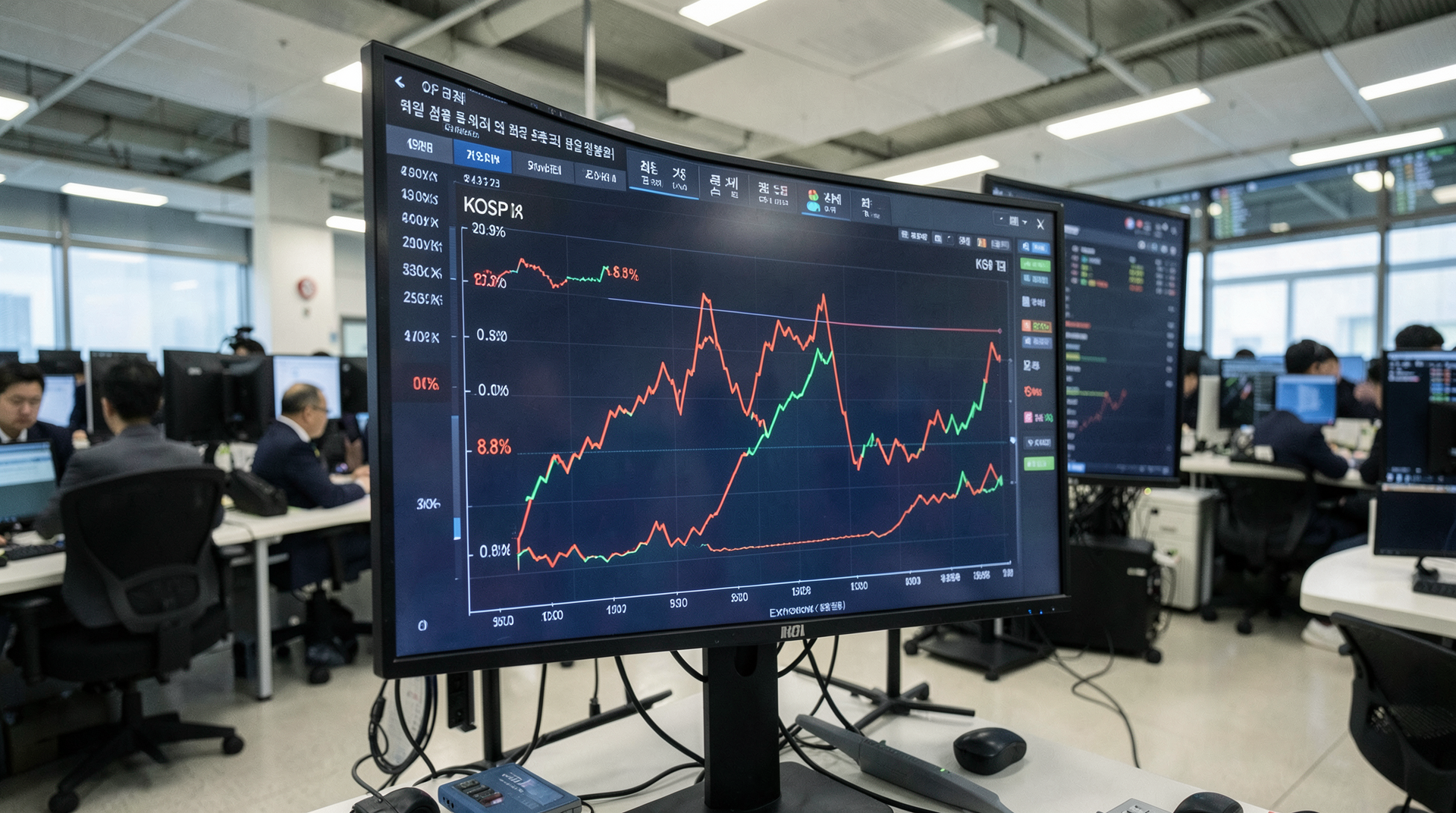
South Korea's KOSPI fell 8.8% at the Monday open, triggering the Korea Exchange's circuit breaker — the worst single-day crash since the index's inception in 1983 [1]. Samsung dropped 11%. SK Hynix fell 10%. The circuit breaker halted trading for the first time in the exchange's history.
The trigger was Broadcom's June 3 earnings report: AI chip guidance of $16 billion versus the $17.2 billion analysts expected [2]. That shortfall cascaded through the global semiconductor sector. Nvidia fell 6.2% on Friday. AMD, Micron, and Western Digital dropped 11-13% [3]. But the KOSPI's crash was qualitatively different from the US selloff because of a structural fact that MSM coverage has underplayed: two companies — Samsung and SK Hynix — carry approximately 50% of the KOSPI's total weight.
The Concentration Problem
The Kobeissi Letter, a widely followed market analysis account on X, broke the news: "BREAKING: South Korea's stock market has been halted after falling -8.4% at the open" [4]. The account framed the halt as a symptom of a deeper problem — index concentration that makes a single sector's earnings miss into a national market emergency.
The _Investinq account went further: "A direct window into the fragility sitting underneath the global AI trade" [5]. The framing matters because MSM outlets — CNBCTV18, EBC Financial, Yahoo Finance — covered the crash as a tech selloff or AI correction [6]. The structural reading is different: the KOSPI is not a diversified index that happens to be heavy in tech. It is a two-company index that happens to list other firms.
Foreign investors sold more than $10 billion in KOSPI shares in the week preceding the crash [7]. The selling was concentrated in memory chips — the same products that powered the global AI supercycle. The $440 billion global memory market depends on a country that imports 100% of its energy through the Strait of Hormuz's periphery.
The War-Energy-AI Triangle
This is where the crash connects to the paper's other threads. Korea's semiconductor fabs — the physical infrastructure behind Samsung and SK Hynix's memory production — depend on imported oil and liquefied natural gas. That energy flows through waters that the Persian Gulf Strait Authority has been tolling, that CENTCOM has been escorting ships through at reduced capacity, and that the weekend's Iran-Israel escalation has now re-threatened.
The paper's June 7 edition covered Korea's sovereign AI factory stack — SK Telecom, SK Hynix, NAVER, Doosan — as a policy-and-infrastructure story [8]. Today the same companies are at the center of a market crash. The $440 billion memory supercycle has a single point of failure: a country whose energy imports transit contested waters, and whose stock market is dominated by two firms whose products the world's AI infrastructure cannot function without.
Jensen Huang, Nvidia's CEO, was physically in Seoul on June 5 meeting with SK, Samsung, LG, Hyundai, and Naver when the selloff began [9]. He called the $1.8 trillion S&P 500 chip selloff a "buying opportunity" on June 8. The juxtaposition — the world's most valuable chip company's CEO dismissing the market's repricing while standing in the capital of the country whose market just crashed — captures the disconnect between the AI industry's narrative and the market's structural reality.
What the Circuit Breaker Means
The Korea Exchange's circuit breaker triggers when the KOSPI falls more than 8% in a single session. It halts all trading for 20 minutes. It has never been triggered before Monday [10].
The circuit breaker is a pressure-release valve, not a solution. When trading resumed, the selloff continued. The structural problem — two companies carrying half the index — does not resolve with a 20-minute pause. It resolves only when either the companies recover, the index rebalances, or investors decide the concentration risk justifies a permanent discount.
The memory chip market faces a specific question: is Broadcom's weak guidance a one-quarter event, or does it signal a broader AI spending slowdown? If the answer is the latter, Samsung and SK Hynix face a demand correction that the KOSPI's structure will amplify. If the answer is the former, the circuit breaker was a violent but temporary reaction to an earnings miss.
MSM coverage in CNBCTV18 framed the crash as an "AI sell-off" [11]. EBC Financial called it a "trading halt" [12]. Yahoo Finance reported the numbers without the structural context. The gap between the coverage and the reality is the same gap the paper identified in its June 7 sovereign-AI coverage: the institutional facts about who makes what, where the energy comes from, and who controls the supply chain matter more than the daily price action.
The Sovereign-AI Question
Seoul now faces a policy question that the crash made urgent. Korea's sovereign AI factory initiative — building domestic AI infrastructure through telecom networks, memory fabs, and power plants — depends on two companies whose stock performance just demonstrated the fragility of that dependence [13].
The government's response will determine whether the crash produces a policy correction or a market intervention. If Seoul treats this as a market-structure problem, it may push for index rebalancing or limits on single-stock concentration. If it treats this as an AI-strategy problem, it may accelerate diversification away from memory chips toward AI software, services, or applications.
Nvidia's Vera Rubin chip — the next-generation GPU that the paper tracked in its June 7 coverage — is now part of the same structural question [14]. If Vera Rubin ships on schedule and drives a new wave of AI infrastructure spending, Samsung and SK Hynix's memory demand recovers. If it doesn't, the KOSPI's two-company problem becomes a two-company crisis.
The circuit breaker halted trading for 20 minutes. The structural fragility it exposed will take much longer to resolve.
-- THEO KAPLAN, Seoul