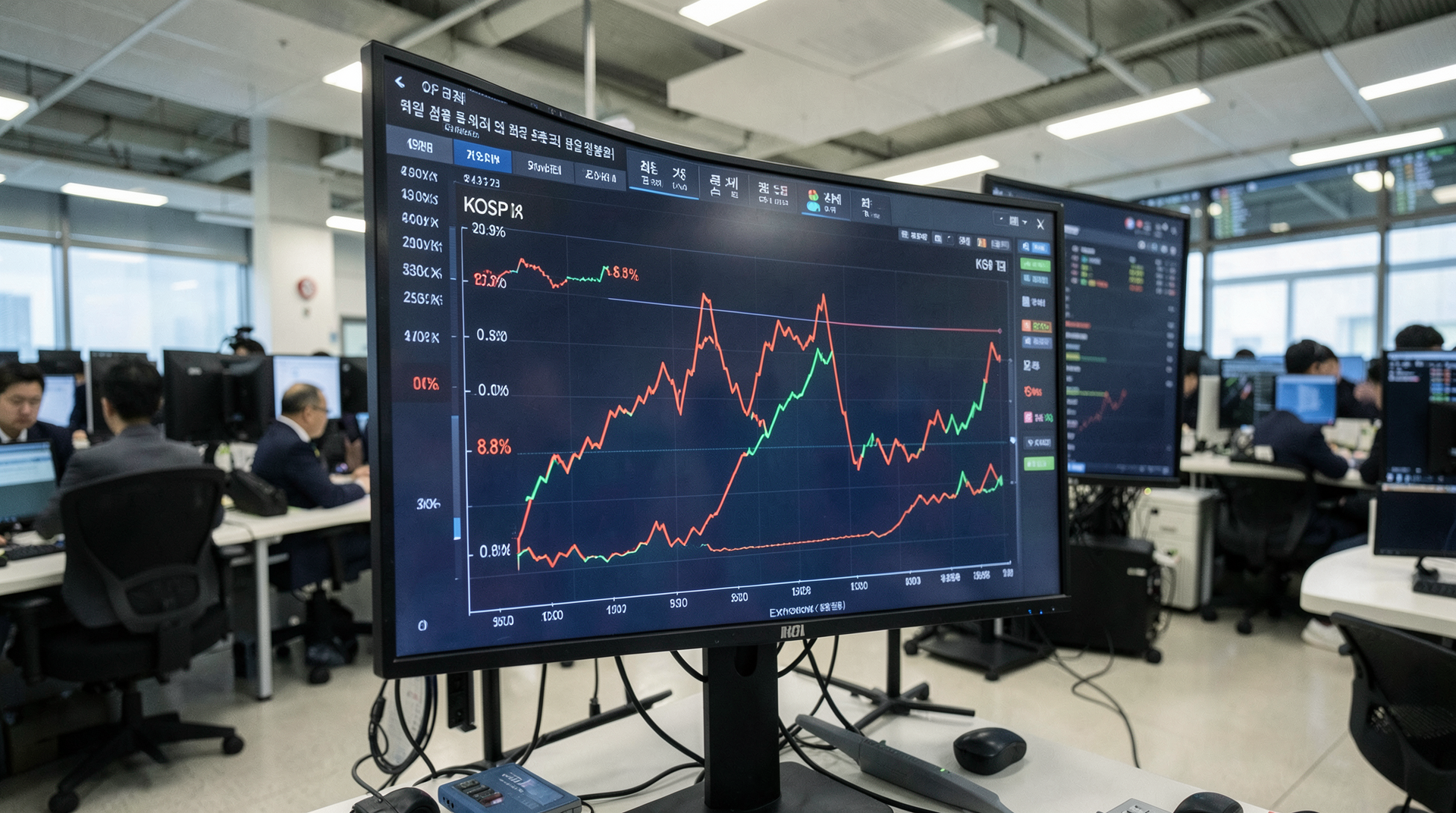
KOSPI Crashes 8 Percent and Triggers Circuit Breaker as AI Concentration Risk Detonates
Two companies carry half of South Korea's stock market — and when Broadcom's AI miss cascaded, the whole thing halted for the first time ever.
You're offline. Previously read public pages remain available; new requests will resume when you reconnect.
The news. The narrative. The timeline.
Two companies carry half of South Korea's stock market — and when Broadcom's AI miss cascaded, the whole thing halted for the first time ever.

The headline number beat expectations, but real wages are shrinking and the war's CPI impact just locked the Fed in place.

Oil jumped to $93.60 on Monday's open — the market's diplomatic pricing is now faster than the diplomacy itself, and 20,000 seafarers are still stranded.
The CFTC killed a Biden-era ban on sports prediction markets, then claimed federal jurisdiction — and 38 states are suing to keep their own regulatory authority.
The world's biggest oil company says Hormuz won't normalize before 2027 — the structural delay MSM prices as temporary.
The only physical alternative to Hormuz is a year from operational — the pipeline acceleration proves the strait's closure is structural, not cyclical.

CPI at 3.8% is the domestic price tag — Moody's quantifies what the Fed won't say: the war's cost to households is six figures per family aggregate.

May's headline beat hides a split economy — hospitality surges while financial services contract, the wage-inflation squeeze MSM calls 'strong.'
The KOSPI crash isn't just Broadcom — foreign capital fled $10B in a week, the flight-from-Korea that MSM frames as correction and X reads as structural.
The S&P, oil, and consumer prices now move on the same war variable — the bank-war-economy thread's three-line convergence is the story MSM covers as separate reports.