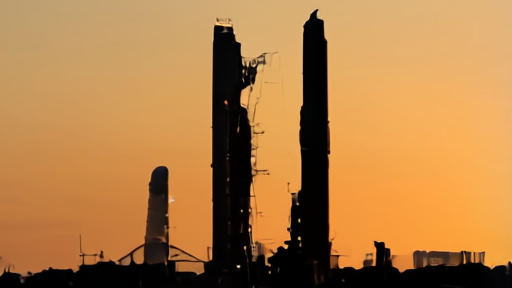
SpaceX launched its investor roadshow the week of June 8 at a $1.75 trillion valuation target, seeking to raise $75 billion in what would be the largest initial public offering in history. The company plans to list on Nasdaq under the ticker SPCX, with pricing expected around June 11 and trading to begin shortly after. Thirty percent of the offering is allocated to retail investors — the largest such allocation for any tech IPO. [1]
The scale alone is staggering. At $1.75 trillion, SpaceX would debut larger than Meta, approaching Alphabet, and surpassed at listing only by Apple, Microsoft, Nvidia, and Amazon among U.S. companies. The $75 billion raise would exceed Saudi Aramco's 2019 IPO. The company told its 21-bank syndicate that retail investors "have been incredibly supportive of us and of Elon for a long time, and we want to make sure that we recognise that." [2]
But the structural story lives in the S-1 filing, not the valuation headline. SpaceX disclosed that Anthropic — the AI lab that confidentially filed its own S-1 on June 1 — pays $1.25 billion per month for compute access through Starlink infrastructure, a relationship that runs through May 2029. The AI-economy circularity is now explicit in the prospectus: SpaceX's satellite constellation underpins Anthropic's training and inference needs, and the IPO effectively asks public-market investors to fund the infrastructure layer of the AI capital stack. [1]
The revenue picture is real but uneven. SpaceX generated $15-16 billion annually, with Starlink producing $1.19 billion in profit last quarter alone — the only profitable segment. The rocket and launch business burns cash at rates consistent with a company building infrastructure for multi-planetary colonization. Starship development alone consumes billions annually in R&D. The company told the SEC it does not expect profitability "any time soon." [2]
The 30% retail allocation changes the risk profile. Fidelity lowered its minimum investment to $2,000, making SpaceX accessible to retail investors who could not participate in prior mega-IPOs. CFO Bret Johnsen told the syndicate that "retail is going to be a critical part of this and a bigger part than any IPO in history." The retail event on June 11 — scheduled mid-roadshow — is an unusual structural choice that signals SpaceX wants retail demand locked in early, not as an afterthought. [2]
What MSM underplays: the xAI merger's contribution to the valuation. SpaceX merged with Musk's AI startup in February at a combined $1.25 trillion. The step-up to $1.75 trillion in four months assumes public markets will accept the AI premium. If they do not, the IPO could price below target — and the Anthropic compute deal becomes the floor argument rather than the ceiling story.
The paper tracked Cerebras's IPO in May as the first test of whether public markets would price AI-state-power risk. SpaceX's offering is the same question at a different altitude: orbital infrastructure, AI compute dependency, and a retail-investor exposure test that will define whether the next generation of mega-IPOs can go public without institutional gatekeeping.
-- THEO KAPLAN, San Francisco