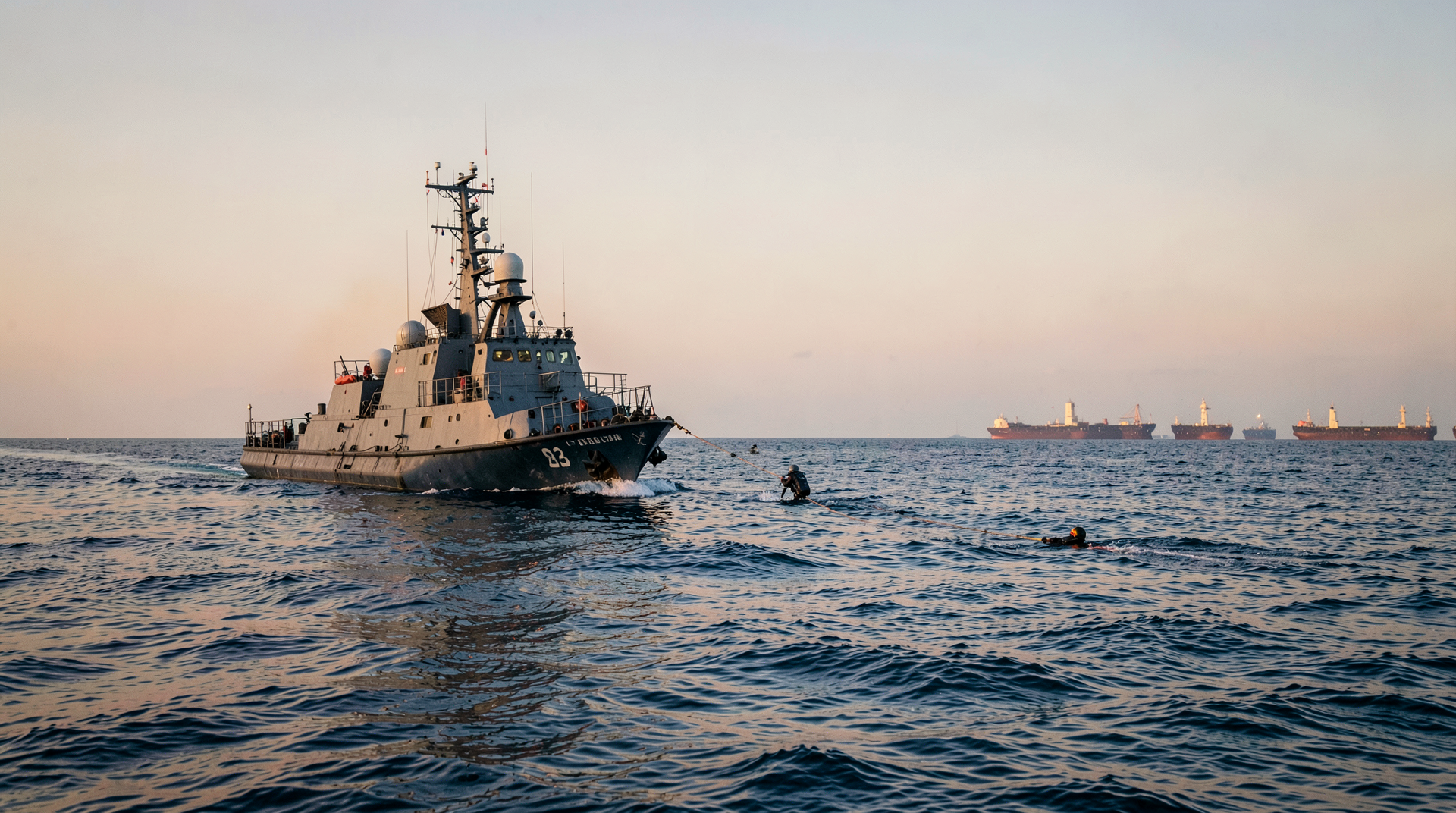
The Strait of Hormuz stayed shut on Tuesday, two days after the United States and Iran announced a deal to reopen it, and the reason is physical, not rhetorical: there are mines in the water, and someone has to remove them. Kpler, the maritime and energy intelligence firm, estimates the clearing alone will take about six months. [1] No announcement shortens that. A naval mine takes the time it takes to find and disarm, regardless of what is posted on Truth Social.
The paper argued June 15 that falling oil prices and reopening rhetoric do not reopen a strait — ships, insurers, and ports do. A day later, the operators who actually move the oil are still behaving as if the waterway is closed, because for working purposes it is. "Operationally, the sector is not rushing back," wrote Richard Meade, editor-in-chief of Lloyd's List, who noted that mine clearance and a return to the internationally recognized transit lanes are "prerequisites for safe navigation." [1] That is the receipt the thread has asked for all week, and it still does not show ordinary movement.
Here is how the strait is functioning in the meantime, which is to say barely and only by permission. Roughly 500 commercial vessels remain trapped in the Persian Gulf, and they cannot all squeeze through the narrow passage at once. [1] The few that leave do so one of two ways. Some trickle out through an Iranian-run vetting lane in the north of the strait. Others slip along the Omani coast in the south with their lights and transponders switched off, moving under the guidance of U.S. forces, because Iran has threatened to fire on ships that use the mid-strait lanes built to keep traffic from colliding. [1] Neither route is commerce. Both are escorted passage through a war zone that has not formally ended.
This is the gap the deal's announcement papered over. On X, the framing is binary and fast: Trump said the strait would open, so the strait is open, or will be on Friday. The analyst Peter Kroeger captured the split that the celebration skipped, noting that while "Trump declared the Strait of Hormuz would open immediately," Iran says it "will remain closed until the deal is formally signed." Mainstream coverage has held the longer view. PBS NewsHour reported flatly that oil and energy flows "won't see an immediate return to what they were before the war — not for weeks or even months." The divergence is not about the facts. It is about time. X is trading the headline; the shippers are reading the calendar.
The calendar is unforgiving. Amena Bakr, who heads Middle East and OPEC+ coverage at Kpler, breaks the delay into stages: about six months to clear mines, two to three months for vessels to cycle out and return to reload, and another three months for some producers to restart wells they shut when storage filled. [1] A round trip to Japan, the chief customer for Gulf crude, already runs 45 to 50 days. [1] Capital Economics estimates energy flows will reach only 80 percent of prewar levels by September. [1] Before the war, this single passage carried roughly a fifth of the world's oil; Iran has effectively controlled it since shortly after fighting began on February 28, when the United States answered by blockading Iranian ports. [3] Reopening that is not a switch. It is a months-long industrial operation that has not started.
Then there is the question of who gets paid, which the announcement also left unresolved. Trump called the reopening a "toll-free opening," and told the New York Times the waterway would be "permanently toll-free" once it reopens after Friday's signing. [1][2] Iran has not confirmed that language, and has in some cases already exacted payment to let ships leave. [1] The Council on Foreign Relations notes that Iran may forgo formal "tolls" while introducing "service fees and other mechanisms" instead. [2] That distinction is not cosmetic. The U.S. and EU have designated the Islamic Revolutionary Guard Corps a terrorist organization, and the U.S. Treasury has sanctioned the very entity Iran has named to run its collections. Unless those sanctions are modified, paying Iran to transit exposes the shipowner and the bank behind the voyage to sanctions of their own. [1] A captain told to pay a designated entity to cross a mined strait is being asked to choose which law to break.
The Associated Press, citing a senior U.S. official, reports the agreement provides for the "immediate" opening of the strait and the lifting of the American naval blockade. [4] "Immediate" is the word in the briefing. Six months is the figure in the data. The deal can declare the strait open on Friday; the mines, the insurers, the sanctions desks, and the 500 idled hulls will decide when it actually is. Until a tanker moves through the middle of the strait, in daylight, with its transponder on and no one's permission required, the reopening remains what it has been since Sunday: an announcement waiting on the water to agree.
-- DARA OSEI, London