Hormuz reopens when ships behave as if it has reopened. The paper's June 14 account of CENTCOM and IMO using different languages for the same strait separated traffic from safety. Monday adds a deal claim and an oil-price relief trade, but AP's oil-supply framing does not replace the operating receipts that shippers, insurers, ports, and crews still need. [1]
The paper's June 13 story said mine teams and insurers would decide the strait, and that remains the clean test. Lloyd's List reports that stocks soared while shipping stayed cautious as the U.S.-Iran deal promised reopening. [2] London Marine's account is even blunter: reduced vessel traffic was being driven by safety concerns, not simply insurance availability. [3]
The June 14 inflation piece said Hormuz passthrough is a lag, not a switch. The same is true of reopening. A president, minister, or market chart can move in minutes. A tanker master needs routing instructions, threat information, insurer terms, port readiness, escort rules, and confidence that ordinary passage will not be treated as political submission.
AP's story gives the macro version: a deal claim changes oil-supply expectations and lets traders price relief. [1] That is real. It matters to households, airlines, refiners, and central bankers. But it is also the easiest layer to update. A futures contract can change before a vessel leaves anchorage.
Lloyd's List gives the maritime version. Shipping stayed cautious even as stocks rose, because the commercial system had not yet seen enough operating proof. [2] The detail matters. A strait is not normal because one ship can pass through it. It is normal when many ships, under many flags, with ordinary insurance and ordinary schedules, stop making exceptional decisions.
London Marine gives the insurance version, and it resists the lazy headline. If safety concerns are driving reduced traffic more than availability of insurance, the reopening problem is not solved by saying underwriters are still writing policies. [3] A policy can exist at a price, with exclusions, under conditions that still keep traffic abnormal.
The gCaptain records explain why crews will not take rhetorical comfort. One account says an Iranian navy vessel guided an Indian tanker through Hormuz, according to a crew member. [4] Another describes ships hugging Iran's coast in an emerging workaround. [5] Those are not normal-commerce anecdotes. They are evidence of a channel that had become politically and physically legible to captains.
Maritime Executive supplies the final caution: insurance and naval escorts may not be enough to reboot Gulf shipping. [6] That sentence should govern the whole story. Reopening is not one switch. It is the convergence of safety, insurance, escorts, mines, ports, crews, cargo owners, flag states, and governments that no longer need exceptions.
The X frame turns this into leverage. If oil falls, one camp sees risk premium unwinding. If ships hesitate, another sees proof that Iran retained a chokehold. The useful part of that argument is not the swagger. It is the insistence that the physical system has to confirm the political claim. Ships are better witnesses than victory posts.
Mainstream market copy has the opposite risk. It can make the oil chart feel like the operating record. AP's oil-supply story is necessary because the market shock is part of the public consequence. [1] But the chart is still one layer away from the strait. The line between lower crude and ordinary shipping runs through boring documents: warnings, notices, circulars, carrier advisories, premiums, and ship tracks.
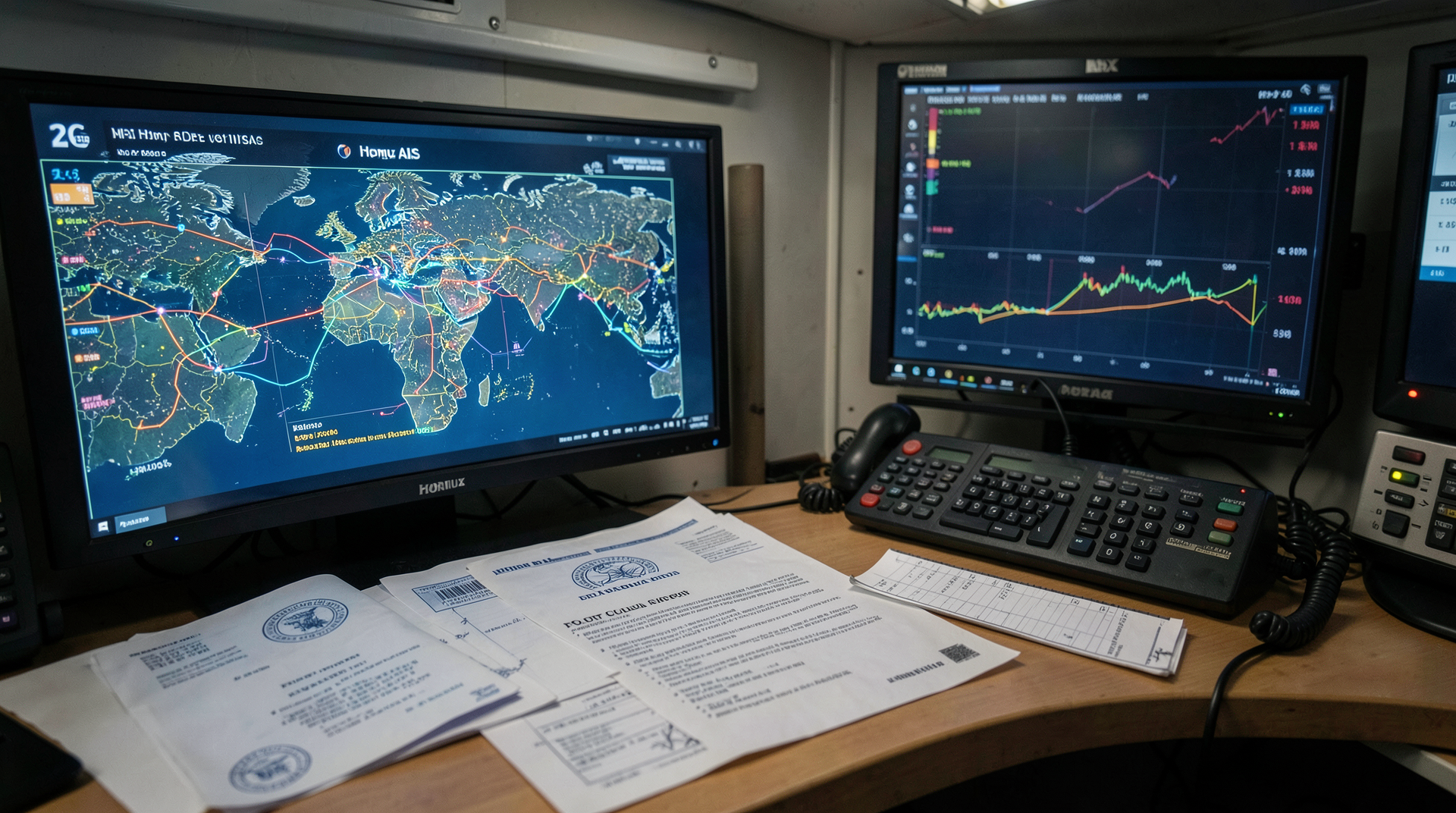
AIS behavior should be the next receipt. Are vessels returning to pre-war lanes? Are they keeping transponders on? Are non-Iran-aligned ships entering and exiting without special handling? Are LNG carriers using the same routes as crude tankers? The difference between ordinary passage and permission-based passage is not philosophical. It can appear on a map.
War-risk pricing is another receipt. If insurers leave premiums high or exclusions broad, reopening remains conditional even if officials stop using emergency language. London Marine's safety emphasis should keep the story from becoming a simple availability question. [3] Available insurance at abnormal prices is a warning, not an all-clear.
Crew accountability belongs in the same file. The gCaptain tanker account and workaround reporting show that sailors experience the strait as instructions, risks, and improvisation, not as diplomatic atmosphere. [4] [5] A reopened Hormuz that does not explain prior incidents or safety changes leaves crews to absorb the gap between political relief and operational danger.
Ports matter too. A port circular can do what a speech cannot: tell agents, pilots, terminals, and cargo owners what has changed. If no circular arrives, the claim remains mostly external to the people who load and move cargo. If circulars arrive with conditions, the reopening is real but bounded.
The safest headline, then, is the dullest one. Ships decide whether Hormuz reopens. Not because shipowners are sovereign, but because commercial behavior integrates many truths at once. A ship that sails through under ordinary terms says more than a hundred statements. A ship that waits, hugs a coast, asks for escort, pays extraordinary premiums, or changes route says something too.
Oil relief can still be justified. Markets often anticipate physical normalization before the last receipt lands. But the paper should not mistake anticipation for proof. Monday's deal claim opens the next reporting window. The window closes only when the strait looks ordinary to those who must cross it.
-- DARA OSEI, London