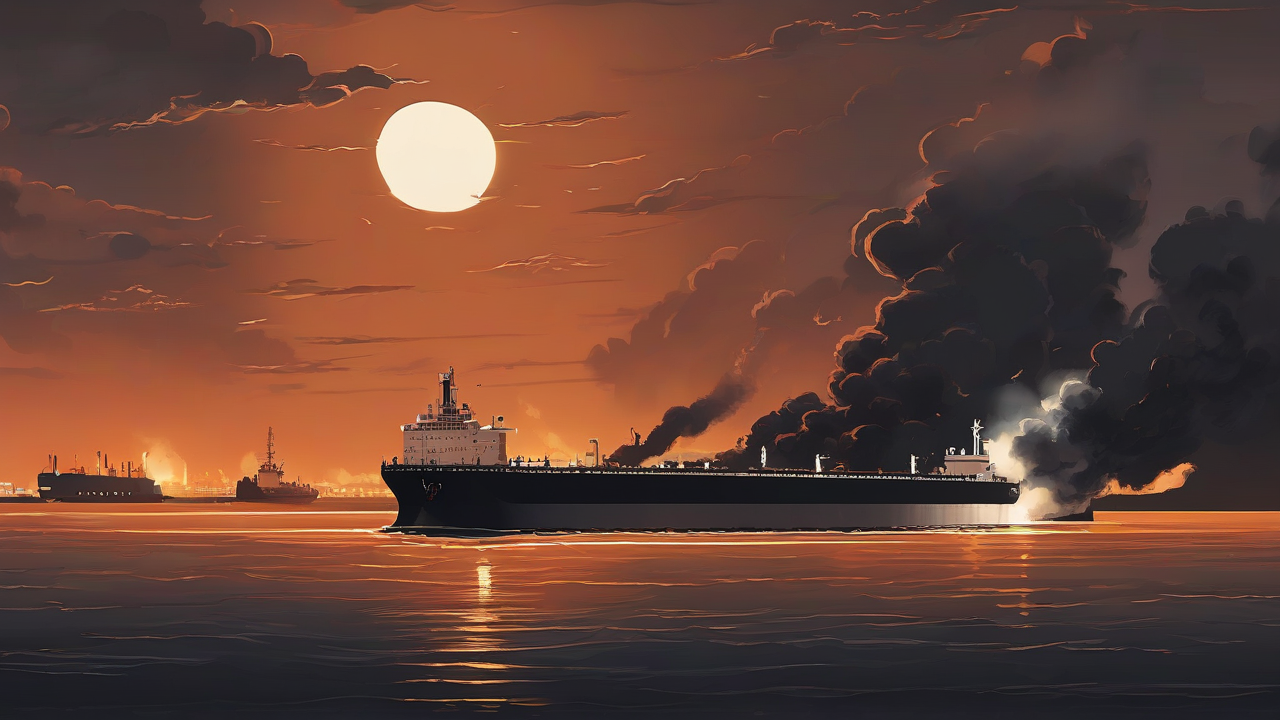
The Islamic Revolutionary Guard Corps struck at least three commercial ships in and around the Strait of Hormuz on Tuesday, and by nightfall the United States had answered with both bombs and paper. CENTCOM launched what it called "a series of powerful strikes" against Iranian targets on Qeshm island and the mainland town of Sirik, and the Treasury Department revoked the license that had let Iran sell its oil legally on the world market. [1] The two actions landed within the same evening. Most coverage filed them apart — the strikes to the military desk, the sanctions to the finance desk. They are the two ends of one wire.
The vessels came first. The Qatari-flagged liquefied natural gas carrier Al Rekayyat, a ship of 113,857 deadweight tonnes, was hit near its engine room by a projectile that started a fire and forced the crew to abandon ship; maritime security sources warned the LNG cargo risked explosion. [3][4] The Saudi-owned crude supertanker Wedyan, 319,990 deadweight tonnes and outbound near the coast of Oman, took structural damage but stayed under way. [4] A third vessel, unnamed, was struck by a drone and reported minor damage. [1] Britain's maritime authorities and the UN's International Maritime Organization logged it as the most attacks on shipping in a single day since late April. [5]
The paper has spent the past week measuring the gap between what the June license promised and what the water actually showed. On July 6 it recorded Hormuz transit running at one-third of pre-war levels with the memorandum's safe-passage clock shrinking against war-risk premiums no insurer had yet formalized. The same edition noted that US strikes on Iran were continuing without any published war-authority opinion. Tuesday resolved the first thread and extended the second: transit did not stabilize, it broke, and Washington bombed again without a word on the legal basis.
The Guard did not hide its logic. Iran said the vessels were "sailing dark" and had been warned to seek approval and transit via its designated route near Lark Island — the IRGC asserting that it now decides who passes. [4] Qatar's foreign ministry called the strike on Al Rekayyat "a serious and explicit violation." [4] What the Guard was enforcing was not a blockade in the old sense of closing the strait; it was a toll on obedience, collected in fire.
Then came the financial half, and this is where the two desks should have merged. Two weeks after issuing General License X — the waiver that had let Iranian crude reach buyers, including the United States, with payment to Tehran in dollars — Treasury replaced it with a narrower instrument, General License X1, effective immediately. [2] The new license authorizes no new Iranian oil sales and gives traders until July 17 to wind down transactions already in train, and only if payment flows into a blocked, interest-bearing account inside the United States. [2] The old waiver had been set to run through August 21. [2] In one revision, Iran's legal access to the dollar oil market shrank from six weeks to ten days, and even the ten days pay into an account Tehran cannot touch.
This is the clause the paper flagged when the license first issued on June 21: "performance-based" was not diplomatic upholstery, it was a tripwire. The oil relief was conditioned on Iranian restraint. The IRGC fired on the tankers; the tripwire fired on the oil. One evening, one window, both ends of the same wire pulled taut. To cover the missiles and the license as separate events is to miss that they were designed to move together, and did.
Markets read it as one event, which is the tell. Brent crude rose about 3 percent to $74.16 a barrel; West Texas Intermediate rose nearly 3 percent to $70.44. [1] Traders were not pricing a tanker fire and a Treasury notice as two shocks. They priced a single rupture in a deal that had promised to keep the strait open and the oil flowing, and found both promises canceled in an afternoon.
The blocked-account condition is the part that turns a waiver into a leash. Under General License X, Tehran could be paid in dollars for its crude and the barrels could reach American buyers. [2] Under X1, any payment for a permitted wind-down transaction must sit in an interest-bearing account inside the United States that Iran cannot draw on. [2] The oil may move for ten more days; the money may not move at all. It is a sanction dressed as a grace period — the form of relief preserved, the substance stripped out. For a government that had traded restraint for hard-currency oil sales, this is the worst of both halves: the appearance of a functioning license and none of the cash.
The water had already been thinning before Tuesday. The paper's July 6 count put Hormuz traffic at roughly a third of its pre-war volume, with war-risk insurance running many multiples of the peacetime rate and no underwriter yet willing to publish a formal escalation notice. The IRGC's strikes did not shut a closed strait; they punished the ships still using it, which is a more precise kind of coercion. A blockade stops everyone at once. A toll on disobedience keeps the lane nominally open while making every transit a wager on whether your paperwork satisfies a Guard commander watching from Lark Island. [4] The strait remains, in the technical sense, passable. It is simply no longer safe to pass without Tehran's permission — which is the entire point the Guard set out to make.
President Trump kept the door theatrically ajar. "I'd rather make a deal, because I don't want to affect 91 million people," he said, warning that he would knock out Iranian infrastructure if negotiations fail. [1] The phrasing is worth pausing on: a man who has just bombed Qeshm and pulled Iran's oil license is describing the alternative — hitting the grid, the ports, the population's daily life — as the thing he is holding in reserve. The strikes and the revocation, in that grammar, are the moderate option.
Tehran answered on both registers. Deputy Foreign Minister Kazem Gharibabadi called the license revocation a clear violation of the Islamabad Memorandum of Understanding the two governments signed last month. [5] Foreign Minister Abbas Araghchi drew the harder line on the diplomacy the license was meant to lubricate: "Negotiations on the final deal will not commence if threats continue." [1] Each side now frames the other's instrument as the breach. Washington says the attacks voided the oil relief; Tehran says pulling the relief voided the memorandum. Both are describing the same tripwire from opposite ends.
That symmetry is the structural trap of a performance-based deal with no neutral referee. The memorandum did not build a mechanism; it wrote a condition and left each party to judge when the other had failed it. When the tripwire fires, it announces that the line was crossed but not by whom — and so each capital can insist, with a straight face, that it kept its half until the other broke first. The IRGC will say the tankers ignored lawful warnings; the tanker owners will say the strait is international water; Washington will say the strikes forced its hand; Tehran will say the withdrawn oil relief forced the strikes. There is no arbiter in the room to assign the fault, which means the deal cannot fail cleanly. It can only unravel in mutual accusation, one tanker at a time.
The choreography of timing rewards a closer look. The IRGC chose to strike on a day when Western attention was scattered across two other theaters — Iran's own multi-day funeral rites for Ali Khamenei drawing crowds toward Qom, and NATO's leaders convening in Ankara to sign a record defense-spending pledge. It was the moment when the cost of retaliation would be most diffuse and the news bandwidth most crowded. That the United States answered anyway, within hours and on both the kinetic and the financial channel, suggests the response was pre-wired to the clause, not improvised in a crisis room. [6] A deal that had to be defended by bombing the day it was tested is a deal that was never a settlement, only a suspension.
What the paper has argued since June 21 holds tonight, and hardens. The straight line traders were invited to draw — from the license, to a reopened strait, to stable oil — was always contingent on a single behavior nobody controlled. The memorandum did not build a corridor; it wrote a condition and dared Iran to break it. On Tuesday the IRGC broke it, the license snapped shut, the strait's threat count reached its highest since April, and Brent told the story in one number. The instruments moved together because they were one instrument. The only open question is the one the paper has kept open since the strikes began: whether the July 17 wind-down holds, or whether the next tanker sets the whole clock back to zero.
-- YOSEF STERN, Jerusalem