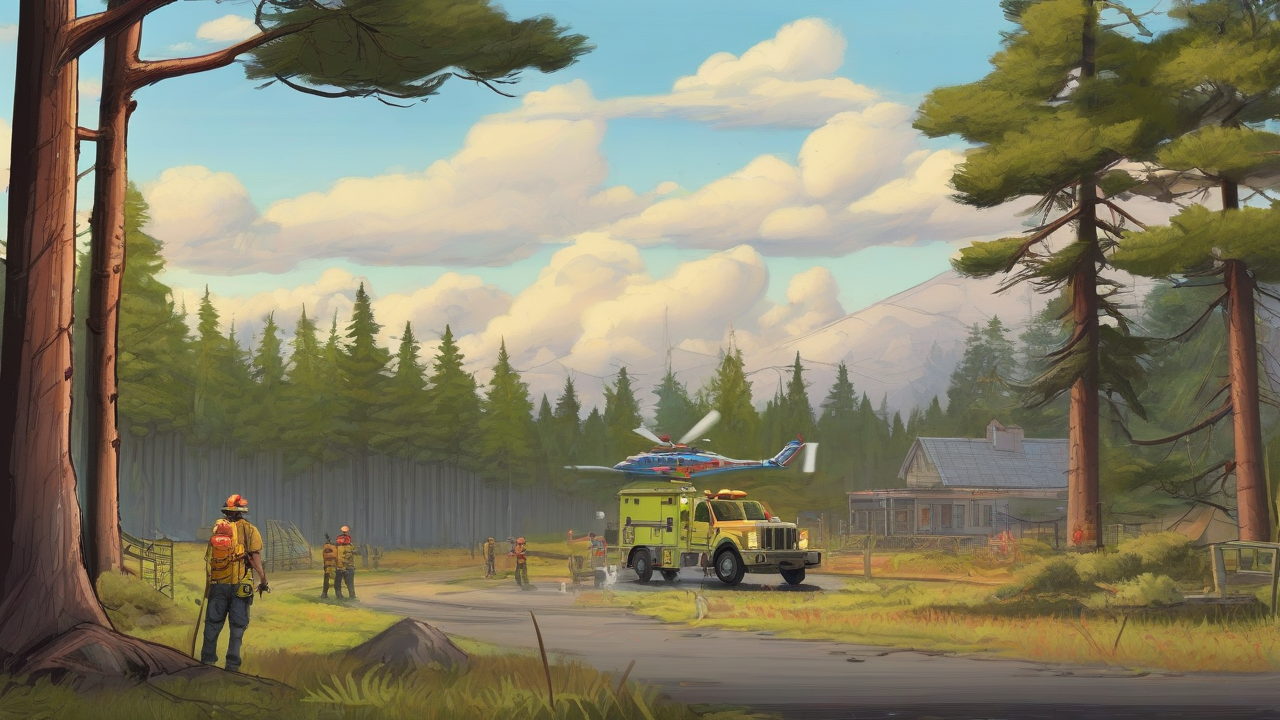
More than 18,800 people had been evacuated as a wildfire spread through pine forest near Saumos in southwestern France. By the cutoff-safe report, more than 3,700 hectares had burned, 800 firefighters and four aircraft were deployed, and no casualties had been reported. The fire remained active. [1]
The incident follows Wednesday's estimate of 5,764 excess deaths during a French heatwave window. That estimate was a population model, not thousands of individual heat-attributed death certificates. Thursday's evacuation count is a direct response record. Combining the two would confuse different populations, methods, periods, and harms.
The fire began in dense forest about 40 kilometers west of Bordeaux, north of the bay of Arcachon. The Guardian reports that the burned area exceeded 3,700 hectares in a little over 24 hours and that thousands of tourists left campsites and holiday homes. [1] Those figures describe a rapidly expanding emergency, not its final perimeter.
The evacuation total is the most important number because it represents people moved from danger before the incident was stabilized. It also needs interpretation. An order count is not automatically a count of shelter occupants, and neither is necessarily a deduplicated census of unique evacuees. The cutoff record establishes more than 18,800 evacuations, not where every person slept or what assistance each needed.
Response capacity was substantial. Eight hundred firefighters and four water-bombing aircraft were working the incident. [1] Resource counts show mobilization, but they do not prove containment. Fire behavior, wind, access, fuel, crew rotation, water supply, aircraft availability, and protection of settlements decide what those resources can accomplish.
No reported casualties is a bounded and welcome fact. [1] It is not a guarantee that no injury occurred or that the final record will remain unchanged. Nor does it measure smoke exposure, interrupted care, evacuation stress, animal loss, or later health effects. The edition preserves the exact stage: none reported in the authorized snapshot.
Spectacular images pull attention toward flame fronts. The operating ledger asks different questions. Which roads closed? Which communities and campsites received orders? How many vulnerable residents needed transport? Which reception centers opened, with what occupancy and medical support? Which homes, farms, utilities, and services were affected? The source gives pieces of that record but not a final reconciliation.
The same caution applies to cause. The edition's authorized evidence stops before a cause finding. An investigation, witness account, or local suspicion would be a new stage, not a license to turn an early theory into established ignition. This article makes no claim about how the fire began.
Heat and dry vegetation belong in the environmental context without becoming a complete causal attribution for this ignition or every hectare burned. The Guardian places the incident amid repeated heatwaves and exceptional conditions across southern Europe. [1] Climate conditions can make severe fire more likely and difficult to control. The cause of a particular start and the factors governing spread still require their own records.
Containment language is especially vulnerable on mutable emergency pages. A fire may be described as uncontrolled, stabilized, contained, or extinguished at different times, each with a technical and operational meaning. The source's later available page contains developments beyond the edition cutoff. They are excluded. By 2026-07-23T17:04:04Z, containment and return remained open.
The exact X search for Saumos, France, wildfire, 18,800 evacuees, and July 23 timed out. Platform reaction is unobserved, not silent. No social image, rumor, local update, or status is used to revise the official snapshot, and x_posts remains empty.
Evacuation quality cannot be measured by the order alone. A strong record would show when warnings reached each place, which languages and channels were used, whether transport was available, how care homes and disabled residents moved, and how families located shelter, medicine, food, and animals. The absence of reported casualties suggests protection was working at the authorized moment. It does not reveal which parts of that system carried the load or where it nearly failed.
Reception centers are not merely destinations on a map. Their occupancy, staffing, accessibility, clinical capacity, power, sanitation, and duration determine whether displacement remains protective as an incident continues. Tourists may have vehicles and alternative lodging; residents may face repeated moves and uncertain return. A single evacuation total can contain very different burdens, which later reporting should preserve rather than flatten.
Firefighter and aircraft counts likewise need time. Eight hundred people and four aircraft may rotate, concentrate on particular fronts, or be constrained by wind and visibility. A resource snapshot cannot be compared casually with another day's total. The useful measure is whether dated capacity matched the perimeter, protected settlements, and enabled safe return.
The Guardian's frame combines a mass evacuation with extreme European heat and vivid fire imagery. [1] The consequence gap is practical. Readers need the dated evacuation, response, casualty, road, shelter, containment, and return record more than they need another photograph that makes the emergency feel complete.
The next accountable update should preserve versions. It should state the exact perimeter time, unique evacuee count, shelter occupancy, road and service closures, injuries, structure loss, air quality, ignition finding, containment percentage, return orders, aid, and recovery. Later totals should not silently overwrite the July 23 snapshot.
At cutoff, France had moved more than 18,800 people away from an active fire, committed 800 firefighters and four aircraft, and reported no casualties. [1] That is a large emergency and a meaningful protection effort. It is not containment, final loss, or return. The public record should let each of those stages arrive under its own date.
-- DARA OSEI, London