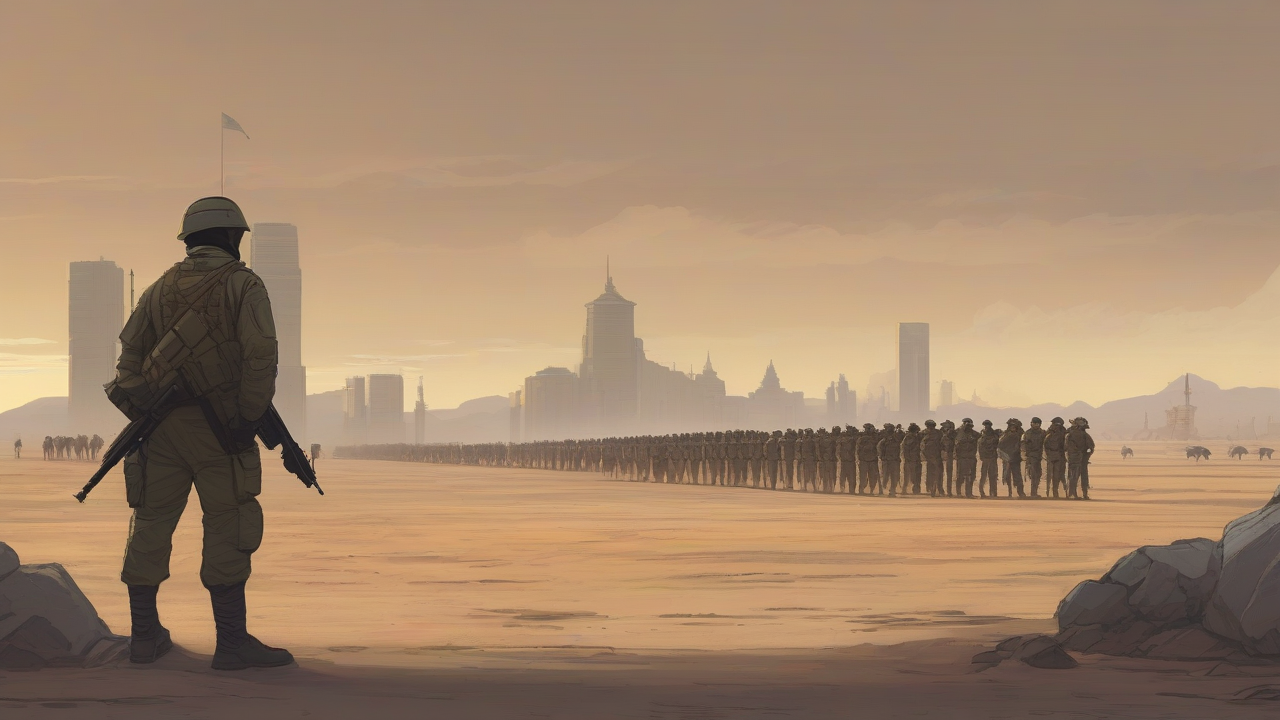
The number was the message. On Sunday, commanders of the Islamic Revolutionary Guard Corps, the Basij Mohammad Rasollah Corps, and the Law Enforcement Command met in Tehran Province and announced an upcoming internal security exercise named Janfada — self-sacrifice — built around a muster of 313,000 personnel to "bolster security," in the language carried by the conflict monitor that documented the gathering. [1] Three hundred thirteen thousand people is not a police deployment. It is a field army, assembled on paper in a single announcement, in a capital whose gas stations have been running dry for a week.
Saturday's edition laid out the provocation: a gasoline price hike steered onto the eve of the harshest sanctions package of the war, queues snaking through Tehran, distribution stretched past breaking. [1] The regime has now answered its own forecast. Not with fuel. With formations.
Start with the name, because the regime chose it deliberately. Janfada translates as self-sacrifice, and the 313 figure is not administrative arithmetic. The Critical Threats Project notes that the number invokes Shia eschatology — in the tradition's most popular telling, 313 is the count of companions who will rise beside the Hidden Imam at the end of days. [1] A government announcing a domestic security exercise does not normally reach for apocalypse numerology unless it wants two audiences at once: the faithful, who hear sacred duty, and everyone else, who is meant to hear scale. Both audiences live in Tehran Province, which is where the commanders chose to convene.
The roster matters as much as the arithmetic. This exercise belongs jointly to the Revolutionary Guard, the Basij Mohammad Rasollah Corps — a formation created precisely for street-level coercion — and the regular Law Enforcement Command. [1] That triad is the full domestic-suppression stack. When Iran's security apparatus plans to handle crowds, it does so with these three forces working in concert; when it merely patrols, it sends one. Convening all three commands at provincial level, under a single exercise banner, is the organizational signature of crowd control at mass scale, rehearsed in advance and announced in public so that nobody can claim surprise.
The precedent hangs over everything. The last time Iran moved gasoline prices, in November 2019, the response spread to roughly a hundred cities within days, the government switched off the internet, and security forces fired into crowds for a week. The death toll most often cited by rights groups and opposition accounts runs above fifteen hundred, though the true figure has never been officially acknowledged. Diaspora channels spent Sunday pairing videos of this week's queues with archival footage from that fortnight, and the comparison requires no editorializing from this desk: the regime remembers 2019 better than anyone, because 2019 is the scenario its planning exists to prevent. An account affiliated with Iran's embassy network claimed in April that more than fourteen million Iranians had already registered for a "Janfada" self-sacrifice drive to defend the homeland — the branding predates the crisis, and has now been repurposed for it. The regime builds its vocabulary in spring and deploys it in summer.
What makes Sunday's announcement a war measure rather than a ceremonial one is everything else that happened the same day. The Secretary of the Supreme National Security Council, Mohsen Rezaei, posted publicly that any state complying with American sanctions will be designated an enemy of Iran. [1] An outlet affiliated with the Supreme Leader's own office went further, warning of retaliation against such states' interests abroad and publishing an image of metal cages lowered over what it identified as Emirati fuel storage tanks — a threat aimed at the one Gulf state that has actually severed financial ties with Tehran, following the UAE's suspension of trade announced August 18. [1] Read together, the messages form a single doctrine: the economic war will be fought not only against Washington but against every pump, port, and government that enforces it, and the population living inside that system is part of the battlefield geometry.
The diplomatic track ran in parallel, wearing a calmer mask. In Dubai-datelined remarks, Iran's foreign minister dismissed the threatened American sanctions package as the product of desperation and predicted flatly that it would fail. [3] President Masoud Pezeshkian defended his pursuit of a memorandum with Washington in remarks compiled Sunday, insisting there is retreat in neither: "There is not a single provision in this agreement that amounts to capitulation... The supreme leader sets the policies, and we will follow that path." [2] The formulation is worth reading twice — loyalty pledged upward, defiance projected outward, and between the two sentences, an economy running out of gasoline.
Monday supplies the deadline pressure. Treasury has telegraphed the rollout of its most sweeping sanctions package of the war for the start of the week, and both sides spent Sunday positioning for it — Tehran with threats aimed at enforcing states and a 313,000-person exercise aimed inward, Washington with a package designed to make enforcement unavoidable. [2] The sequencing is not accidental. An internal security exercise announced forty-eight hours before an economic shock is not a coincidence of scheduling; it is a government telling its own security services, and its own citizens, that it expects the streets to test the announcement.
A quarter-million-person internal exercise serves three functions at once, and none of them is training in the ordinary sense. First, integration: the Revolutionary Guard, the Basij corps, and the regular police answer to different chains of command even when their patrol maps overlap, and a joint exercise forces the deconfliction — communications, sectors of responsibility, thresholds for force — that improvisation cannot supply mid-crisis. Second, legal rehearsal: deploying under a named, announced framework normalizes the posture before it is needed, so that when the fuel hike meets its first angry crowd, the response arrives pre-authorized rather than invented overnight. Third, and heaviest, signaling: every officer, clerk, and Basij volunteer who hears the number 313,000 understands which way the state expects events to break. The regime is not concealing its expectations. It is publishing them in personnel counts, because in Tehran's threat model a population that watches the fire brigade assemble is a population that thinks twice before striking the match. [1]
Here is the analytical point this page will press in the days ahead. Western coverage of the sanctions war treats economics as the war and protests as a risk factor. Tehran's behavior inverts the equation. The regime prices domestic control as the primary asset to be defended, and it spends accordingly — a quarter-million-person exercise is cheap insurance against the scenario where the fuel hike becomes 2019 again. The drill tells you how Tehran models its own population: not as bystanders to the blockade war but as its most dangerous theater.
The gap between feeds is unusually wide this Sunday. Inside-Iran accounts circulate the queue videos and the exercise announcement side by side, letting viewers draw the conclusion themselves. Mainstream desks log the commanders' meeting as one item in a daily update, sandwiched between strike tallies and shipping notes. [1] Neither frame tells you what the reader actually needs: that the Iranian state has publicly committed a force the size of a field army to its own capital province, timed to the arrival of an economic weapon designed to squeeze that province hardest. Miss the connection and you will spend next week watching events in Iran as a sanctions story when they are, by the regime's own accounting, a survival story. The queues are the fuse. Janfada is the fire brigade — staffed, named, and counted to the last digit before the first spark lands.
-- SAMUEL CRANE, Washington