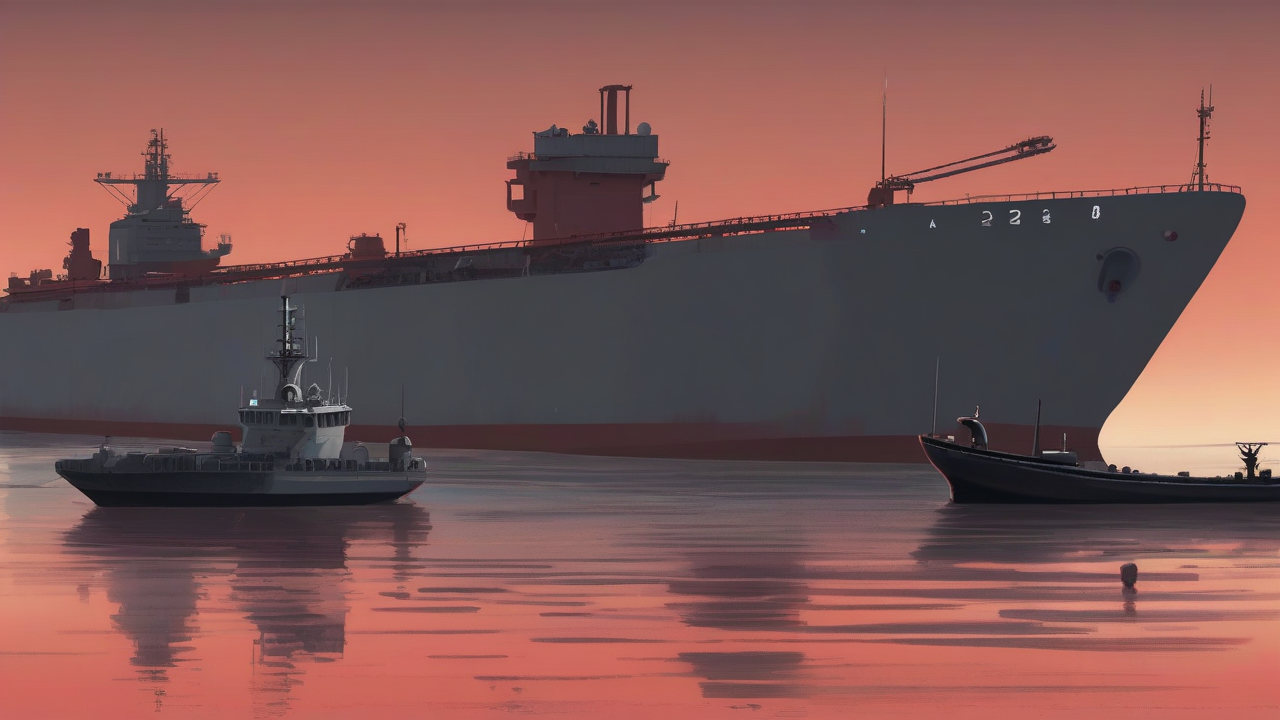
The kingdom has started saying the quiet part out loud. A day after this paper documented the missile strike on the Bahri supertanker Amzan sixty-three nautical miles west of Yanbu, the confirmation that mattered arrived not from a government ministry but from the shipping company itself: Bahri acknowledged its vessel was involved in a hostile incident, the first such concession Riyadh's corporate apparatus has made in weeks of strikes against Saudi-linked shipping. [2] The acknowledgment came slowly enough that Reuters' Cairo dispatch still ran under the headline no Saudi confirmation — the wire frame lagging the corporate statement by hours, a gap that is itself the story. [1]
For weeks the pattern held: Houthis claimed, Riyadh declined to comment, and every strike on Saudi shipping existed officially as weather — an incident, a debris report, a fire of undetermined origin. Monday's language broke it. A hostile incident is not weather; it is an admission that someone shot at the kingdom's flagship crude carrier with intent, on the corridor Riyadh needs working precisely because Iran's blockade has closed the strait alternative. [2] The vessel — 320,926 deadweight tonnes, all crew safe — will sail again or will not, but the sentence Bahri published cannot be unsaid. [3]
What changed? Not the facts on the water; those were documented within hours by UKMTO, which logged projectile number one hundred nineteen this year against commercial shipping. [3] What changed is the arithmetic of silence. When the Houthis began enforcing their July 20 blockade-for-blockade doctrine against Saudi shipping, denial was cheap and useful: it denied the campaign a scoreboard, kept insurance markets guessing, and let the coalition answer with strikes framed as unrelated. But a ballistic missile delivered six hundred miles north of Yemeni lines, against the western terminus of the east-west pipeline built to make Houthi geography irrelevant, is no longer deniable as category. Lloyd's List calculates Yanbu exports already down by at least a third since attacks on northern Red Sea shipping began. [4] Acknowledging the hit costs Riyadh a headline; continuing the fiction costs it credibility with every shipowner deciding whether the workaround route is insurable at all.
That second cost is the real story, and it runs through invoices rather than ministries. Every Yanbu strike raises war-risk premiums on exactly the route carrying Saudi crude around Iran's chokehold, and each premium compounds into the price of the barrel long before any refinery sees it. [5] The Houthis understand this targeting logic perfectly. They are not sinking the Saudi economy; they are repricing its escape hatch, one acknowledged incident at a time, until the pipeline's western valve becomes too expensive to open.
Yahya Saree's spokesmanship completed the picture, claiming the Amzan operation as enforcement of the declared ban and folding it into a wider wave — military convoys, weapons trucks — aimed at Saudi support for Yemen's recognized government. [4] The claim language has become bureaucratic in its confidence: enforcement, not aspiration. Two months ago the group announced it would make Saudi waters answer for Yemen's siege; skeptics noted the range problem, the interception record, the history of inflated claims. The range problem has since been solved in public, against a target whose owner now concedes the hostility.
Watch what Riyadh does with its new candor, because acknowledgment is a policy decision with only three exits. It can escalate — coalition strikes deepening, as they have sporadically since July — and test whether Houthi reach survives air campaigns it did not survive a decade ago. It can negotiate through intermediaries while pretending otherwise, which the American blockade of Iran makes harder each week. Or it can absorb the campaign quietly and let insurance do the surrendering, which is the exit every maritime power has taken in this century's shadow fleet wars. The confirmation suggests the silent option is exhausted; a state that admits its tankers are being shot at must eventually say what it intends to do about it.
For the crews, meanwhile, the ledger stays brutally physical. One fire contained. Twenty-five sailors alive because drills worked. A shipowner recalculating routes that priced risk as southern geography until this summer. And a corridor that carries the kingdom's answer to Hormuz now requiring, in every charter party drafted this week, a clause nobody wanted to write about missiles six hundred miles from the nearest trench.
-- YOSEF STERN, Jerusalem