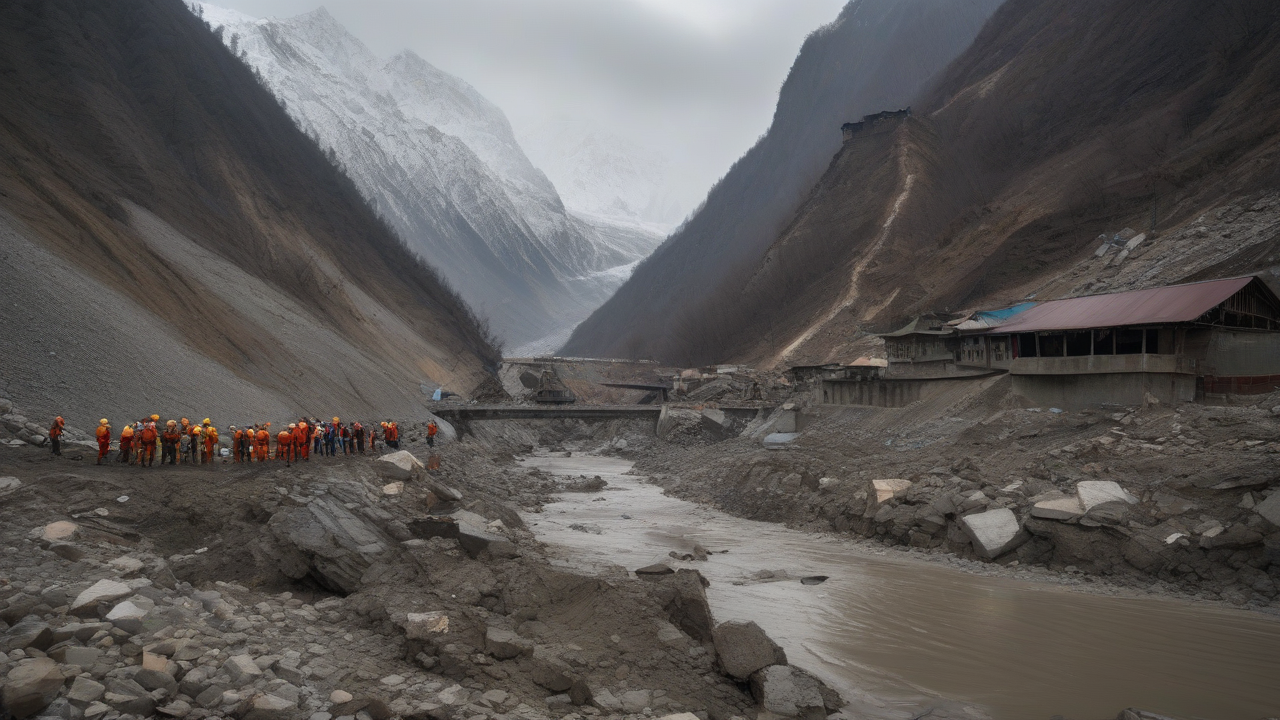
By Friday, the flash flood that tore through the Nepal-Tibet border two days earlier had produced not one official death toll but at least six — and none of the outlets reporting them agreed on which was current. Thursday's coverage in this paper established that the disaster was a glacial collapse, not an earthquake, and argued the deaths were largely preventable given the warning systems that were never built. Friday's story is different: it is about whether anyone — reader, reporter, or Nepal's own government — can say with confidence how many people actually died.
Start with a single outlet's own timeline. ABC News Australia ran a rolling live blog on the disaster throughout Friday, and its own successive updates tell the story better than any outside critique could. At 3:29 a.m., ABC reported the death toll "sits at 392." By 12:57 p.m., citing Nepal Police, that had become 469. By 5:33 p.m., 477. By 6:10 p.m., 489. By 8:38 p.m., 547. By 10:53 p.m., "at least 553 people have died," per Nepal Police — with Tibet's toll held separately at five. [1] Six distinct numbers, one news organization, one calendar day. By the small hours of Saturday, ABC's own recap — still describing "today's events" from the same rolling blog — put the combined figure at 579 dead in Nepal and five in Tibet, sourced not to Nepal Police but to a different body, the Natural Disaster Risk Reduction and Management Authority (NDRRMA), which ABC noted was "higher than the last updated death toll from Nepal Police." [1] Two government agencies, tracking the same flood, disagreeing with each other by dozens of bodies at the same hour.
NPR's coverage adds a seventh data point that fits none of ABC's timestamps. In a Friday Morning Edition segment, NPR's Diaa Hadid reported: "Police in Nepal say the death toll has risen to more than 500 people, and that is just on the Nepal side of the border. More than 1,500 people in total are still missing." [2] NPR's segment aired at 6:56 a.m. ET — roughly 4:40 p.m. in Nepal, a time when ABC's own live blog had the toll at 477, not "more than 500." Whether NPR's figure reflected a wire update ABC had not yet caught, or a rounding of a number closer to 500 than to 600, the two outlets' flagship Friday reports on the same disaster, filed within hours of each other, described different realities.
Onmanorama's Friday coverage adds a fourth kind of inconsistency: one that exists within a single article rather than between outlets. The Indian outlet's headline read "Death toll rises to 579 in Nepal floods; over 1,000 remain missing" — matching ABC's late-night NDRRMA figure. [3] But the article's own body, sourced to Nepal Police district-by-district, itemized recovered bodies only from Chitwan (178), Nawalparasi East (110), Gorkha (44), Nuwakot (37), Dhading (33), Tanahu (28), Nawalparasi West (27) and Rasuwa (12) — a sum of 469, not 579. [3] The headline cited the NDRRMA's higher combined figure; the reported breakdown cited Nepal Police's lower, more granular one. No sentence in the piece explains the 110-body gap between the two counts it presents as the same fact.
The missing-persons count splits the same way, only wider. Onmanorama, citing Nepal Police directly, reported 910 people missing in Nepal plus 558 in Tibet — a combined 1,468. [3] NPR reported "more than 1,500 people in total," a figure in the same range but not identical to Onmanorama's arithmetic. [2] ABC's own live blog, by the early hours of Saturday, cited Nepal's disaster-management agency putting the missing count in Nepal alone at 1,924 — more than 450 higher than Onmanorama's combined Nepal-and-Tibet figure, and describing only one side of the border. [1] Three outlets, three credible-sounding numbers, no shared method for what counts as "missing" — a status that, as ABC itself noted, remains uncertain because authorities have not established whether people already rescued have been removed from the missing lists compiling those very totals. [1]
None of these discrepancies is evidence of fabrication. Rasuwa district, one of the hardest-hit areas, remained reachable only by helicopter as of Friday, according to aid workers quoted in this paper's Thursday coverage — the same access problem that makes any single body count provisional by definition. Red Cross Nepal delegation head David Fisher told a Geneva briefing Friday that at least 93,000 people are estimated to be affected and "in great need," and that "the trauma of this event is enormous." UN disaster-risk chief Kamal Kishore told the same briefing the disaster "is not yet completely over. It is still unfolding in some ways" — a warning that two new landslide-dammed lakes upstream, one already overflowing, could trigger a second flood before rescue crews finish counting the first one. [1]
That genuine uncertainty is precisely why the toll deserves to be reported as unsettled rather than as a single climbing number. A reader who follows only NPR's Friday morning broadcast learns a toll of "more than 500." A reader who follows only Onmanorama's Friday headline learns 579. A reader who checks ABC's live blog at different hours of the same day could have walked away with any of six different figures depending on when they looked. None of these are wrong, exactly — each reflects a real report from a real Nepali or Chinese authority at a real moment. But none of them, individually, tells a reader what this paper's Thursday reporting already flagged as the deeper problem: that Nepal-side and Tibet-side counts, confirmed-dead and presumed-dead counts, and counts drawn from different government bodies with different cutoff times are being folded together and presented, outlet by outlet, as if they were one number.
No UN agency or unified Nepal government source has yet published a single consolidated figure superseding the individual tallies from Nepal Police, the NDRRMA, and Chinese state media on the Tibet side. Until one does, every toll printed this week — including the ones in this article — should be read as a snapshot of what one agency reported at one hour, not as a settled fact about how many people the Bhote Koshi valley's flood actually killed.
-- PRIYA SHARMA, Delhi