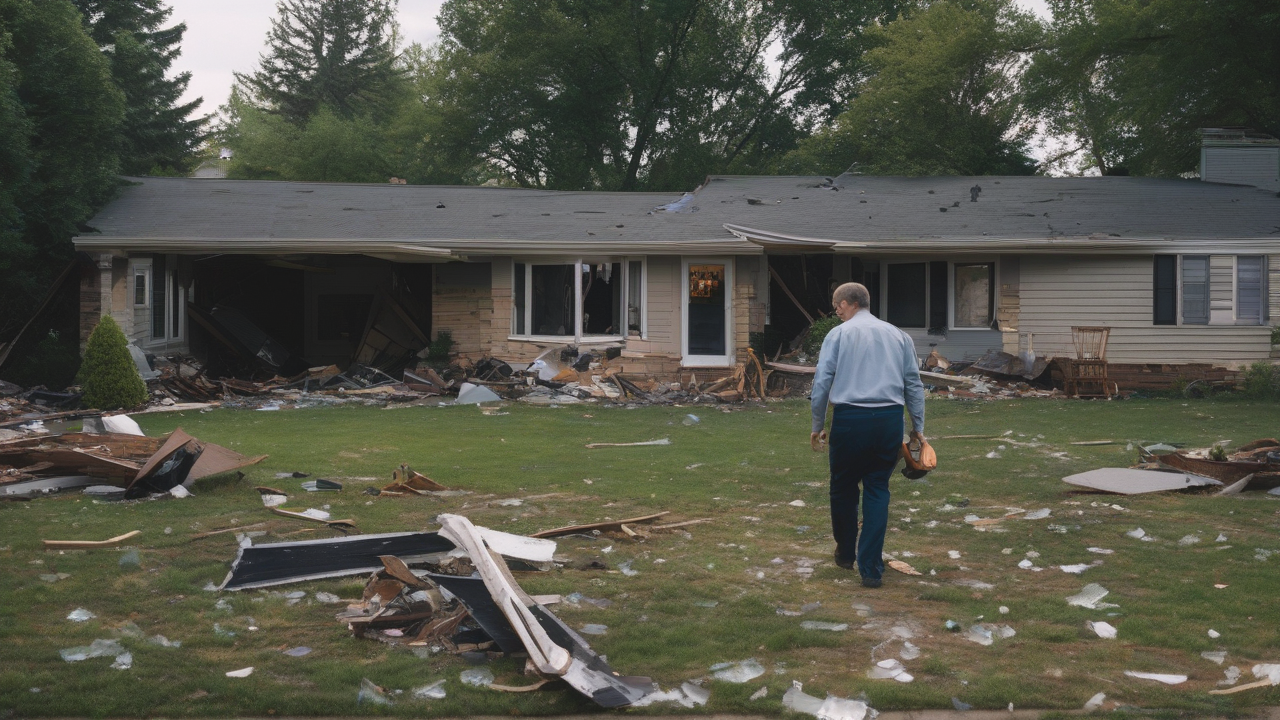
The death toll from Friday's Russian strike on a Kyiv-area ammunition depot rose to 38 on Sunday, with four people still missing, President Volodymyr Zelensky said, as emergency crews continued extinguishing fires and neutralizing unexploded ordnance three days after the blast. [1] Twenty people were injured, including two children. [2]
Saturday's account of the strike centered on an unusual admission Zelensky volunteered alongside his condemnation of Russia: that Ukrainian officials had stored explosives beside a care home for elderly and disabled residents in violation of the country's own law, and that "terrible negligence" — not just the Russian strike itself — explained why 34 of the day's dead were care-home residents. Sunday's developments did not soften that admission. They hardened it. Zelensky confirmed criminal proceedings are underway into how the ammunition came to be stored at the site in Myla, a village in the Bucha district, and Russia's Defense Ministry maintained its position that the warehouse held components and launch boosters for long-range drones — a legitimate military target, in Moscow's framing, that Kyiv's own storage decision turned into a civilian catastrophe. [1][2]
Reuters found Liudmyla Polianychko, a 48-year-old entrepreneur, still cleaning glass from her shattered home in Myla on Sunday. Charred artillery shells and belts of ammunition lay scattered across her lawn — ordnance she said she had no idea was stored nearby. "We didn't think that there could be something like that," she said. "But we're alive, and thank god for that." [1] Her account gives concrete shape to the abstraction at the center of Zelensky's negligence admission: residents living beside a munitions depot they did not know existed, until it detonated through their neighborhood.
Reuters' own reporting from the scene underscores how ordinary the neighborhood looked before Friday. Polianychko described a "quaint neighbourhood" set ablaze by secondary explosions after the initial strike, hundreds of people evacuated in the immediate aftermath. [1] She said she sheltered in her bathroom with her daughter as a wall collapsed around them, unaware until the debris settled that artillery shells and belts of ammunition were scattered across ground she had walked every day. That gap between what residents believed they lived beside and what Ukraine's own military had actually stored there is the specific negligence Zelensky admitted to Saturday and confirmed again Sunday — a gap that, unlike the Russian strike itself, was entirely within Kyiv's own power to close before Friday night.
Russia's escalation is not confined to Myla. NBC reported Sunday that Russia's Defense Ministry announced it is preparing "massive strikes" against Ukraine's energy infrastructure, describing the planned attacks as retaliation for Kyiv's own campaign against Russian oil, gas and dual-use commercial targets — including strikes on Wildberries, Russia's largest online retailer, which Ukraine says sells goods that aid Moscow's war effort. [2] Kremlin spokesman Dmitry Peskov vowed "an appropriate response" to what he called Ukraine's "path of escalation," describing Russia's own strikes as "fairly systematic" targeting of military and war-related infrastructure. [2] Ukrainian officials have separately warned that this coming winter, with the grid already strained, may prove the hardest since Russia's full-scale invasion began. [2]
The pattern Zelensky described Saturday as a repeat failure is now, on the record, a repeat one. Ukrainian Prime Minister Serhii Koretskyi drew an explicit line from Myla back to a nearly identical strike on an ammunition depot in the Kyiv suburb of Vyshneve in early July, which killed 22 people when munitions detonated beside homes. "Unfortunately, we can already see that the terrible tragedy in Vyshneve did not become a lesson," Koretskyi said, according to Saturday's reporting. "In the fifth year of a full-scale invasion, making the same mistakes is criminal negligence." Two officials at state-owned arms producer Ukroboronprom were already held accountable for the Vyshneve failure; whether the Myla site involved the same institutional pattern of choosing convenient storage over legal compliance remains the open question Sunday's toll increase does not answer.
The broader bombardment shows no sign of slowing. Russian strikes on Kyiv Saturday killed a 2-year-old girl and injured 12 others, Mayor Vitali Klitschko said, while a strike on the village of Bilbasovka in eastern Ukraine killed a 13-year-old and an adult after Russian forces dropped bombs on private homes Sunday, according to local official Vadim Lyakh. [2] Russia's Defense Ministry said it downed or neutralized almost 500 Ukrainian drones overnight into Sunday, while independent Telegram channels on both sides of the border reported drone strikes had set fire to the Kirishi Petroleum Organic Synthesis refinery southeast of St. Petersburg — one of Russia's largest, and the only major refinery in the country's northwest. [2] Regional governor Alexander Drozdenko confirmed a fire in Kirishi's industrial zone without officially attributing it, and said 62 drones had been shot down over the surrounding region. [2]
Ukraine's own institutional churn compounds the pressure on its war effort. New Defense Minister Yevhen Khmara, who took the post Saturday after weeks of protests following predecessor Mykhailo Fedorov's dismissal, said Sunday he inherited a $27 billion defense funding gap and is exploring options including accelerating disbursement of a 90 billion-euro European loan planned for next year. [2] "Ukraine will show its partners a clear vision and a clear plan," Khmara said in his first briefing with reporters, adding that avoiding battlefield ammunition shortages while ensuring soldiers are paid remains the immediate priority. [2] A defense ministry facing a funding shortfall of that scale is, by definition, a ministry under pressure to store what it has wherever space allows — precisely the pressure Zelensky's negligence admission implicitly indicts, even if Sunday's coverage did not draw that connection explicitly.
Elsewhere, the war's toll continued on both sides of the front. A Ukrainian strike on a mine in Russian-occupied eastern Ukraine killed a female employee and injured five others, according to Leonid Pasechnik, the Kremlin-installed head of the occupied Luhansk region. [2] Ukrainian drone strikes injured at least four people in Russia's border regions of Kursk and Belgorod the same day. [2] Neither casualty count has been independently verified, and both illustrate how routine cross-border strikes have become even as Myla's death toll and its underlying accountability question continue to dominate the domestic Ukrainian news cycle.
The specific language Russia is using to justify its threatened energy-grid strikes deserves scrutiny of its own. Moscow frames the planned campaign as retaliation for Ukrainian strikes on Wildberries, the Russian online retailer Kyiv says sells goods that aid the war effort, and on Russian oil refineries that have already produced what NBC described as an "unprecedented fuel crisis" inside Russia itself. [2] That framing treats Ukraine's economic-infrastructure campaign and Russia's own civilian-infrastructure targeting as symmetrical responses to each other — a claim that elides the years-long pattern, predating this week's exchange, in which Russia has systematically battered Ukraine's power grid during each of the war's previous winters, well before Ukraine's drone campaign against Russian refineries began in earnest. Peskov's promise of "an appropriate response" arrives, in that context, less as a new grievance than as the latest rhetorical justification for a targeting pattern Russia has already run for three consecutive winters.
What Myla adds to that pattern is a reminder that negligence and aggression are not mutually exclusive explanations for the same tragedy. Russia's Defense Ministry can be telling the truth that the warehouse held drone components — a legitimate military target under the laws of war, if accurately described — while Ukraine's own storage decision remains the reason 34 care-home residents, rather than the ammunition itself, absorbed the strike's force. Sunday's rising toll and Sunday's new escalation threat both flow from the same underlying condition Ukrainian officials have described for months: a country fighting a war of attrition on multiple fronts simultaneously, with neither the ammunition-storage discipline nor the air-defense capacity to fully protect the civilians living beside either.
What Sunday leaves unresolved is the question this paper posed Saturday: whether Ukraine's criminal proceedings will ultimately identify a specific chain of decisions behind the Myla storage — who chose the site, who signed off on it, and whether it mirrors the Vyshneve failure closely enough to implicate the same institutional actors. Zelensky's confirmation that a probe is underway is, so far, a restatement of Saturday's promise rather than an answer to it. With the toll now at 38 and Russia signaling a new phase of strikes on the energy grid, the accountability question Zelensky opened voluntarily risks being crowded out by the war's next headline before it produces one.
-- KATYA VOLKOV, Moscow