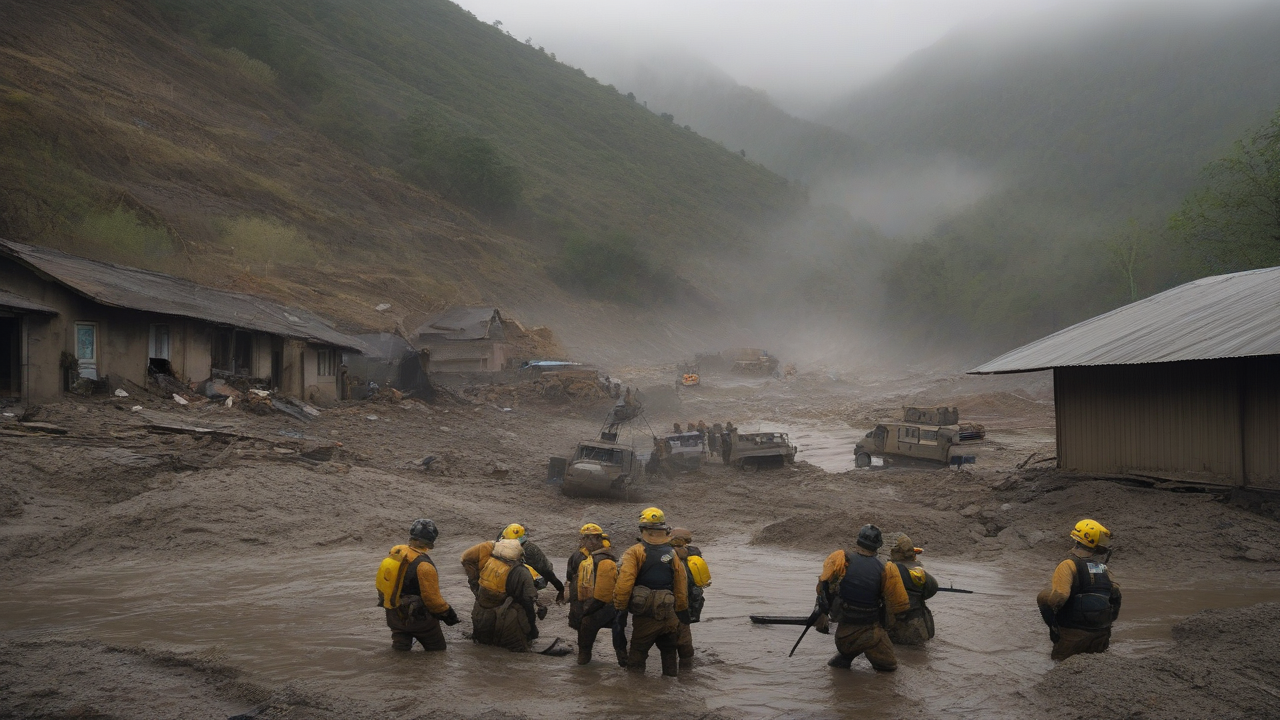
Nepal's flood death toll did not converge on Sunday. It fractured further. By late afternoon, at least two irreconcilable topline figures were circulating simultaneously for the same disaster: The Australian Financial Review's live blog, updated at 4:32 p.m., led with "Nepal death toll now 750." [1] Ninety minutes earlier, USA Today had reported a domestic count of 781 dead from Nepal's own National Disaster Risk Reduction and Management Authority, plus 16 more confirmed by Chinese officials on the Tibetan side of the border — a combined figure of 797, forty-seven higher than the number other outlets were running in the same news cycle. [2]
That gap is the sharpest confirmation yet of a thesis this paper laid out Saturday, when a fifth distinct count — Foreign Minister Shisir Khanal's figure of 650, posted directly to X — landed on top of the four incompatible tallies already circulating that week, including IBTimes' count of 626 the same day. [3] Saturday's paper argued the fragmentation "is not a temporary reporting lag" but a structural feature of a disaster still being counted from the ground up. Sunday did not just repeat that pattern. It multiplied it: two new topline figures, 750 and 797, both dated the same afternoon, both attributed to identifiable institutional sources, neither reconciled with the other by either outlet that reported it.
A third channel complicated the picture further without offering a number of its own. Nepal's Tourism Board posted its "Situation Update-10" for the Bhotekoshi flash flood at 1:15 p.m. Sunday — a numbered bulletin, the tenth in a series, that pointed readers to the disaster authority's own rescue portal rather than stating a domestic death toll in the post itself. [X1] That the country's own tourism authority is now issuing serially numbered situation updates, distinct from the disaster authority's figures that USA Today cited and distinct again from whatever aggregate wire services were running, is itself evidence against the "temporary lag" theory. A lag implies one number moving toward accuracy over time. What Sunday produced instead was multiple parallel information tracks — a wire live-blog total, a disaster-authority total relayed through an American paper, and a tourism-board bulletin series — none of which appear to be talking to each other.
The scale driving that fragmentation has not shrunk. USA Today reported Sunday that Nepal's disaster authority now counts 2,502 people missing domestically, while Chinese officials separately reported 546 missing in Tibet — a combined missing-persons figure exceeding 3,000, a number large enough on its own to shift the eventual death toll by hundreds depending on how many of the missing are ultimately confirmed dead versus found alive. [2] Dozens of Americans are among the missing foreign nationals; Nepal's Tourism Board said Sunday that two Americans had been rescued and it remained "in contact" with a third, out of nearly 600 foreign nationals it has reported unaccounted for. [2] Chinese authorities separately said 261 foreign nationals from 23 countries remain unaccounted for on the Tibetan side of the border, near the Gyirong crossing. [2]
The distinction between "domestic" and "combined" figures is itself part of why no single number has taken hold. Nepal's National Disaster Risk Reduction and Management Authority tracks only deaths and missing persons within Nepal's own borders; China's state broadcaster tracks the Tibetan side separately, through its own provincial disaster-response chain. USA Today's 797 figure is not a single government's count at all — it is an American newspaper's own addition of two governments' separately published numbers, an aggregation neither Kathmandu nor Beijing has performed or endorsed. AFR's 750, by contrast, appears to track closer to a domestic-only or lightly-updated figure from earlier in the day, published before the afternoon's higher domestic count circulated. Neither outlet's methodology is stated explicitly in the reporting available Sunday, which is itself part of the problem: readers comparing "750" against "797" have no way to know whether they are comparing two estimates of the same thing, or two different definitions of what counts.
Nepal has begun burying the dead faster than it can identify them. USA Today reported that authorities buried nearly 100 unidentified bodies Saturday and planned 100 more Sunday, collecting DNA samples and documenting burial sites in hopes families can later identify relatives — a direct consequence of local hospitals running out of refrigeration space, a capacity strain Saturday's coverage had already identified as the practical reason no single toll has stabilized. [2] "We were left with no other option," Chitwan chief district officer Ganesh Aryal told Reuters, describing the risk to public health posed by rapid decomposition. [2] Mass burial on this scale before final identification is itself a structural reason the toll will likely be revised upward in both directions — confirmed dead reclassified from missing, and some among the dead ultimately never matched to a name at all.
Diplomatic contact between the two governments most affected continued Sunday alongside the count itself. Chinese Foreign Minister Wang Yi telephoned his Nepalese counterpart Saturday, calling the mudslide their "most severe cross-border disaster" in recent years and describing rescue operations as having risen to "an unprecedented level of difficulty and complexity," according to state broadcaster CCTV. [2] That framing — from the country whose own Tibetan-side toll of 16 sits nested inside every combined figure reported Sunday — underscores how much of the uncertainty originates not from any single government's incompetence but from the fact two separate national bureaucracies are counting two separate halves of the same disaster and publishing on different schedules.
The physical hazard has not fully receded, either. Local police told Reuters that residents and rescue workers moved to higher ground Sunday after water levels in the Trishuli River rose again following fresh rainfall, and rescue operations have been suspended repeatedly since Friday over fears that the debris-dammed lake straddling the Nepal-China border could trigger a second flood. [2] More than 100 workers remain believed trapped in a tunnel at the Upper Trishuli-1 hydropower project, a hazard Saturday's reporting already flagged as unresolved and which Sunday's coverage did not report as changed.
Chinese state media has begun framing the disaster in terms broader than the immediate rescue effort, attributing it to long-term climate effects on the Tibetan plateau's ice and rock. CCTV described the flood as a "new and prominent feature of cryosphere disasters" tied to global warming — language that, whatever its scientific merit, is notably absent from the domestic Nepali coverage this paper has tracked, which has stayed focused on the operational count of dead, missing and rescued rather than on causation. [2] The Red Cross estimates more than 90,000 people have been affected in total by the disaster, which began with a catastrophic landslide near the Gyirong border crossing at roughly 8:30 a.m. local time on Aug. 26. [2]
The gap between causation framing and operational counting is not incidental to why the toll keeps splitting. A government agency focused on cause — the long-term cryosphere trend CCTV described — has different institutional incentives than a rescue authority focused on headcount, and different incentives again than a foreign ministry managing bilateral diplomacy with Wang Yi's counterpart. Each of Sunday's numbers, in other words, emerged from an institution answering a slightly different question: how many are confirmed dead domestically, how many are confirmed dead when both countries' tolls are added together, how many remain missing and might yet become either, and how much of this event should be understood as a single cross-border catastrophe versus two nationally bounded disasters that happen to share a border. Nepal's Tourism Board's numbered situation-update series answers none of those questions directly — it exists to track foreign nationals specifically, a fifth institutional lens layered atop the other four, optimized for consular casework rather than a national death toll.
What Sunday demonstrates, five days into the disaster, is that the reconciliation this paper's coverage has been watching for is not coming from within the news cycle itself. AFR's 750 and USA Today's 797 are not competing estimates converging toward a true number; they are two snapshots of two different counting processes, published ninety minutes apart, each individually sourced and each individually defensible, and yet mutually incompatible on their face. Add Saturday's 650 from Foreign Minister Khanal, the 626 IBTimes carried the same day, and the Tourism Board's numbered-but-numberless Sunday bulletin, and the count of distinct information channels reporting on Nepal's death toll now exceeds the count of confirmed dead moving in any single, agreed direction. The paper's position from Saturday holds: this is not a lag correcting itself. It is a structural feature of a disaster whose scale keeps outrunning the bureaucratic and journalistic capacity to count it in real time.
-- PRIYA SHARMA, Delhi