Economy
TL;DR
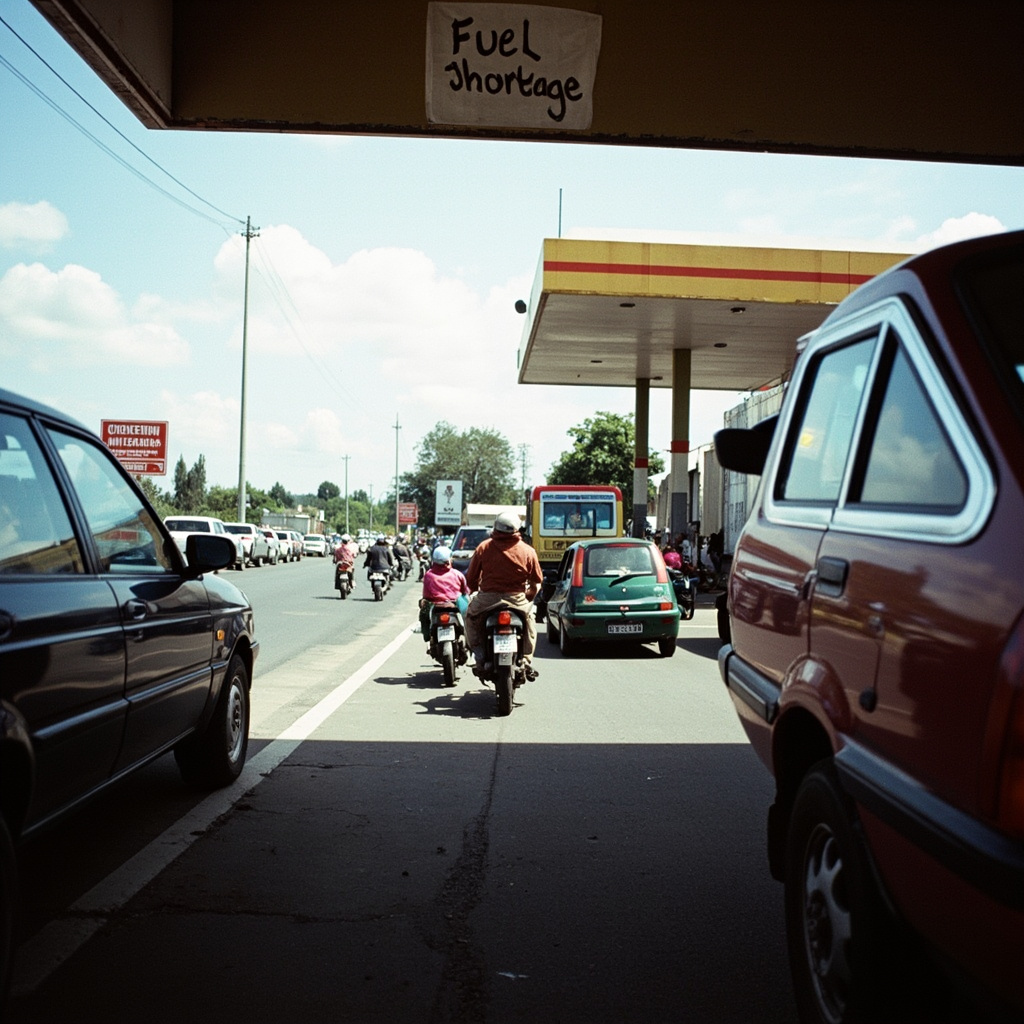
Zambia has moved to emergency fuel procurement and Cape Town fuel stations are reporting shortages as the Africa-wide crisis reaches its most acute phase yet.
MSM Perspective
The Washington Post's framing — Africa hurting from a crisis it had no part in starting — has become the dominant MSM lens; Reuters and Daily Maverick have provided the granular regional detail.
X Perspective
X's African economic commentary has settled on a phrase that keeps appearing in different languages: a war we did not fight is starving our cities.
Zambia's government announced emergency fuel procurement procedures on Friday, authorizing state energy company ZESCO to bypass standard tender processes to secure fuel supplies at whatever price the market will bear. The announcement came four weeks after this paper reported Africa's early warning signs and twelve days after shortages became visible at filling stations in Lusaka, Ndola, and Kitwe. The emergency designation means the government has formally acknowledged what citizens had been experiencing for nearly two weeks: the crisis is no longer theoretical. [1][2]
In South Africa, the situation is more politically complicated and in some ways more dangerous. The government in Pretoria has insisted, against considerable contradictory evidence, that there is no supply failure — only "illegal stock withholding by some suppliers." The South African government's statement, posted on official channels over the weekend, is technically defensible and operationally useless. Whether Cape Town fuel stations are empty because of a supply failure or a hoarding response to an anticipated supply failure, Cape Town fuel stations are empty. The distinction matters for regulatory enforcement. It does not matter for the driver with an empty tank. [3][4]
Daily Maverick, which has been tracking the South African situation with unusual precision, reported on March 19 that the country's fuel supply is "strained due to the Middle East conflict, resulting in shortages and soaring prices." The publication's framing contradicts the official position without quite refuting it — strain and shortage can coexist with technical supply adequacy if the distribution system cannot move product from refinery to pump at the pace demand requires. [4]
The structural vulnerability is not new. South Africa's crude oil imports are approximately 65 percent Gulf-derived. When the Strait of Hormuz began showing supply disruptions in the second week of March, South Africa's refinery throughput dropped before the government acknowledged any problem existed. The gap between what refineries received and what consumers needed was initially absorbed by strategic reserves. Those reserves have a floor. [3][4]
Zambia's position is more exposed than South Africa's and less reported. The country has no refining capacity and imports all of its petroleum products. Its fuel supply chain runs through Tanzania and Mozambique to regional distribution hubs, and then north. The disruption to Gulf oil flows translated into a Zambia problem with a longer delay than South Africa's but with less capacity to absorb the shock — no strategic reserve, no domestic refining, and a government that spent the early weeks of the crisis publicly minimizing the risk. [1][2]
Bizwe Kamanga, a Lusaka-based economist who warned publicly about the risk on March 4, wrote last week that the government's initial dismissiveness had made the crisis more severe by delaying procurement action. "When the shortage starts manifesting," he wrote, "the accusations about oil marketing companies hoarding fuel will surface. They will be true and they will miss the point." The emergency procurement authorization is an implicit admission that Kamanga was correct. [2]
Reuters, in a comprehensive survey published March 26 of how the conflict is hitting Africa, identified three distinct channels of impact: direct fuel supply disruption, price transmission through global commodity markets, and currency pressure on countries holding significant dollar-denominated energy import bills. All three are operating simultaneously across sub-Saharan Africa. The third channel — currency — is the one that will outlast the conflict regardless of when it ends. Countries that have depleted reserves to buy emergency fuel at elevated prices will face the currency consequences long after the Gulf reopens. [1]
The Washington Post's framing — "Africa hurting from a crisis it had no part in starting" — is accurate and insufficient. It captures the injustice. It does not capture the mechanism, which is structural dependence on a single geographic source of a critical commodity, managed by governments that prioritized near-term budget stability over strategic supply diversity. The war created the crisis. The dependence made it inevitable.
-- DARA OSEI, Nairobi
Sources & X Posts
News Sources