TL;DR
A fire truck responding to one emergency became the cause of another — two pilots killed, 41 hospitalized, and an airport system already under severe strain just broke.
MSM Perspective
CNN and AP lead with the pilot deaths and the fact that the fire truck had been cleared to cross the runway, while CNN explicitly connects the crash to the broader DHS shutdown.
X Perspective
X is sharing photos of the sheared-off nose of the CRJ-900 and the overturned fire truck, with many connecting the crash to the DHS shutdown and TSA staffing crisis.
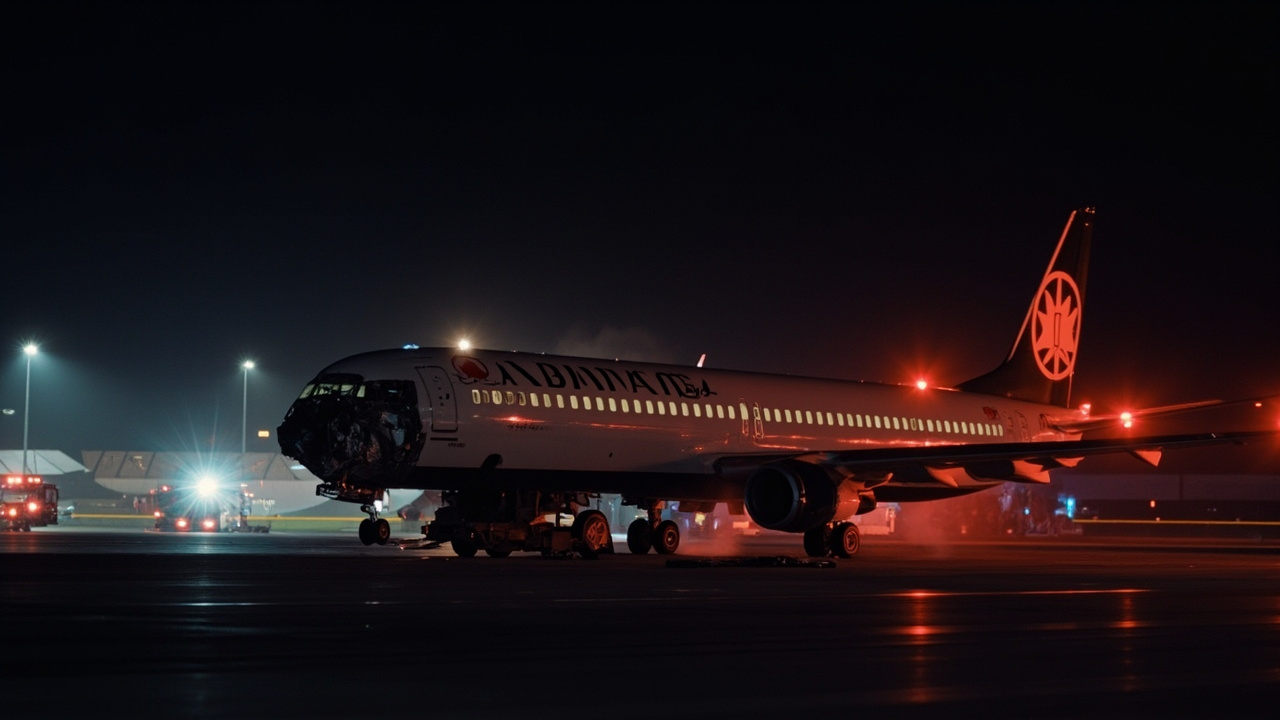
Air Canada Express flight 8646 from Montreal touched down on Runway 4 at LaGuardia Airport at approximately 11:40 p.m. on Sunday night and struck a Port Authority fire truck that was crossing the runway. The pilot and copilot were killed. The fire truck had been responding to a separate, unrelated incident — another aircraft had reported an unknown odor in its cockpit — and had been, according to the Port Authority, "preliminarily cleared" to cross the active runway. The plane was traveling at approximately 130 miles per hour at the moment of impact, according to FlightRadar24 data. [1] [2]
There were 72 passengers and four crew members aboard the Bombardier CRJ-900, operated by Jazz Aviation under the Air Canada Express banner. Forty-one people were hospitalized. Thirty-two have been released. At least one unaccompanied minor was among the passengers. The two occupants of the fire truck were also hospitalized and are reported in stable condition. Jazz Aviation confirmed the incident in a statement early Monday morning. [1] [3]
The airport closed immediately and will remain shut until at least 2 p.m. Monday. More than 500 flights have been canceled. The airport system was already under severe strain before a CRJ-900 collided with a fire truck on a runway in the dark. Three hundred and sixty-six TSA officers have quit since the DHS shutdown began on February 14. The officers who remain are working without pay. The system was degrading by the week. Now it has produced a catastrophe. [1] [2]
Photographs from the scene show the nose of the aircraft sheared off entirely, exposing the cockpit structure. The fire truck was found overturned on the runway, its emergency lights still visible. The severity of the frontal damage is consistent with the speed data — a regional jet at landing velocity striking a heavy vehicle that was not supposed to be in its path. The cockpit, where the pilot and copilot sat, absorbed the full force of the collision. They had no chance and no warning. [2] [4]
The detail that will define this crash in the investigative record is the chain of causation. A fire truck was dispatched to respond to a cockpit odor report on a different aircraft. That response required the truck to cross an active runway. The truck was cleared to cross. An inbound flight was on approach. These are the facts as the Port Authority and FAA have described them. The National Transportation Safety Board will investigate how a vehicle cleared to cross a runway was in the path of a landing aircraft — which is to say, the NTSB will investigate the most basic function of an airport: keeping the runway clear. [1] [2]
CNN reported Monday morning that the crash has intensified scrutiny of the DHS shutdown's impact on aviation safety. The current shutdown, now in its second month, has depleted TSA staffing and strained airport operations across the country. Air traffic controllers are not directly affected by this particular shutdown — unlike the 2018-2019 standoff, they continue to be paid and staffed. The question CNN raises, and the FAA will have to answer, is whether the broader degradation of airport operations — stretched resources, exhausted personnel, systems running above capacity with fewer people — contributed to the conditions that put a fire truck on an active runway at the wrong moment. [1]
That question does not have an answer yet. The NTSB investigation will take months. But the question itself is the point. A partial government shutdown is not supposed to kill people. It is supposed to be a political tool — a mechanism of leverage, an inconvenience with a negotiated end date. The 366 TSA officers who have quit did not quit because they were in danger. They quit because they could not pay rent. The two pilots who died on Runway 4 were not victims of a policy dispute. They were victims of a fire truck that was in the wrong place, which was in the wrong place because it was responding to a different problem, which required it to cross a runway, which someone cleared it to cross.
Systems do not fail all at once. They fail in sequences that are only visible as sequences afterward. A congressional standoff over immigration enforcement leads to a DHS funding lapse. The funding lapse leads to TSA officers working without pay. The unpaid officers quit. The airports stretch thinner. The spring break surge arrives. Resources are reallocated. A cockpit odor report dispatches a fire truck across a runway at 11:40 p.m. A jet from Montreal touches down at 130 miles per hour.
The pilot and copilot of Air Canada Express flight 8646 did everything right. They flew the approach. They landed the plane. The runway was supposed to be clear. It was not clear because the system that keeps runways clear is the same system that has been losing staff, losing funding, and losing capacity for five weeks. The DHS shutdown is not an abstraction. It is not a negotiating position. As of Sunday night, it is a runway at LaGuardia Airport with two dead pilots and a fire truck on its side.
-- MAYA CALLOWAY, New York
Sources & X Posts
News Sources
X Posts