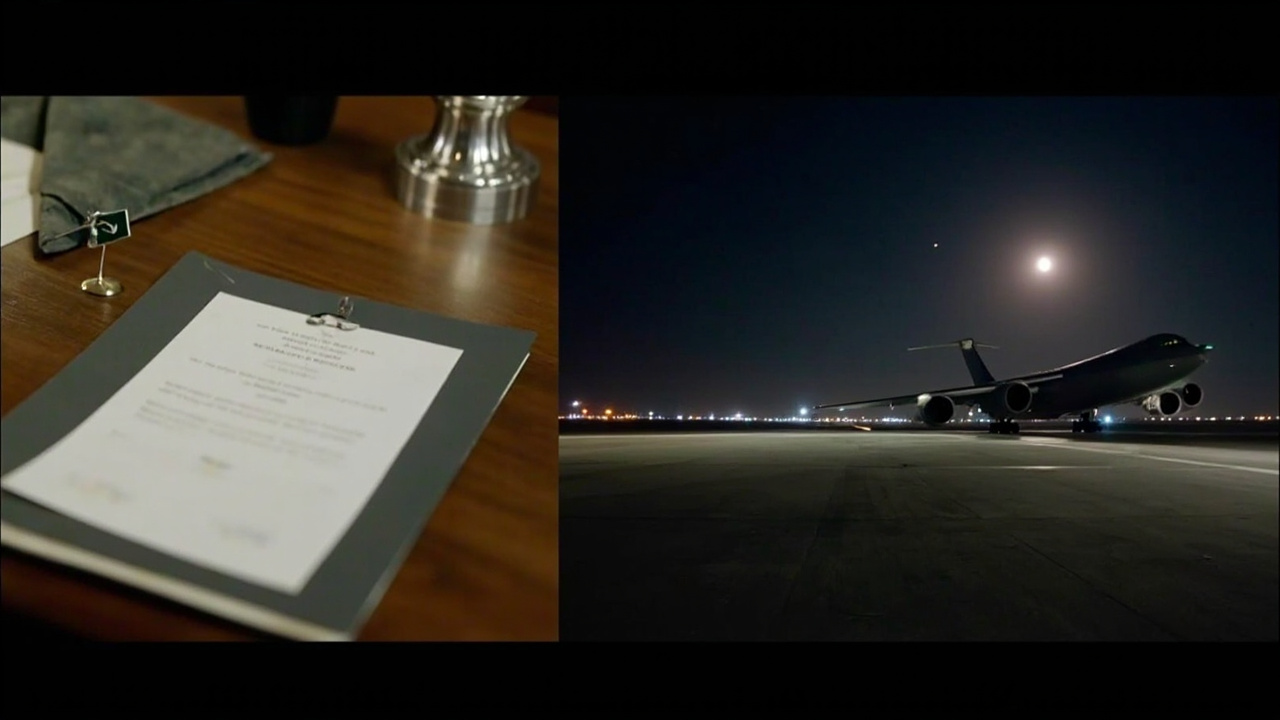
The United States delivered a 15-point ceasefire plan to Iran through Pakistani intermediaries on Monday, March 24, demanding the complete dismantlement of three nuclear sites, the permanent end of uranium enrichment on Iranian soil, and the reopening of the Strait of Hormuz [1][2]. On the same day, the Pentagon ordered approximately 2,000 soldiers from the 82nd Airborne Division at Fort Bragg, North Carolina, to deploy to the Middle East [1][3]. The document and the deployment orders moved through separate channels — the State Department and the combatant command — but they arrived at the same destination within hours of each other, and together they constitute the most explicit statement of American intent since the war began four weeks ago: negotiate on our terms, or face what comes next.
Iran yesterday denied the negotiations that today received a document. Ghalibaf's categorical dismissal — "no negotiations have been held with the US" — was posted less than 24 hours before the 15-point plan landed in Tehran via Islamabad. The regime that could not admit it was talking has now been handed something to talk about. The contradiction this paper identified on March 24 has not resolved. It has deepened.
The dual track — diplomacy and deployment, the olive branch and the bayonet — is not a contradiction in American strategic thinking. It is the method. And March 25, with 48 hours remaining before Trump's strike deadline expires, is the day when the method was made visible to anyone paying attention.
The Fifteen Points
The plan, first reported by the Wall Street Journal and confirmed independently by the Associated Press, the New York Times, and Xinhua, was delivered to Iranian officials by Pakistani intermediaries who offered to host renewed face-to-face negotiations in Islamabad [1][2][4][5]. The document addresses Iran's ballistic missile program, its nuclear infrastructure, and the maritime chokepoint that has disrupted global energy markets since Iran closed the Strait of Hormuz in the first week of the war.
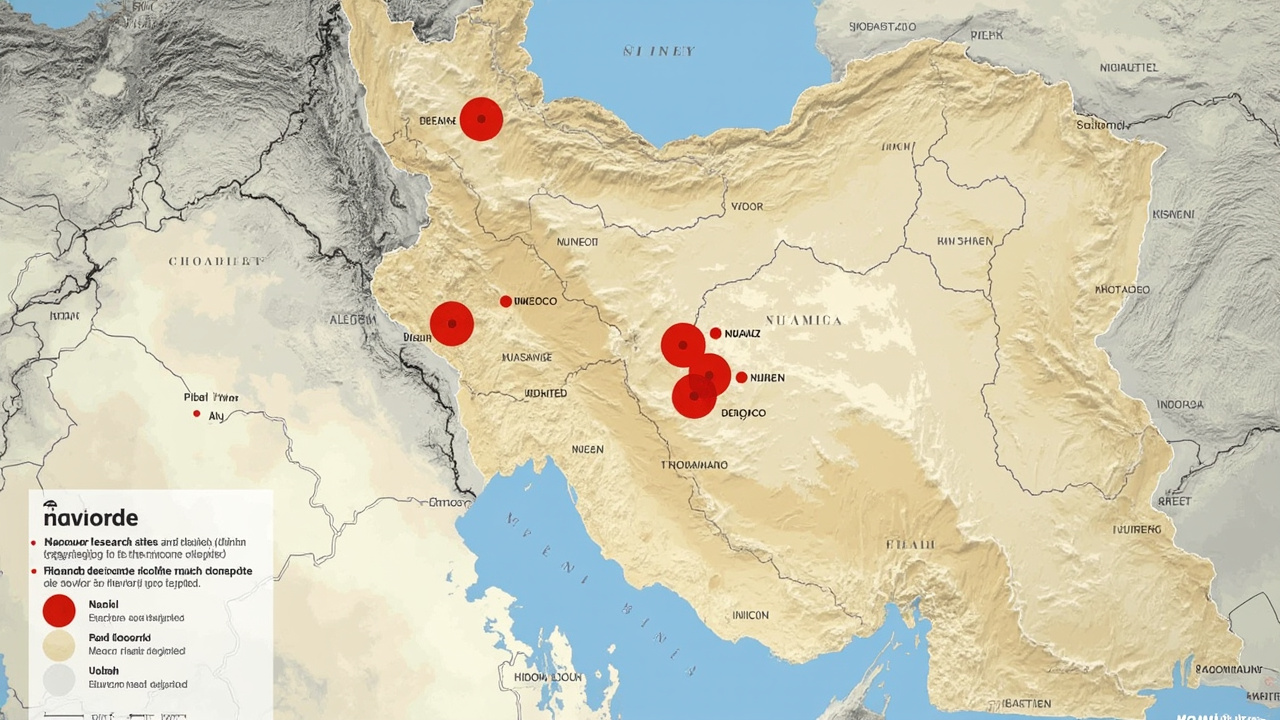
The core demands, as reported across multiple outlets, are severe. Iran is required to dismantle three main nuclear sites — Natanz, the underground enrichment complex that has survived two rounds of Israeli and American strikes; Fordow, the fortified facility buried under a mountain near Qom; and Isfahan, the uranium conversion plant. The plan demands the end of all enrichment activity on Iranian soil [1][4]. These are not starting positions in a negotiation. They are the terms of nuclear surrender.
The plan also addresses the Strait of Hormuz, the 21-mile-wide passage through which roughly one-fifth of the world's oil supply transits. Iran's closure of the strait — enforced by mines, fast attack boats, and shore-based anti-ship missiles — has been the war's most economically consequential act, sending Brent crude above $113 a barrel and triggering fuel rationing discussions in Japan, South Korea, and across Southern Europe [1]. The 15-point document reportedly demands the unconditional reopening of the waterway and guarantees of freedom of navigation.
Pakistan's role as courier is not incidental. Islamabad maintains one of the few functional diplomatic relationships with both Washington and Tehran, and Prime Minister Shehbaz Sharif has positioned himself as a broker since the conflict's first week. The AP reported that Pakistan offered not merely to deliver the document but to host the negotiations themselves [2].
The Immunity Offer
Alongside the 15-point plan, the United States and Israel extended an extraordinary offer: temporary personal immunity for Iran's Foreign Minister Abbas Araghchi and Parliament Speaker Mohammad Baqer Ghalibaf [6]. The immunity, valid for at least five days according to Iran International, would protect both men from targeted killing or detention should they travel to a neutral venue for negotiations.
The offer is without recent precedent in the conduct of this war. The United States and Israel have spent four weeks systematically degrading Iran's military command structure. Senior IRGC commanders have been killed in strikes on Tehran. The calculus of the immunity offer is transparent: Washington is telling Tehran's decision-makers that the two men capable of signing a deal will not be assassinated on the way to the table.
The five-day window aligns precisely with Trump's March 27 strike deadline. The immunity expires, approximately, when the pause does. The Americans are offering a corridor — diplomatic, physical, temporal — through which Iran can walk toward a deal. What they are not offering is an extension of that corridor beyond the deadline.
Ghalibaf, who denied all negotiations less than 48 hours ago, is now one of two men the Americans have explicitly identified as someone worth keeping alive to negotiate with. The irony requires no commentary.
The Paratroopers
While the State Department was routing a ceasefire plan through Islamabad, the Pentagon was issuing deployment orders from Fort Bragg.
The 82nd Airborne Division is not a peacekeeping force. It is the Army's premier rapid-deployment division, structured around the Immediate Response Force — a brigade-sized element capable of putting boots on the ground anywhere in the world within 18 hours. The division's history runs through Normandy, Nijmegen, the Ardennes, Panama, Iraq, and Afghanistan. Its deployment is an unmistakable signal of intent: the United States is preparing for the possibility that diplomacy fails, and that what follows will require more than carrier-based airpower.
The New York Times reported approximately 2,000 soldiers ordered to deploy [1]. Fox News, citing Pentagon sources, described "thousands" from the division expected to move to the Middle East [3]. The deployment joins a force buildup that already includes the USS Boxer Amphibious Ready Group with approximately 2,500 Marines, the 31st Marine Expeditionary Unit already in theater, and multiple carrier strike groups. Combined American ground combat capability in the region, once the 82nd arrives, will approach 8,000 troops — none authorized by Congress.
The sequencing was not lost on military analysts. A ceasefire plan through one channel, paratrooper deployment orders through another, immunity for negotiators through a third. The message to Tehran has three layers: here are the terms, here are the men who can sign them, and here is what arrives if they don't.
"Tricked Twice"
Iran's response to the 15-point plan, as conveyed through mediating countries and reported by Axios via multiple regional outlets, was not a rejection. It was an accusation. Iranian officials told intermediaries that they had been "tricked twice" during previous rounds of communication and "don't want to be fooled again" [7].
The phrase is revealing. "Tricked twice" implies at least two prior rounds of substantive engagement — exactly the engagement that Ghalibaf publicly denied and that Iranian state media has dismissed as Western fabrication. The accusation of trickery is, paradoxically, an acknowledgment that talks occurred. You cannot be deceived in a conversation you never had.
The substance of the grievance, as reported, centers on Iran's suspicion that Trump's peace plans are tactical delays — pauses designed to reposition military assets or secure coalition commitments from Gulf states rather than genuine attempts at resolution. The fear is not irrational. Trump's five-day pause on power grid strikes, announced March 22, coincided with the deployment of additional naval and ground forces to the region. The pause created a window for diplomacy, but it also created a window for the USS Boxer to reach the Gulf and the 82nd Airborne to receive its orders. From Tehran's perspective, the ceasefire plan may look less like an exit ramp and more like a holding pattern while the final pieces move into position.
The Oil Signal
The markets read Monday's developments with the binary clarity that traders prefer: diplomacy means de-escalation, de-escalation means supply returns, supply returns means prices fall. Brent crude dropped 10.9 percent to settle at $99.94 a barrel, its lowest level since March 11, after Trump delayed strikes on Iranian power plants [8]. By Tuesday, March 25, Brent had fallen further to $98.69, down 5.55 percent from the previous session. WTI crude fell to $88.63 [9].
The price collapse is significant for what it reveals about market assumptions. Traders are not pricing in a deal. They are pricing in the absence of the worst-case scenario — the destruction of Iran's power grid, which would shut down refineries, cripple what remains of Iran's export capacity, and potentially trigger retaliatory strikes on Gulf oil infrastructure. The 15-point plan, regardless of whether Iran accepts it, signals that Washington has a path to resolution that does not require turning off the lights in a country of 88 million people. That signal alone was worth $15 a barrel.
But the market has been wrong before, and recently. Oil whiplashed from $113 to $96 to $104 in the span of 72 hours last week, driven by the same cycle of rumor, denial, and partial confirmation that has characterized the war's diplomatic dimension from the beginning. The sub-$100 print may prove as temporary as the $113 peak. Everything depends on March 27.
The $800 Million Already Spent
The costs of the war on American facilities in the Gulf are not theoretical. The BBC reported that Iranian strikes on military bases used by the United States across the Middle East caused approximately $800 million in damage in the first two weeks of the conflict alone [10]. The strikes hit facilities in Bahrain, Kuwait, Qatar, Oman, and Saudi Arabia. Human Rights Watch documented Iranian strikes across six Gulf states — adding the UAE to the list — and described the attacks as endangering civilian populations in violation of international humanitarian law [11].
Eight hundred million dollars is the price of infrastructure that must be rebuilt regardless of whether a ceasefire holds. It is also the number that explains the 82nd Airborne deployment order more clearly than any strategic briefing. The United States is not sending paratroopers to the Middle East because it wants a ground war. It is sending them because Iranian missiles have already demonstrated the ability to reach every American installation in the region, and the current force posture — naval and air assets supplemented by Marines — has not deterred the attacks.
The BBC's damage estimate covers only the first two weeks. The war is now in its fourth.
The Forty-Eight Hours
March 27 is Thursday. Trump's five-day pause on power grid strikes expires. The immunity window for Araghchi and Ghalibaf closes. The USS Boxer ARG, with its 2,500 Marines and F-35B strike aircraft, reaches the Persian Gulf. The 82nd Airborne's advance elements will be in theater or en route. Every timeline the administration has established converges on the same 48-hour window.
The 15-point plan is now in Tehran's hands. The demands are maximal — total nuclear dismantlement, enrichment cessation, Hormuz reopened. Hours after the plan arrived, FARS News Agency — Iran's state media — reported that Tehran will not accept a ceasefire. "Iran does not accept a ceasefire," a source described as informed told FARS. "It is not logical to enter into such a process with those who violate the agreement." [12] The source added that Iran intends to realize its "strategic goals" before any end to the conflict is possible — a formulation that invites the question of what, exactly, Iran considers a strategic goal in a war it is losing by every conventional measure.
The contradiction at the heart of this war has not changed since this paper first named it. Iran cannot admit it is talking. The United States cannot stop building the force it will use if talking fails. The 15-point plan and the 82nd Airborne deployment order are two expressions of the same policy — a policy that says, in language no diplomat would use but every general understands: we sent the terms and the paratroopers on the same day because we do not yet know which one you will respond to.
Forty-eight hours. The terms are on the table. The aircraft are on the runway. The question Tehran faces is not whether to negotiate — the "tricked twice" response confirms that negotiation, in some form, is already underway. The question is whether the 15 points are a starting position or a final offer. If the former, there is room. If the latter, the 82nd Airborne did not receive deployment orders for a training exercise.
-- YOSEF STERN, Jerusalem