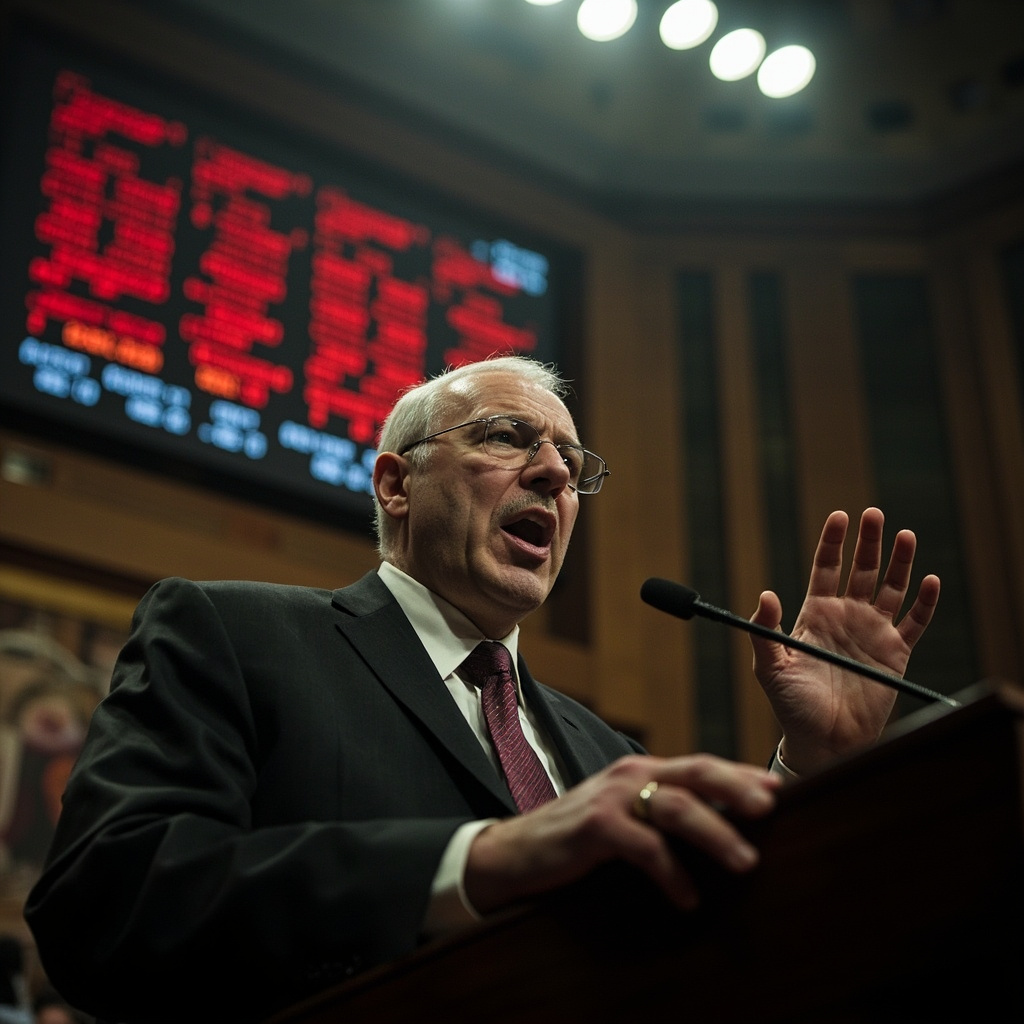
Mohammad Bagher Ghalibaf, the speaker of Iran's parliament, posted a single statement on X at 3:54 p.m. GMT on Sunday, March 23, and in doing so attempted to demolish 48 hours of cautious optimism. "No negotiations have been held with the US," he wrote, "and fake news is used to manipulate the financial and oil markets and escape the quagmire in which the US and Israel are trapped" [1].
The statement was categorical. It was also, according to reporting from Ynet confirmed by Iran International, incomplete. Iran's Foreign Minister Abbas Araghchi had, in a phone call with U.S. envoy Steve Witkoff and Jared Kushner, signaled Tehran's "readiness to move toward a deal" — provided Iran's conditions were met. Araghchi told his American counterparts that new Supreme Leader Mojtaba Khamenei had given approval to "close the issue quickly" [2]. The Jerusalem Post, citing a separate source, reported that Ghalibaf himself was leading the talks he publicly denied [3].
This paper noted on March 23 that Trump blinked — postponing strikes on Iran's power grid for five days after what he called "very good and productive conversations". That framing centered on Washington's reversal. Today's story is about Tehran's — the regime that cannot admit it is talking while it cannot afford to stop.
The Architecture of Denial
The contradiction is not accidental. It is structural.
Iran's domestic politics require the appearance of defiance. Ghalibaf's post was addressed to an Iranian audience that has endured 24 days of war, at least 1,443 civilian dead according to the rights group HRANA, a near-total internet blackout, and an economy hemorrhaging under sanctions and conflict [4]. The regime cannot tell its population that it is negotiating with the country currently bombing it. The Islamic Republic's founding mythology is built on resistance to American power. Admitting to backchannels would undermine the narrative that has sustained the regime since 1979.
But Iran's military position requires the reality of diplomacy. The war has been devastating. U.S. and Israeli strikes have hit nuclear facilities at Natanz twice, destroyed missile storage depots across Tehran, degraded air defense networks, and — most critically — brought American military assets to within striking distance of the power grid that keeps 88 million people alive. The 48-hour ultimatum Trump issued on Saturday, March 21, was not abstract. It named the target: power plants, starting with the biggest [5].

So Iran does what regimes under existential pressure have done throughout history: it talks through one channel and denies through another. Araghchi texts Witkoff. Ghalibaf posts on X. The foreign ministry spokesman, Esmail Baghaei, threads the needle by acknowledging that "messages had been conveyed in recent days through several friendly countries" while insisting there have been "no negotiations" during the 24 days of war [1]. The distinction between "messages conveyed through intermediaries" and "negotiations" is the kind of semantic construction that keeps diplomatic careers and national mythologies alive simultaneously.
The Intermediaries
The backchannel architecture has become clearer in the past 48 hours. According to Axios, officials from Turkey, Egypt, and Pakistan have been mediating and passing messages between Tehran and Washington [6]. Israeli officials told Reuters they believe the United States and Iran could hold direct talks in Islamabad as soon as this week, with Vice President Vance potentially serving as the senior American representative [3].
The Islamabad venue is significant. Pakistan has maintained relations with both Washington and Tehran throughout the conflict, and Prime Minister Shehbaz Sharif has positioned himself as a potential broker. Turkey's role is older — Ankara has been a go-between for Iranian-American communications since the Obama administration. Egypt's inclusion is newer and reflects Cairo's deepening concern about oil prices and Suez Canal revenue.
But the most revealing detail comes from the Ynet report: Araghchi told Witkoff that Khamenei — the son who succeeded his father as Supreme Leader after the elder Khamenei's death in the early days of the conflict — had personally authorized the pursuit of a deal [2]. If true, this means the negotiations have the highest possible sanction within the Iranian system. The denial is theater. The diplomacy is real.
Trump, for his part, has been characteristically indiscreet. In a phone interview with CNBC on Monday, he described the talks as "very intense" and said Iran had "initiated contact" [7]. He told reporters that Iran's leadership had agreed in principle to abandon nuclear weapons — a claim no Iranian source has confirmed and which, if accurate, would represent the most significant concession in the history of the Islamic Republic's nuclear program. "They're not going to have nuclear weapons anymore. They're agreeing to that," Trump said. He added, with the confidence of a man who has never been troubled by the gap between assertion and verification: "If we didn't hit them, they would have had a nuclear weapon within two weeks to a month" [3].
The Market Verdict
The oil market did not wait for the contradiction to resolve itself. It simply picked a side.
Brent crude, which had traded above $113 a barrel as recently as Saturday on the back of Iran's threat to permanently close the Strait of Hormuz, fell more than 10 percent on Monday. Bloomberg reported the drop at approximately 14 percent from weekend highs, with futures settling near $97 before recovering slightly to around $104 by the close [8]. The Wall Street Journal described it as the largest single-session percentage drop since the early days of the pandemic [9].
The market's logic was straightforward: if Trump is pausing strikes on the power grid, and if some form of communication — call it negotiations, call it messages, call it whatever allows both sides to avoid the word — is underway, then the probability of an immediate catastrophic escalation has declined. Traders priced in the pause, not the denial.
But the denial matters. If Ghalibaf's statement reflects a genuine factional split — hardliners who refuse to negotiate versus pragmatists around Araghchi who see no alternative — then the backchannel could collapse at any moment. And if the denial is purely performative, designed for domestic consumption while the real work happens in Islamabad, then the risk is different: it is the risk that Iran's population, seeing their leaders deny talks that are actually happening, loses whatever residual trust remains in the regime's honesty.
The European Pressure
The contradiction between Tehran's public posture and private signals has not gone unnoticed in Brussels. European Commission President Ursula von der Leyen, speaking from Canberra on Monday, demanded an "immediate" negotiated end to the war, describing the situation as "critical" [10]. The International Energy Agency's executive director, Fatih Birol, went further, warning that the current energy crisis is worse than both oil shocks of the 1970s combined [8].
Von der Leyen's language was notable for what it did not contain: any assignment of blame. The EU has maintained a studied ambiguity throughout the conflict, refusing to condemn the U.S.-Israeli military campaign while expressing "deep concern" about civilian casualties and energy market disruption. Monday's statement sharpened the tone without changing the substance. Europe wants the war to end. It is not prepared to say who should end it.
What the Five-Day Pause Actually Covers
The pause is narrower than it appears. Trump's Truth Social post specified that the postponement applied to "military strikes against Iranian power plants and energy infrastructure." It did not cover:
- Israeli strikes on Tehran, which continued Monday. The IDF confirmed hits on missile storage facilities and "regime targets" in the Iranian capital [11].
- Hezbollah's rocket campaign against northern Israel, which included approximately 30 rockets at the Haifa Bay area and 20 additional projectiles at other northern targets on Monday [12].
- Iranian missile launches at Israel, including a strike on a central Tel Aviv residential building that injured six people [13].
- The ongoing Strait of Hormuz closure, which Iran has maintained since early March.
- The U.S. naval buildup in the Gulf, which now includes the USS Boxer Amphibious Ready Group with approximately 2,500 Marines, deployed from San Diego on March 20 [14].
The war, in other words, continues at full intensity on every front except one: the American threat to Iran's electrical grid. That single exception is what markets are pricing. It is also what Iran's denial is designed to obscure — because acknowledging the pause as a diplomatic concession would imply that Iran had something to do with extracting it.
The Ghalibaf Paradox
The most fascinating detail in the emerging picture is Ghalibaf's dual role. The Jerusalem Post reports he is leading the Iranian side of the talks [3]. Iran International reports he is the man who publicly denied them [1]. If both reports are accurate, then the parliament speaker is simultaneously the chief negotiator and the chief denier — conducting diplomacy with one hand and burning the evidence with the other.
This is not without precedent in Iranian politics. During the 2015 nuclear negotiations that produced the JCPOA, then-Foreign Minister Mohammad Javad Zarif maintained a public posture of defiance while conducting intensive backchannel discussions with U.S. Secretary of State John Kerry. The difference is that Zarif eventually acknowledged the talks. Ghalibaf, at least for now, cannot.
The reason is the war itself. The JCPOA negotiations took place during peacetime, when the cost of acknowledgment was political embarrassment. The current negotiations — if that is what they are — take place while American bombs are falling on Iranian soil. Acknowledging talks under those conditions would be seen not as pragmatism but as surrender.
The Clock
Trump's five-day pause expires on Thursday, March 27. That is the same day the USS Boxer ARG and its Marine complement are expected to arrive in the Persian Gulf [14]. It is the same day the 82nd Airborne Division's Immediate Response Force may begin deploying, according to Pentagon planning reported by the New York Times [15]. The convergence is not coincidental.
The deadline structure creates a negotiating framework whether Iran acknowledges it or not. Before March 27, there is time to talk. After March 27, the American military will have additional ground forces in theater, the Marines will be in position, and the political cost of further delay will rise. Trump told reporters Monday that he believed a deal was possible: "I think if I were a betting man, I'd bet for it. But again, I'm not guaranteeing anything" [3].
Iran's denial, viewed from this angle, is not obstruction. It is a holding action — preserving domestic credibility while the backchannel runs. The question is whether five days is enough to bridge the gap between what Trump demands (nuclear disarmament, Hormuz reopening, end of hostilities) and what Iran requires (compensation, security guarantees, withdrawal of American forces from the Gulf). Based on reporting from the WSJ, the UAE's national security adviser Tahnoun bin Zayed has described Iran's demands as "too high" for mediation [16].
The gap between the two positions is enormous. The time available to close it is small. And the regime that holds the key to its own survival is the one insisting, publicly and on the record, that the door is not open.
It is open. The question is whether anyone can walk through it before March 27.