TL;DR
Artemis II's $4 billion per-launch cost drew pointed comparisons to shuttered federal agencies and suspended services.
MSM Perspective
Science journalists defended Artemis as inspiration while budget analysts questioned the timing.
X Perspective
X users contrasted Moon-mission spending with TSA closures, FEMA cuts, and gas at $4 per gallon.
Sofia Lindqvist is a freelance reporter based in Stockholm.
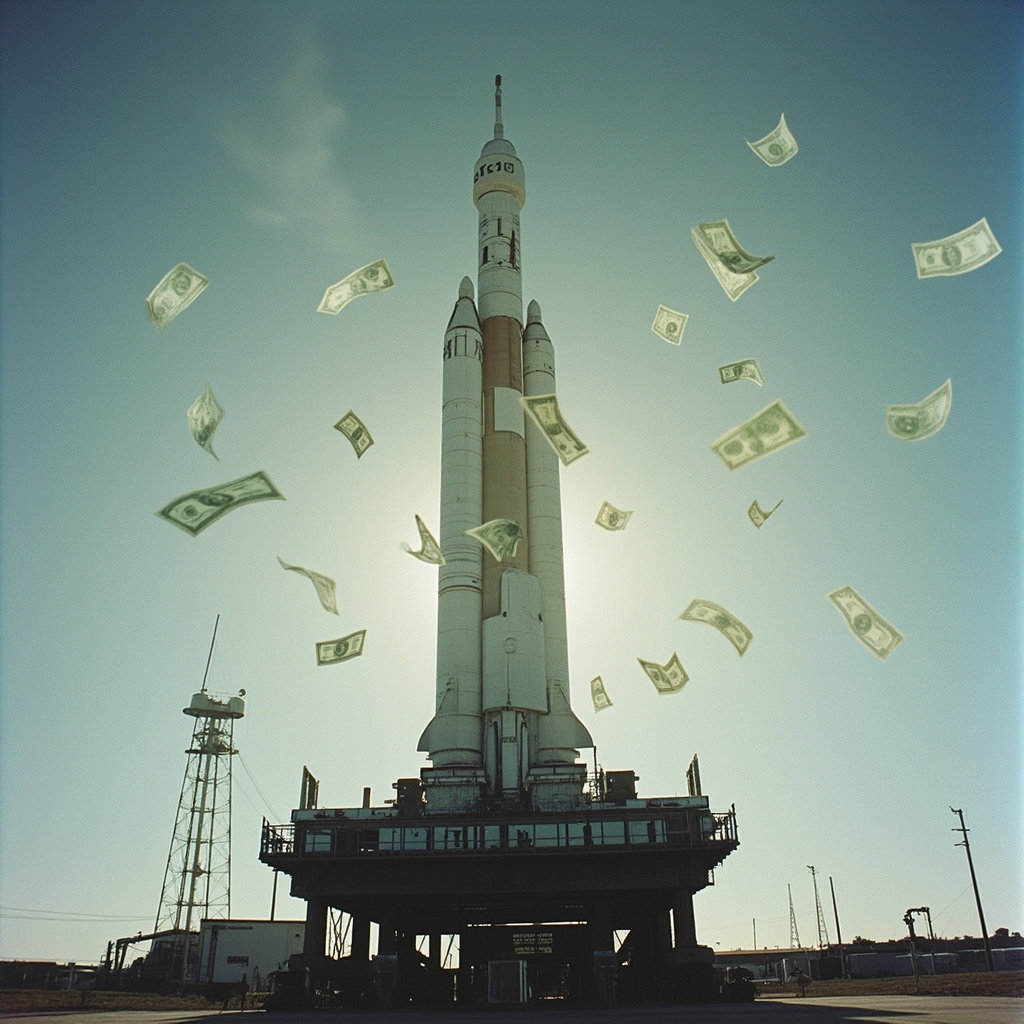
The Space Launch System rocket standing on Pad 39B at Kennedy Space Center on Wednesday afternoon represented, by Bloomberg's most recent estimate, more than $4 billion in per-mission costs for the SLS and Orion hardware [1]. The Artemis program as a whole had consumed north of $44 billion since its inception, with projections running between $93 billion and $127 billion through 2050 depending on which audit you consulted [2][3].
These were not new numbers. But on April 1, 2026, they landed differently. As we covered in our Artemis countdown report, the launch was proceeding with a two-hour window opening at 6:24 p.m. EDT. The astronauts were strapped in. The countdown was live. And on X, the budget conversation was unavoidable.
"What do you tell Americans who are struggling to buy groceries?" asked one widely shared post from journalist Catherine Herridge, citing NASA's $24 billion annual budget [4]. Peter Diamandis, the XPrize founder, posted calculations showing that SpaceX's Starship could theoretically perform similar missions at three to nine times lower cost per launch [5]. Space journalist Eric Berger had spent weeks documenting public ignorance about the mission's existence, noting that many Americans had "NO IDEA Artemis II is taking humans out to the moon."
The timing made the arithmetic impossible to ignore. The TSA PreCheck and Global Entry programs had been suspended during the partial government shutdown. Gas had reached $4 per gallon. The Philippines had declared a national energy emergency. Cuba was in the dark. And the United States was spending $4 billion to send four people on a ten-day loop around the Moon with no landing.
NBC News ran a lengthy feature examining the tension directly, noting that Artemis II was "NASA's make-or-break moon shot" arriving at a moment when the agency's critics had more ammunition than usual [2]. The mission would not put boots on the lunar surface. That was Artemis III, years away and dependent on hardware that did not yet exist in flight-ready form. Artemis II was, in the most literal sense, a test flight.
NASA's defenders argued that the mission's value was precisely in what it was not. It was not a war expenditure. It was not a bailout. It was not a response to crisis. It was a choice to invest in capability, in knowledge, in the kind of long-horizon project that democracies are supposed to be uniquely positioned to sustain. The $4 billion bought life-support data, heat-shield validation, and deep-space communication testing that no simulation could replicate.
The counterargument wrote itself. A country at war, running a deficit, with shuttered airports and rationed fuel, was choosing to send a capsule around the Moon because it had committed to doing so before the world caught fire.
Both arguments were correct. That was what made the arithmetic so uncomfortable. The Moon mission was a genuine achievement and a genuine luxury, and there was no rhetorical framework that could hold both truths at once.
The countdown continued.
-- Sofia Lindqvist, Stockholm
Sources & X Posts
News Sources
X Posts