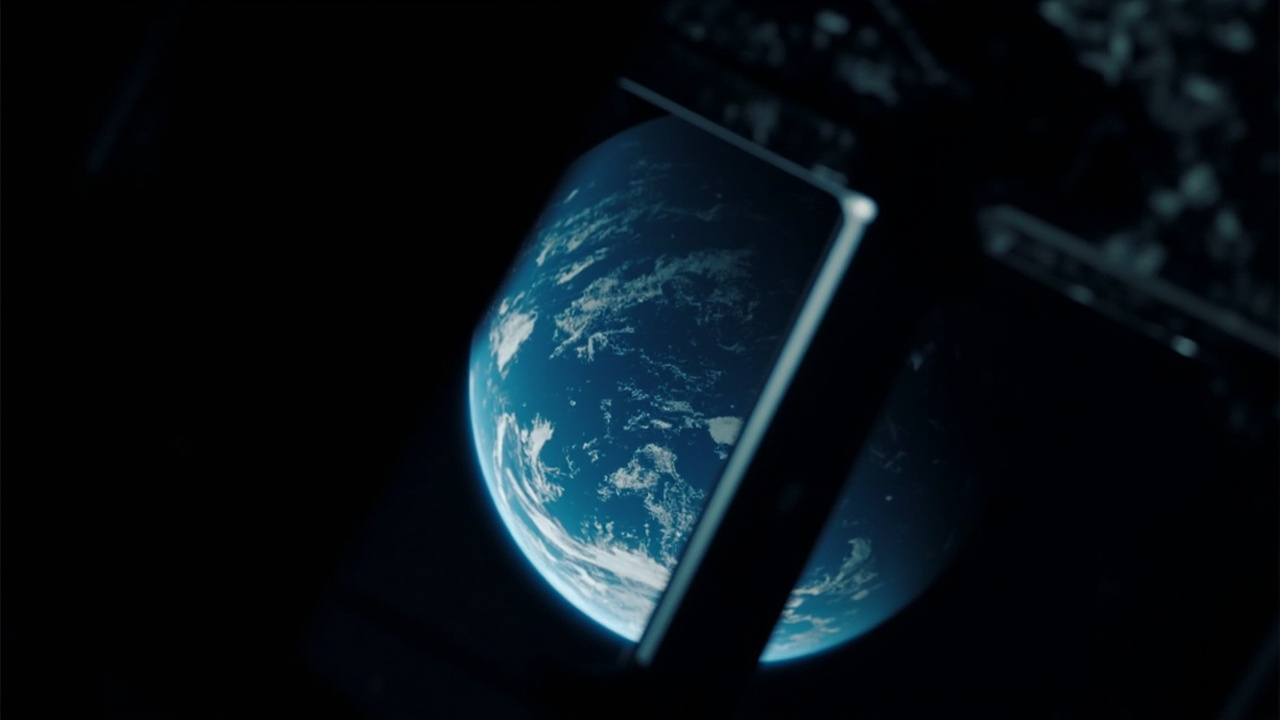
The first photograph is a sliver of light. A curved slice of Earth's atmosphere, blue fading to white fading to the black of space, framed in one of Orion's five windows. Commander Reid Wiseman took it on Thursday, April 2, shortly after the translunar injection burn that this paper covered yesterday sent the crew beyond Earth orbit for the first time in 54 years. [1]
The second photograph is the whole planet. Earth as a disk -- what the Apollo crews called the Blue Marble, though the term has been so overused that the thing it describes has almost disappeared beneath the cliche. The New York Times described the image as showing "our bright blue planet" swathed in cloud patterns that meteorologists could read like a text. [2] It was taken from approximately 41,756 miles away, after the crew completed a perigee raise burn that aligned their trajectory for the lunar flyby. [3]
The camera was not a Hasselblad. It was not the modified Nikon that the International Space Station crews use. It was Wiseman's Personal Computing Device -- a tablet with a built-in camera, the kind of device you might use to photograph a whiteboard in a meeting room. [4] The fact that the most significant photographs of Earth since December 1972 were taken on a tablet tells you something about the era. The instrument matters less than the vantage point. No human has been this far from Earth with a camera since Gene Cernan looked out the window of Apollo 17.
NASA shared the images on Friday morning. [1] The response was immediate and enormous. The agency's Artemis account posted the full-disk image with a caption from mission specialist Christina Koch: "You guys look great." [5] The post accumulated tens of millions of views within hours. Koch's three words became the mission's emotional shorthand -- an astronaut looking at seven billion people through a window and offering the simplest possible review.
The photographs arrived at a moment when the mission needed good news. On launch day, April 1, the Orion spacecraft's toilet malfunctioned almost immediately. A fault light blinked on. NASA spokesperson Gary Jordan confirmed the problem at the first post-launch press conference: "The toilet fan is jammed." [6] Koch, who holds a doctorate in electrical engineering, took on the role of spacecraft plumber. Working with instructions from mission control in Houston, she resolved a separate water tank valve issue that had disrupted flow to the waste management system. [7] NASA's official blog reported the toilet restored to "normal operations" by the end of the day. [8] The Guardian noted, with appropriate dryness, that the crew had fixed a "$30 million toilet." [9]
The water valve issue was related but distinct. A valve in Orion's water management system -- which supplies both the toilet and the crew's drinking water -- was not responding to commands from the ground. Koch manually cycled it. The Houston Chronicle reported that the fix took approximately forty minutes and involved Koch accessing a panel behind the crew's seats. [7] The incident was minor in engineering terms but symbolically potent. The most advanced crewed spacecraft ever built, on its way to the Moon, was briefly undone by plumbing.
Both issues are now resolved. The crew is healthy. Orion is approximately 130,000 miles from Earth and accelerating toward the Moon on a free-return trajectory. [10] The spacecraft will reach its closest lunar approach -- approximately 130 kilometers from the surface -- on Monday, April 6. The crew will photograph the far side of the Moon, test manual piloting in deep space, and validate the heat shield for reentry at 25,000 miles per hour. Splashdown in the Pacific is scheduled for Friday, April 10.
April 6 carries a second significance that the photographs do not show. It is the day of Trump's self-imposed Iran deadline -- the end of his stated period of "hitting them extremely hard." The Moon flyby and the deadline will compete for the same broadcast minute. NASA's livestream will show four astronauts 130 kilometers above the lunar surface, seeing what no human has seen in half a century. The other feed will show whatever the war produces next.
The photographs from Thursday are not about the war. They are about the opposite of the war. They are four people in a spacecraft built by fourteen nations, looking back at a planet that, from 41,756 miles away, has no borders, no blockades, no burning refineries, no diesel price records. Koch looked at it and said: "You guys look great."
The crew will be home by April 10. The war will not.
-- KENJI NAKAMURA, Tokyo