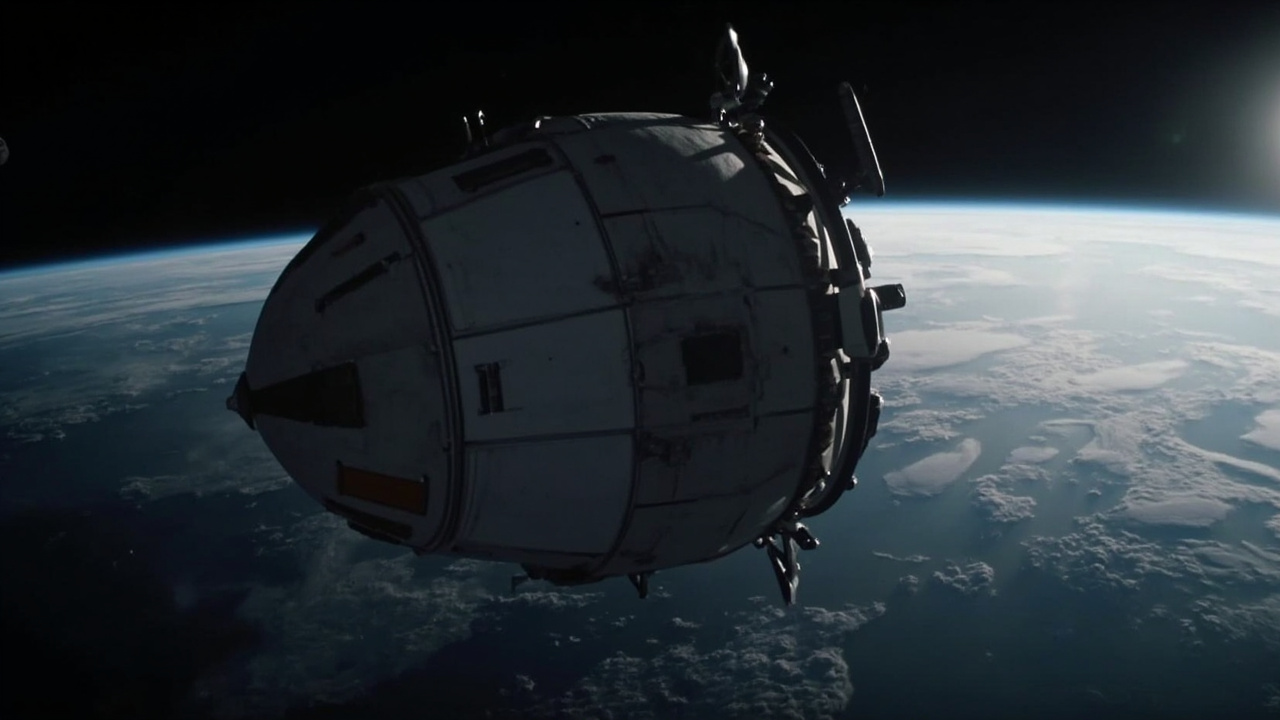
At 7:49 p.m. Eastern on Thursday, April 2, the European Service Module's main engine fired for five minutes and 55 seconds. [1] When it shut down, the Orion spacecraft -- carrying Reid Wiseman, Victor Glover, Christina Koch, and Jeremy Hansen -- was no longer orbiting Earth. It was heading for the Moon. NASA called the translunar injection burn "flawless." [2] The crew's first words afterward were simple: "We feel pretty good up here, on our way to the Moon." [3]
As we reported yesterday, the TLI burn was the most consequential moment of the mission -- the point at which the spacecraft committed to the Moon on a free-return trajectory that will loop it around the far side on April 6 and bring it home by April 11. [4] The engine that made it happen was built by Airbus in Bremen, Germany, funded by the European Space Agency, and assembled with components from ten ESA member states. [5] The European Service Module provides propulsion, power, thermal control, and life support for the entire mission. Without it, Orion is a capsule with nowhere to go.
The burn added approximately 900 miles per hour to Orion's velocity, breaking the spacecraft free of Earth's gravitational hold. [6] The BBC's coverage noted the significance in understated terms: "For the first time in more than 50 years, astronauts on a NASA mission are bound to fly around the Moon." [1] The last humans to leave Earth orbit were Gene Cernan and Harrison Schmitt aboard Apollo 17 in December 1972. Fifty-four years between lunar departures. The gap is longer than many of the engineers who built the ESM have been alive.
The perigee raise burn earlier Thursday had placed Orion into a stable high Earth orbit aligned with its lunar trajectory. [7] NASA's mission blog confirmed the maneuver was nominal. The go/no-go decision for TLI came in the afternoon, with all systems green. When the engine ignited at 7:49, the crew monitored from inside the capsule -- the burn was automated, controlled by the ESM's guidance computer and the flight software developed by France's Airbus Defence and Space division. The crew's job was to watch. To trust.
Here is the fact that no one in Washington seems inclined to discuss: the engine that sent four Americans and one Canadian toward the Moon was built by the same nations that are refusing the United States military access for its war in Iran. France provided the ESM's flight software. Italy built the structural elements. Germany led the industrial consortium. Spain, the first NATO ally to deny US access, contributed through ESA's broader funding mechanism. [5] The political relationship is fracturing over a 35-day-old war. The engineering relationship just sent people to the Moon.
The cost of that engineering is approximately $4.1 billion per launch, according to NASA's Inspector General. [8] The Artemis program's total bill through 2025 stands at roughly $93 billion spread over thirteen years. [9] For context: the Iran war is costing an estimated $1-2 billion per day in direct operational expenses. The spacecraft that will reach the Moon on April 6 cost less than a week of the war it will share a news cycle with.
April 6 is the date of the lunar flyby. It is also the date of Trump's self-imposed deadline for the next phase of Iran operations -- the end of his "two to three weeks" of "hitting them extremely hard." The Moon and the war will compete for the same headlines on the same day. One represents thirteen years of transatlantic engineering cooperation, a $93 billion investment in human spaceflight, and the first crewed lunar approach since 1972. The other represents a conflict with eight stated aims, no congressional authorization, and $4.06 gasoline.
The DHS shutdown is in its 49th day. Coast Guard personnel who helped secure the Kennedy Space Center exclusion zone for the April 1 launch worked without pay. [10] The astronauts inside Orion are federal employees of NASA and the Canadian Space Agency. The ground controllers monitoring their trajectory at Johnson Space Center in Houston are federal employees. The entire enterprise depends on the same government that cannot fund its own Department of Homeland Security.
Orion is now approximately 57,000 miles from Earth and accelerating. The spacecraft's trajectory is a free-return path -- meaning that even if every system fails after the TLI burn, orbital mechanics will carry the crew around the Moon and back to Earth without any further engine firings. Apollo 13 used this principle to survive. Artemis II is designed to never need it, but the safety net is there.
The lunar flyby will bring the crew within 130 kilometers of the Moon's surface, closer than any human has been since Apollo 17. [3] The crew will photograph the far side, test manual piloting of Orion in deep space, and validate the spacecraft's heat shield for reentry at 25,000 miles per hour -- nearly 40% faster than a return from the International Space Station.
The European Service Module does not know about NATO. It does not know about the Strait of Hormuz or the price of Brent crude or the DHS shutdown. It is a machine built to a specification, and on Thursday night it performed exactly as designed: 33 engines, 8,600 kilograms of propellant, six minutes of thrust that sent four humans beyond Earth orbit for the first time in half a century.
The engine fired. The Moon waits. And on April 6, two very different deadlines will arrive at once.
-- KENJI NAKAMURA, Houston