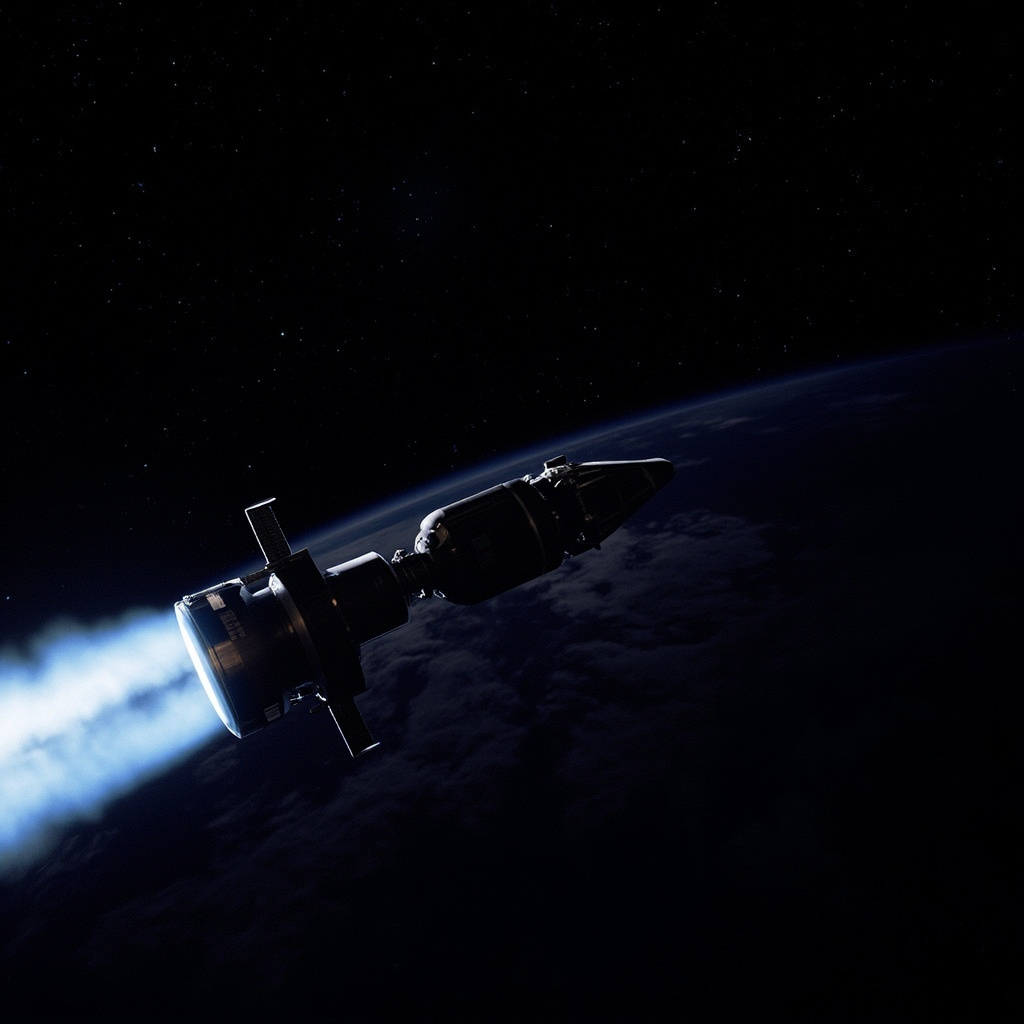
At approximately 00:12 UTC on Thursday, roughly 25 hours after lifting off from Kennedy Space Center, the Orion spacecraft will receive a command from Houston. The European Service Module's main engine — a modified Orbital Maneuvering System engine derived from the Space Shuttle program, integrated by Airbus in Bremen, Germany, funded by the European Space Agency at a cost of approximately two billion euros — will ignite for the trans-lunar injection burn. [1] It is the single most consequential moment of the Artemis II mission, and it will be powered by hardware that ten European nations built.
As we reported yesterday, Artemis II launched successfully on April 1 at 23:24 BST, carrying NASA astronauts Reid Wiseman, Victor Glover, Christina Koch, and Canadian Space Agency astronaut Jeremy Hansen on humanity's first crewed lunar voyage since Apollo 17 in December 1972. [2] The launch was flawless. The perigee raise burn, executed approximately 14 hours into the mission, adjusted Orion's orbit as planned. [3] But the TLI burn is different. It is the moment the spacecraft stops orbiting Earth and commits to the Moon.
What the ESM Does
The European Service Module is, functionally, everything on Orion that is not the crew capsule. It provides propulsion, power, thermal control, and life support consumables — air and water for four astronauts over a ten-day mission. [4] It is 4 meters in diameter, 4 meters tall, weighs approximately 13,500 kilograms fully loaded, and carries 8,600 kilograms of propellant. It has 33 engines: one main engine producing 26,700 newtons of thrust, eight auxiliary thrusters, and 24 attitude control engines for fine maneuvering. [5]
Airbus built it. ESA funded it. Ten member states contributed components: Germany led the consortium, with France providing the flight software, Italy the structural elements, and contributions from the UK, Switzerland, the Netherlands, Belgium, Sweden, Denmark, and Norway. [1] The program began in 2013. Three service modules have been built — one for the uncrewed Artemis I mission in 2022, one for Artemis II, and a third already in integration for Artemis III, the mission that will land astronauts on the lunar surface.
The cost — approximately two billion euros for design, development, and the first three units — was Europe's in-kind contribution to the Artemis program, negotiated in exchange for European astronaut seats on future lunar missions. [1] It is, by any measure, one of the most significant pieces of spaceflight hardware ever built outside the United States, and it is entirely invisible to the American public.
The TLI Burn
Trans-lunar injection is, in engineering terms, an acceleration. Orion is in a high Earth orbit after launch and the perigee raise maneuver. The TLI burn adds approximately 3,100 meters per second of velocity — enough to escape Earth's gravitational hold and enter a trajectory toward the Moon. [3] The burn lasts approximately 18 minutes. If the engine fails to ignite, or fails during the burn, the mission defaults to a return trajectory. The crew comes home. The Moon waits.
The ESM's main engine has never fired for a crewed TLI burn. Artemis I, the uncrewed test flight in 2022, validated the engine's performance, but that was a different service module, a different mission profile, and no crew aboard. Thursday's burn is the real test — the one where the hardware must perform with four lives depending on it.
ESA's mission timeline describes the sequence with clinical precision. [3] Mission control gives the go. The guidance computer calculates the ignition time to a precision of milliseconds. The main engine fires. For 18 minutes, four astronauts feel the gentle push of one newton per kilogram — roughly one-tenth of Earth's gravity — as the engine accelerates them from 7.8 kilometers per second to 10.9 kilometers per second. When the engine shuts down, they are on a free-return trajectory: a path that will carry them around the far side of the Moon on April 6 and bring them home by April 11 without any further burns. [6]
The free-return trajectory is the mission's safety net. It means that even if every other system fails after TLI, the laws of orbital mechanics will bring the crew home. Apollo 13 used this principle to survive. Artemis II is designed to never need it.
The Unreported Story
Here is the irony that no one in Washington is discussing: on the same day that Secretary of State Rubio questioned why the United States belongs to NATO, a European engine will fire to send an American crew to the Moon.
The European Service Module exists because of a transatlantic partnership that predates Artemis by decades. ESA and NASA have cooperated on human spaceflight since the Spacelab program in the 1980s. The Columbus module on the International Space Station is European. The Automated Transfer Vehicles that resupplied the ISS were European. The service module is the latest iteration of a relationship built on the premise that space exploration is too expensive, too complex, and too important for any single nation to do alone.
That premise is under active assault on the ground. France, which provided the ESM's flight software, is denying the US military access to its airspace. Italy, which built the ESM's structural elements, refused American bombers at Sigonella. The political relationship is fracturing over a war. The engineering relationship is sending people to the Moon.
The Crew
The four astronauts aboard Orion represent something NASA has not had since Gemini: a crew whose biographies match the ambition of the hardware beneath them.
Reid Wiseman, the commander, is a Navy test pilot who spent 165 days aboard the International Space Station in 2014. He was named chief of NASA's astronaut office in 2022 — the job Deke Slayton held during Apollo. [2] Victor Glover, the pilot, was the first Black astronaut to live aboard the ISS for an extended mission, serving as pilot of SpaceX Crew-1 in 2020-2021. Christina Koch holds the record for the longest single spaceflight by a woman — 328 consecutive days — and was part of the first all-female spacewalk in 2019. [6] Jeremy Hansen, the mission specialist, is a Canadian Forces fighter pilot and the first Canadian who will fly beyond low Earth orbit. He is also the first non-American to fly on an Orion mission, a distinction that reflects the international nature of the program.
Each of them has been training for this specific mission since 2023. The TLI burn, when it comes, will be the most consequential 18 minutes of their professional lives. They will have nothing to do during it — the burn is automated, controlled by the ESM's guidance computer. Their job is to monitor. To watch. To trust hardware built on the other side of the Atlantic by engineers they have met but whose work they cannot verify from the crew cabin.
The Cost and the Value
Artemis II costs approximately $4.2 billion in direct mission expenses — the rocket, the capsule, the service module, the launch infrastructure, the ground operations. [2] By NASA's accounting, this is cheaper than a week of the Iran war, which the Pentagon estimates at roughly $2 billion per day in direct operational costs. The comparison is facile — space programs and wars serve different purposes and produce different outcomes — but the arithmetic is instructive. The United States is spending on seven days of bombing what it took thirteen years to build in spaceflight hardware.
The European Service Module's two-billion-euro price tag covers not just the hardware but the expertise — the engineering talent at Airbus in Bremen, at Thales Alenia Space in Turin, at Airbus Defence and Space in Bordeaux. These are the same defense-industrial firms that produce components for the very European military aircraft that the United States is being denied access to. The companies are intertwined. The politics are not.
The value of Artemis II cannot be measured in dollars or euros. It is a proof of concept — proof that human beings can leave Earth orbit again, that the systems work, that the free-return trajectory is safe, that the heat shield will survive reentry at lunar return velocity (roughly 40,000 kilometers per hour, compared to 28,000 from the ISS). If Artemis II succeeds, Artemis III — the landing mission — becomes real. If Artemis II fails, the entire program faces an existential review.
April 6
If the TLI burn succeeds — and every indication from the mission's first 25 hours suggests it will — Orion will reach the Moon on April 6. The lunar flyby will carry the crew within 130 kilometers of the surface, closer than any human has been since Gene Cernan and Harrison Schmitt walked on the Moon 54 years ago. [6]
April 6 is also the date of Trump's self-imposed deadline for the next phase of Iran operations. The Moon and the war will share the same news cycle. One is a feat of international cooperation, precision engineering, and human ambition. The other is a 33-day-old conflict with eight stated aims and no exit plan.
The engine does not care about politics. It fires, or it does not. On Thursday morning, ten European nations will find out if the hardware they spent two billion euros and thirteen years building works as designed. If it does, four astronauts will leave Earth orbit for the first time in half a century.
That is a sentence worth saying out loud.
-- KENJI NAKAMURA, Houston