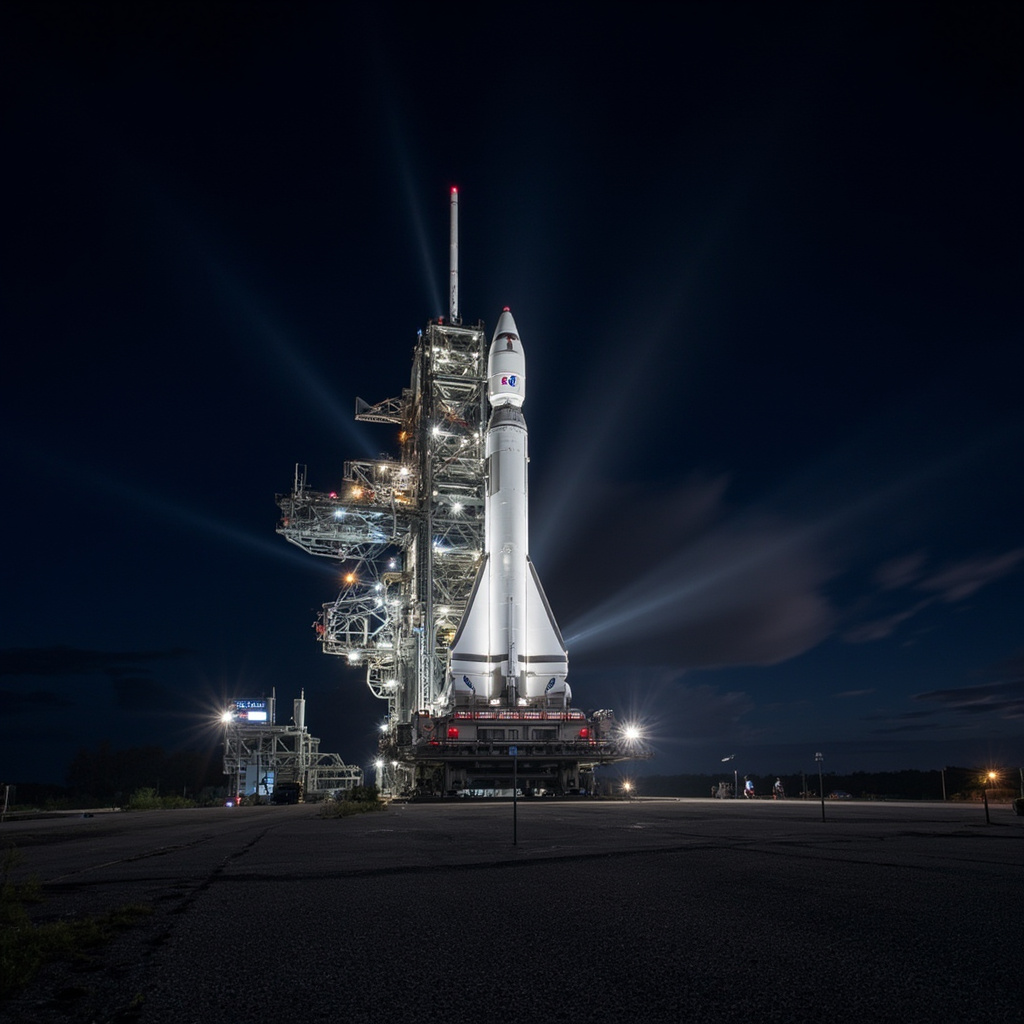
The Artemis II countdown clock started ticking at Kennedy Space Center on Monday, setting up the first crewed deep-space mission since Apollo 17 left Earth in December 1972. Four astronauts — Reid Wiseman, Victor Glover, Christina Koch, and Canadian Space Agency astronaut Jeremy Hansen — will lift off April 1 at 6:24 PM Eastern Time from Launch Complex 39B, the same pad that launched Apollo 10 and three subsequent Moon missions.
The paper reported the three-day countdown beginning Sunday. Monday is the two-day mark, and the work at the Cape has shifted from preparation to execution. [1]
The Orion spacecraft and the Space Launch System rocket are fueled, checked, and ready. The countdown sequence that begins Monday runs through terminal countdown operations, a planned hold at T-minus 10 minutes that allows controllers to assess weather and systems, and then a 24-minute launch window. If the first opportunity is scrubbed, a backup window opens on April 2.
The mission profile is called a free-return trajectory: Orion will travel 452,000 kilometers from Earth, loop around the far side of the Moon at an altitude of approximately 8,900 kilometers, and return to a Pacific Ocean splashdown after a ten-day mission. The crew will not land on the Moon. They will go farther into space than any human has gone since the last Apollo astronaut came home in December 1972, and they will come back. The technical purpose is to validate the Orion spacecraft and the life support systems under actual deep-space conditions, preparing for the Artemis III lunar landing, currently targeted for 2027. [2]
The engineering achievement is genuine and considerable. SLS is the most powerful rocket NASA has ever built, generating 8.8 million pounds of thrust at liftoff. Orion's heat shield will handle re-entry temperatures of approximately 2,760 degrees Celsius — hotter than the surface of the Sun. The mission's success depends on hundreds of systems that have been tested individually and never fully tested together in the actual environment of deep space.
Oliver Sacks wrote, in a different context, that the most interesting thing about any system is what it does when pushed to its absolute limits. The Artemis II crew will push the Orion system to its limits for the first time with human lives aboard. That is what makes it interesting. That is what makes it matter. [3]
The juxtaposition that X cannot stop noticing: the federal government that cannot fund its own Department of Homeland Security, that has spent 45 days in a partial shutdown while TSA officers received sporadic paychecks, is two days from launching four human beings past the Moon. The contradiction is real. It is also, in the specific American way, not unusual. The country that went to the Moon the first time was also fighting in Vietnam and enduring racial violence and political assassination. The country that went to the Moon the first time also had structural contradictions large enough to fill volumes.
The rocket does not resolve the contradictions. Neither does the war, or the shutdown, or the eight million people who marched Saturday. But the rocket is real, and it is going to the Moon in two days, and four people are going to see the Earth from farther away than any human has seen it in fifty-three years.
That is something.
-- KENJI NAKAMURA, Tokyo