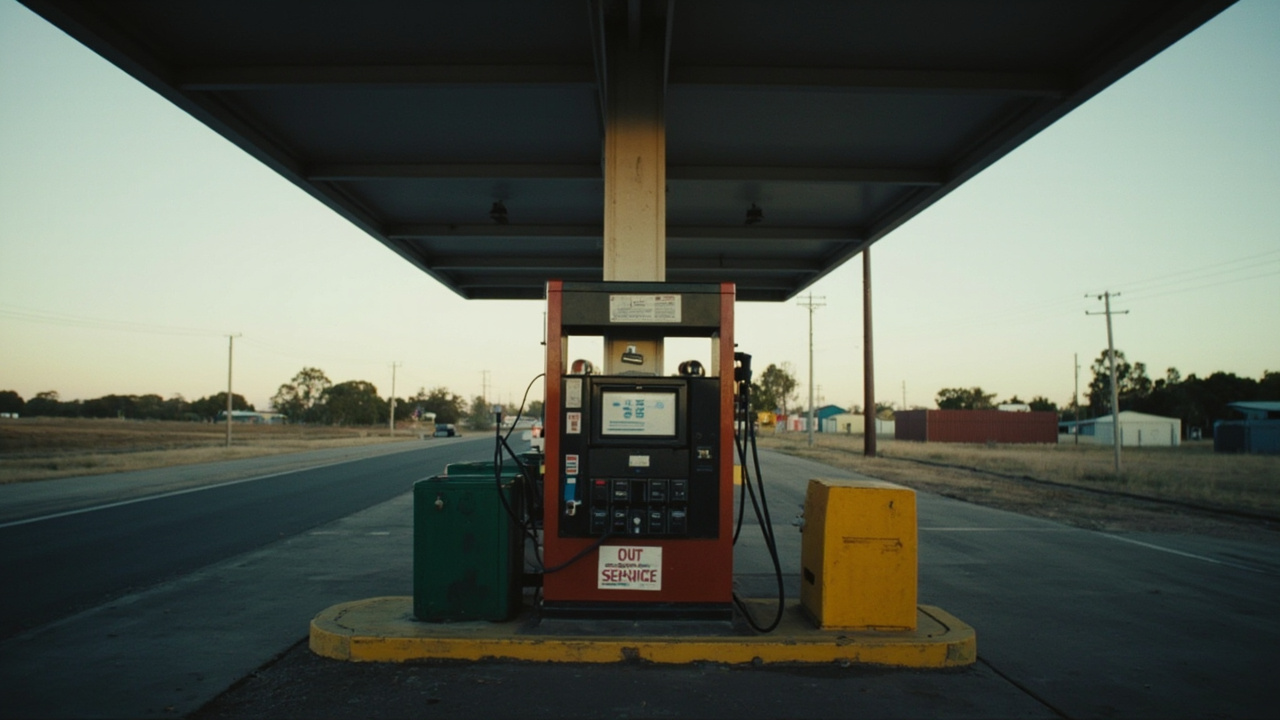
One hundred and eighty-two fuel stations in New South Wales have run out of diesel. The number comes from the NSW state government's fuel monitoring program, and it represents approximately 13% of the state's total service station network. [1] Across Australia, more than 500 stations have run dry on at least one fuel type, with diesel shortages the most severe. The crisis is not localised. It is national, and it is getting worse.
The cause is not complicated. Australia imports approximately 90% of its refined fuel. [2] The majority of that fuel arrives on tankers that transit the Strait of Hormuz. The strait has been effectively blockaded since the IRGC imposed its $2 million toll on transiting vessels in mid-March. Tankers are rerouting around the Cape of Good Hope, adding two to three weeks to delivery schedules. The ships that were due to arrive in late March have not arrived. The ships that departed before the blockade have been offloaded. The gap between those two facts is a diesel shortage.
Diesel prices in Australia have surged more than 50% since the war began. [1] Regional stations, which depend on fewer and less frequent fuel deliveries than metropolitan ones, have been hit hardest. Farmers in western NSW, preparing for the autumn planting season, are rationing diesel allocations. Livestock transporters are reporting that some routes have become uneconomical — the cost of fuel to move cattle to market now exceeds the margin on the cattle themselves.
The federal government has responded with a series of escalating measures. An export ban on refined fuel products was imposed in late March. Fuel rationing guidelines were issued to states, though implementation has been inconsistent. The government released stocks from the national fuel reserve, which at last report held approximately 32 days of diesel supply. [2] That reserve was designed for a temporary disruption — a refinery fire, a cyclone, a single tanker delay. It was not designed for an indefinite blockade of the strait that supplies 60% of Asia's crude.
The Fox News liveblog carried the Australian shortage alongside reports of fuel crises in Pakistan, South Africa, Bangladesh, and the Philippines. [3] The pattern is identical in each case: a country with no part in the war, no vote on its commencement, and no mechanism to end it, discovering that its economy depends on a waterway controlled by a belligerent it has no diplomatic relationship with.
Australia is 11,000 kilometres from the Strait of Hormuz. It has no military forces engaged in the conflict. It has not been asked to provide basing, overflight, or logistical support to either side. Its connection to the war is entirely structural — crude oil transits Hormuz, refineries in Singapore and South Korea process it into diesel, tankers carry it to Australian ports, and trucks distribute it to the stations that farmers, tradespeople, and freight companies depend on. Every link in that chain is functioning. The first link — transit through Hormuz — is not.
The 182 dry stations in NSW are not a failure of Australian energy policy, though they expose its fragility. They are the product of a blockade imposed by a country responding to strikes ordered by another country in a war that Australia did not start, did not support, and cannot influence. The diesel was supposed to arrive three weeks ago. It is still on a ship, somewhere south of the Cape of Good Hope, adding nautical miles to a supply chain that was never designed for this.
-- DARA OSEI, London