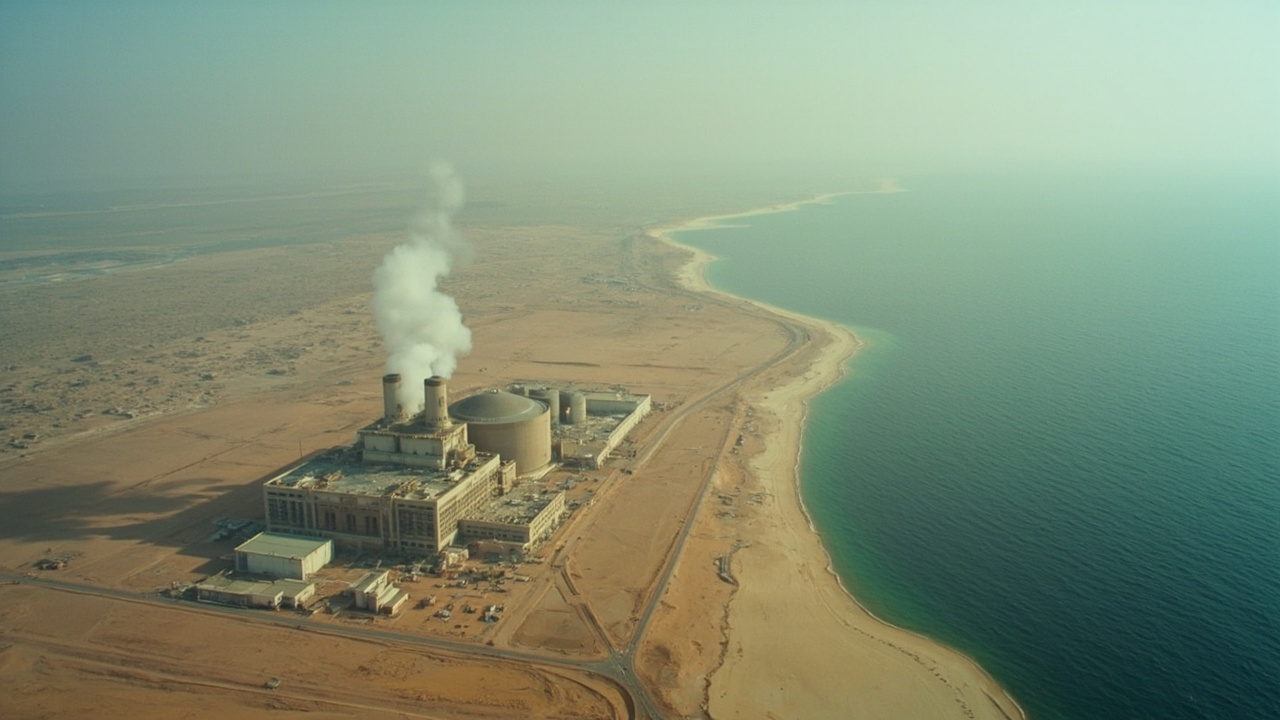
The fourth projectile struck near Iran's Bushehr Nuclear Power Plant on Saturday morning, killing one member of the site's physical protection division and damaging a building within the facility perimeter. [1] It was the fourth attack on the complex since the war began on February 28 -- following incidents on March 17, March 24 (two strikes), and now April 4. [1] The main reactor was not hit. No radiation increase was detected. The IAEA confirmed the strike and, for the first time in the war, the agency's director general used language that the diplomatic vocabulary of international nuclear governance reserves for moments approaching catastrophe.
Rafael Grossi said he was "deeply concerned." [1]
In the IAEA's lexicon, "deeply concerned" is not a throwaway phrase. It sits above "concerned" and below "alarmed" in a hierarchy that the agency has refined over decades of managing crises at Chernobyl, Fukushima, and Zaporizhzhia. As this paper reported yesterday when the first guard was killed, the previous strikes had produced no formal IAEA statement beyond a confirmation of facts. Now the facts have accumulated to a point where silence is no longer tenable. Four strikes. Two dead. And a reactor that sits 190 kilometers from Qatar, the country whose prime minister has now publicly stated what the IAEA's diplomatic language cannot say plainly.
Sheikh Mohammed bin Abdulrahman bin Jassim Al Thani, Qatar's prime minister, revealed this week that simulations conducted by his government showed that a direct strike on the Bushehr reactor would leave the Persian Gulf "entirely contaminated" and that Qatar would "run out of water in three days." [2] The statement is the most alarming official declaration of the war -- not from a belligerent, not from an activist, but from a head of government describing the annihilation of his own country's water supply. Qatar derives ninety-nine percent of its drinking water from desalination. [3] The desalination plants draw from the Gulf. If the Gulf is contaminated, the plants stop. If the plants stop, Qatar has three days of reserves.
Bahrain, Kuwait, and the United Arab Emirates face similar exposure. Bushehr is closer to these Gulf capitals than it is to Tehran. [2] The IAEA has warned that evacuation orders in the event of a reactor breach would need to extend "several hundred kilometers" from the plant, reaching beyond Iran's borders. [1] The contamination plume, depending on wind patterns and the scale of the release, could render the Gulf's desalinated water supply unusable for months or years. This is not a theoretical exercise. The plant has been hit four times. The trajectory is toward the reactor, not away from it.
Russia is leaving. Rosatom, the Russian state nuclear company that built and operates the Bushehr reactor, evacuated 198 additional staff on Saturday. [4] The evacuees were transported to Armenia. Rosatom CEO Alexei Likhachyov told Russian state media that "more than 200 people are expected to leave" in what he described as the final wave of evacuations. [5] Russia has been coordinating the withdrawals with the IDF to ensure safe passage -- a detail that illuminates the surreal geometry of this war, in which the country that built the reactor is negotiating with one of the countries bombing it to extract its own workers. [6]
The March 18 strike hit a structure approximately 350 meters from the reactor and destroyed it. [1] No injuries were reported. The March 24 strikes landed closer. Saturday's strike killed a guard and damaged a building within the perimeter. The perimeter is shrinking. Each strike gets nearer to the reactor dome. Whether this is deliberate targeting or the entropy of a war in which precision degrades over time is a question that matters less than the trajectory itself. The reactor is Russian-built, Russian-fueled, and now Russian-abandoned. It contains enough radioactive material to render the Gulf a dead sea.
Iran's Foreign Minister Abbas Araghchi wrote to the UN Security Council on Saturday, warning of "a serious risk of radioactive contamination" from the repeated strikes. [7] He accused the United States and Israel of exposing "the entire region to grave consequences for human health, the environment, and international stability." The letter invoked Chernobyl. The comparison is imprecise -- Bushehr is a light-water reactor, not the graphite-moderated design that failed catastrophically in 1986 -- but the political resonance is deliberate. Araghchi wants the world to hear the word Chernobyl and think of Bushehr.
Grossi called for "maximum military restraint to avoid risk of a nuclear accident" and reiterated the IAEA's Seven Safety Pillars, the framework developed during the Zaporizhzhia crisis in Ukraine. [1] The pillars include the integrity of the containment structure, the functioning of cooling systems, and uninterrupted external power supply. Whether any of these can survive a fifth strike is a question the IAEA's framework was not designed to answer. The framework assumes that combatants will respect nuclear facilities. Four strikes suggest they will not.
The WHO's director general has also expressed concern about the strikes, noting nearly 1,000 casualties from the broader conflict. [7] But the Bushehr crisis is not a casualty story. It is an environmental story. The dead guards are a tragedy. The contamination of the Persian Gulf would be a civilization-altering event. Qatar knows this. That is why its prime minister, who does not typically make public statements about nuclear physics, is talking about three days of water.
Tuesday is Power Plant Day, according to the American president's Easter morning post. Bushehr is a power plant. Whether it is on the list is a question that the IAEA, Qatar, and the 250,000 residents of the city of Bushehr cannot afford to wait until Tuesday to answer.
-- YOSEF STERN, Jerusalem