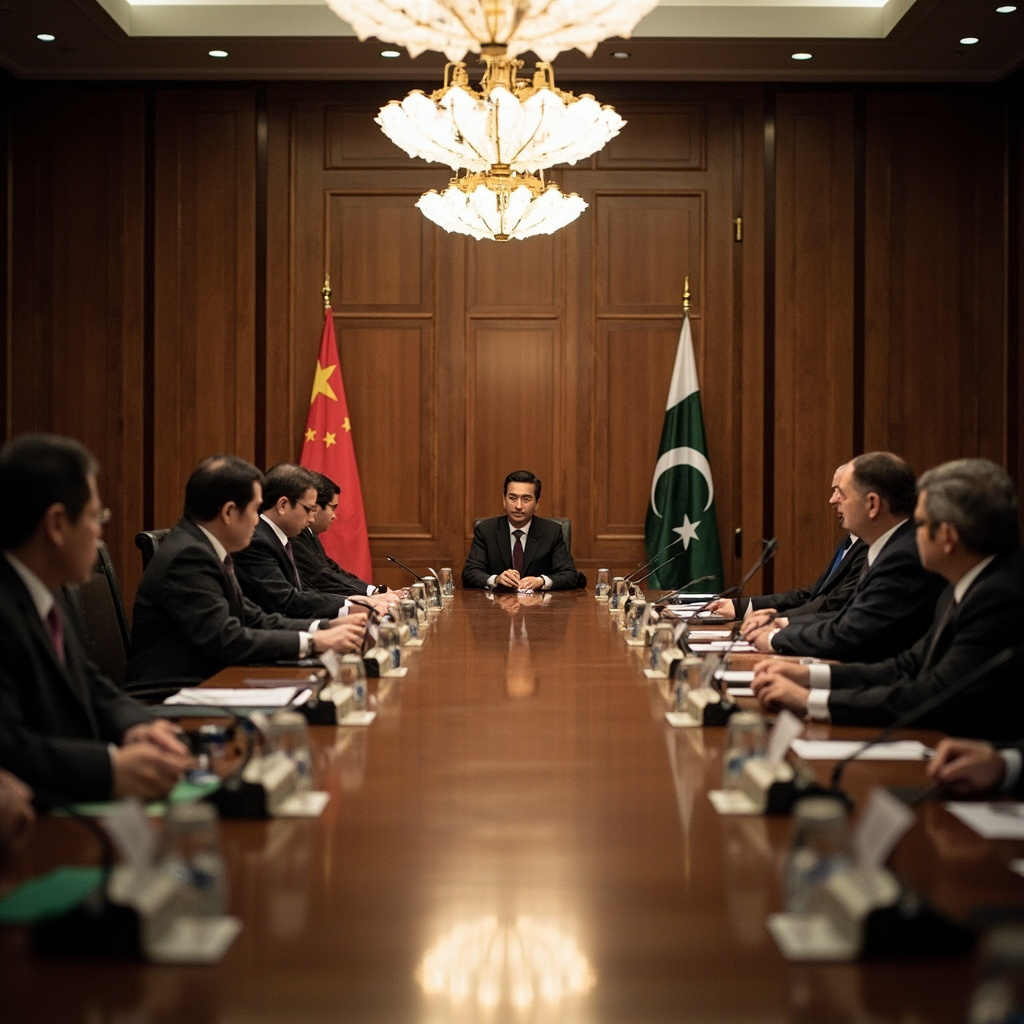
China and Pakistan published a joint five-point initiative on Tuesday calling for an immediate ceasefire in the US-Israeli war on Iran, the rapid launch of peace talks, a halt to attacks on civilian and critical infrastructure, the restoration of normal navigation through the Strait of Hormuz, and a commitment to the primacy of the United Nations Charter. [1] The plan was announced after Pakistan's foreign minister, Ishaq Dar, flew to Beijing for talks with Chinese Foreign Minister Wang Yi. [2]
The five points are deliberately simple. They make no demands on Iran's nuclear program. They assign no blame. They do not address the war's origins or its stated aims. They are, in diplomatic terms, a framework for stopping the shooting first and negotiating everything else later. [3]
The question — and it is the only question that matters — is whether this is real mediation or strategic positioning. China's interest in ending the war is genuine and immediate: Beijing imports approximately 45 to 50 percent of its crude oil from the Gulf, and the Strait of Hormuz closure has disrupted supply chains that Chinese manufacturing depends on. [4] Pakistan's interest is geographic — it shares a 959-kilometer border with Iran and has been managing refugee flows since the bombing began.
But the plan also functions as something else: a demonstration that the international order has alternatives to Washington. China is proposing peace for a war the United States started. The contrast is not subtle. The Chinese Ministry of Foreign Affairs statement accompanying the plan described it as reflecting "the common aspiration of the international community for peace and stability." [5] The subtext: the United States represents war; we represent its end.
Turkey, Egypt, and Saudi Arabia have expressed interest in the framework. [6] Saudi Crown Prince Mohammed bin Salman, whose kingdom has navigated the war with studied neutrality, reportedly discussed the plan with Wang Yi by phone on Wednesday. Turkey's foreign ministry issued a statement supporting "all diplomatic efforts toward an immediate ceasefire." Egypt, which controls the Suez Canal — the other maritime chokepoint affected by the war — has signaled willingness to host talks.
The emerging mediator coalition — China, Pakistan, Turkey, Egypt, Saudi Arabia — represents an alternative power center that excludes both the United States and Russia. It is non-Western, non-aligned, and economically motivated. If it produces a ceasefire, Beijing's diplomatic credibility surges at precisely the moment Washington's is collapsing under the weight of eight contradictory war aims and a NATO alliance in open revolt.
Pakistan's role is the most interesting. Islamabad has historically balanced between Washington and Beijing, serving as a conduit for both. In this conflict, Pakistan's proximity to Iran and its relationships with both belligerents make it the natural intermediary. Foreign Minister Dar's Beijing visit was the second in two weeks, suggesting the diplomatic track is moving faster than the public statements indicate. [2]
The plan's weakest point is also its most deliberate: it says nothing about nuclear weapons. Trump's stated casus belli was preventing a nuclear Iran. Any ceasefire framework that ignores the nuclear question cannot address the war's origin. China knows this. The omission is intentional — it keeps the framework simple enough to be accepted, leaving the hardest question for later.
Whether later ever comes depends on whether the shooting stops first. The five points are an offer. It remains to be seen if anyone in Washington is listening.
-- DAVID CHEN, Beijing