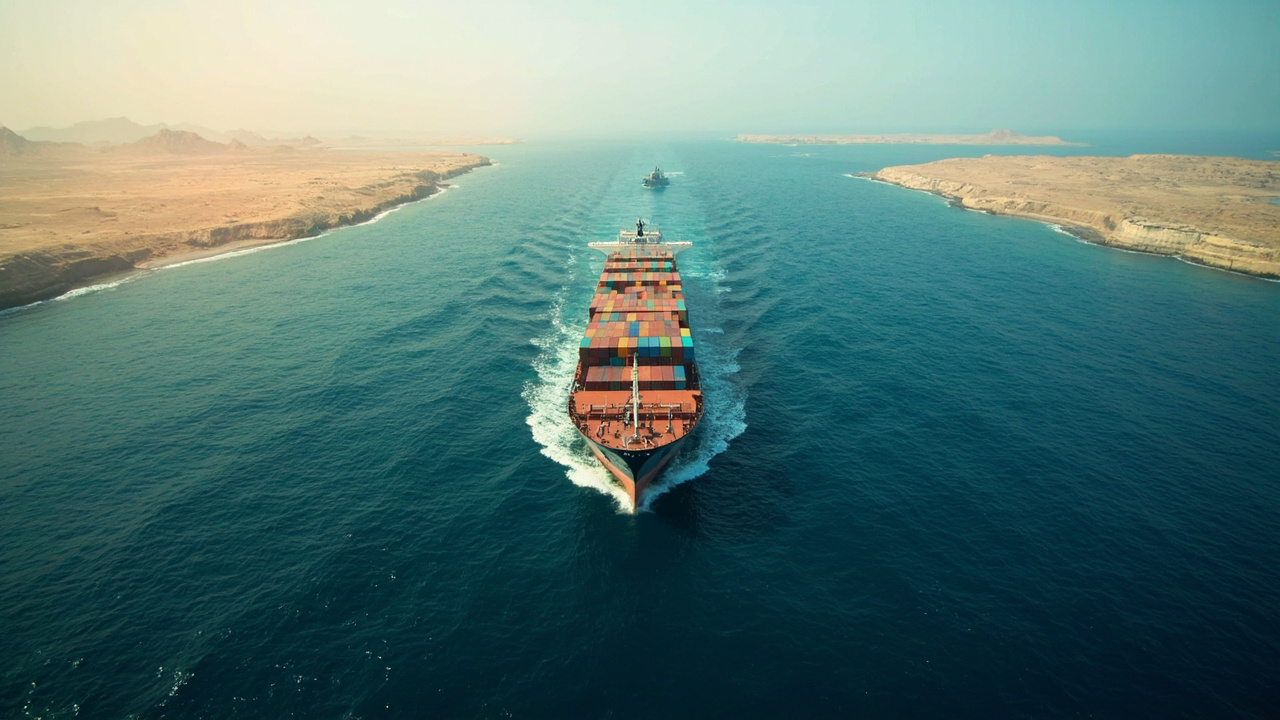
The CMA CGM Kribi, a Malta-flagged container ship owned by France's CMA CGM -- the world's third-largest container shipping line -- crossed the Strait of Hormuz on April 2 [1]. MarineTraffic data confirmed the transit. It was the first vessel tied to Western Europe to make the crossing since the war began thirty-seven days ago [2]. The ship paid for passage. It paid in Chinese yuan.
The price, according to an Iranian lawmaker cited by the Independent, was two million dollars per journey [3]. The currency was not negotiable. Ships transiting Iran's toll system pay in "Chinese yuan or stablecoins," after undergoing a vetting process that screens for links to the United States, Israel, or other states Iran classifies as hostile [3]. Upon successful payment, vessels receive a secret passcode they broadcast on approach, summoning an IRGC patrol boat to escort them through a narrow channel north of Larak Island -- away from the normal shipping route, through a corridor Iran monitors, taxes, and can close at will [3].
As this paper reported Friday, Iran's announcement that it would authorize passage for "essential goods" to its own ports was not a concession. It was the formalization of a licensing regime that replaces international maritime law with bilateral Iranian deal-making. The Kribi transit proves the system works for third parties. The blockade is no longer a blockade. It is a toll booth denominated in the currency of America's strategic rival.
Bloomberg reported on April 1 that Iran's National Security Committee had approved a bill to impose formal fees on Strait of Hormuz transit [4]. The bill arrived after the system was already operational -- legislation ratifying reality, not creating it. The toll structure uses a five-tier grading system, ranking nations from one to five based on their perceived friendliness to Iran [3]. Friendlier countries receive better rates. The base fee starts at one dollar per barrel of oil aboard [3]. For a supertanker carrying two million barrels, the math is self-explanatory.
The IRGC's operational control is the story's spine. USNI News reported on March 27 that the IRGC had opened tolled passage for merchant ships, describing the system as a mechanism for Iran to exert additional control beyond its military capabilities [5]. Ships queue near Larak Island awaiting clearance. Some have been turned back. Three Omani vessels recently transited the strait without using the IRGC tollbooth -- the first traceable ships to bypass the system since March 15, according to USNI's follow-up reporting on April 3 [5]. The Omani exception may reflect geographic privilege, diplomatic arrangement, or both. It does not change the structural reality: for everyone else, the IRGC decides who passes.
The traffic reduction is staggering. The toll system has cut Hormuz transit by approximately 90 percent [3]. Before the war, roughly 21 million barrels of oil per day and a quarter of the world's liquefied natural gas moved through the strait. The selective reopening has restored a trickle -- a trickle that pays. If the two-million-dollar fee holds and Iran processes even a fraction of pre-war traffic, the strait becomes a revenue engine. One hundred thirty-eight ships per day at two million dollars each would generate $276 million daily [4]. Iran will not see those volumes. But it does not need to. Even ten ships per day at that rate generates more revenue than most sanctions-era workarounds.
The yuan dimension is the geopolitical accelerant. The Strait of Hormuz has been a dollar-denominated chokepoint since the petrodollar system was established in the 1970s. Oil priced in dollars, shipped through American-secured waters, insured by London and New York underwriters -- that was the architecture. Iran has replaced every element. The oil moves on Iranian terms. The payment is in yuan. The insurance is either Chinese or nonexistent. The security is provided by the same IRGC that closed the strait in the first place. For Beijing, the arrangement is a live demonstration that global trade can function without American financial infrastructure. For Washington, it is a precedent that may prove harder to reverse than the war itself.
A French shipping company -- from a NATO member state whose aircraft carrier participated in early coalition operations -- paid the toll. CMA CGM did not issue a public statement. The company's vessels had been trapped in the Gulf since the blockade began. The commercial logic is straightforward: paying two million dollars to move a cargo worth hundreds of millions is not capitulation. It is accounting. But the geopolitical logic is less comfortable. Every European vessel that pays the toll validates the system. Every yuan transaction that clears strengthens the precedent. The blockade was a military action. The toll booth is an institution.
The ceasefire, whenever it comes, will not automatically dismantle what Iran has built. A toll system with paying customers, an IRGC escort infrastructure, a yuan-denominated payment rail, and a grading system that rewards diplomatic alignment -- these are not wartime improvisations. They are the architecture of a permanent chokepoint economy. The question is no longer whether Iran can close the strait. It is whether Iran will choose to reopen it when the war ends, or whether the toll booth outlasts the conflict that created it.
-- DARA OSEI, London