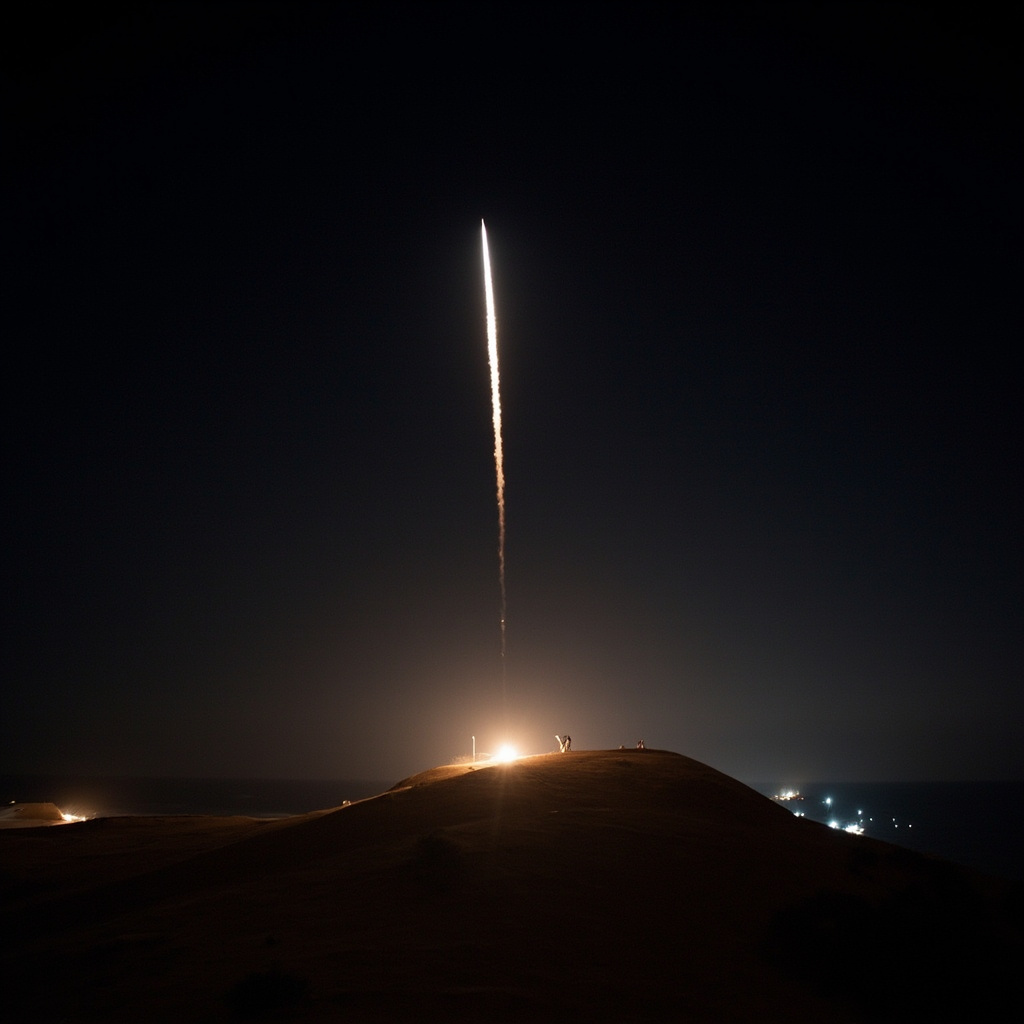
The first ballistic missile launched from Yemeni territory toward Israel in the current war crossed 1,800 kilometers of airspace on Saturday morning and triggered air raid sirens in the southern city of Beersheba. Israeli defense systems engaged. The military reported no casualties and no confirmed impact. Seven hours later, a second wave arrived -- cruise missiles and armed drones on a coordinated trajectory toward the Negev. Israel said it intercepted every projectile. The Houthis said this was only the beginning. [1] [2]
Two days earlier, this paper argued that the deadline that keeps moving is no longer a deadline -- that the administration's second extension of the Iran strike pause had drained the mechanism of meaning. The Houthi entry into the war is what happens when a deadline signals indecision instead of restraint. A pause that compels nothing invites everything.
The Houthi attacks were not improvised. Ansar Allah military spokesman Yahya Saree issued a public warning on Thursday, March 26, stating that any expansion of strikes against Iranian territory would trigger a Yemeni response. On Friday, March 27, Israel struck the Arak heavy-water plant and the Yazd yellowcake facility -- the first Israeli strikes on Iranian nuclear infrastructure since the war began. The Houthi timeline was cause and effect. Saree confirmed the attacks on Saturday afternoon, claiming that Yemeni forces had launched "a ballistic missile of the Palestine-3 type" toward Beersheba and a follow-up salvo of cruise missiles and drones. [1] [3]
The operational significance is not the damage. It is the geometry. The war that began as a bilateral American-Israeli air campaign against Iranian infrastructure is now a multi-axis conflict. Iran retaliates against Israel and Gulf-based American forces. The Houthis strike Israel from the south. The Lebanese front -- frozen since the ceasefire -- creaks under the weight of an ambassador expulsion deadline that arrived Sunday with no visible enforcement. Each front has its own actors, its own escalation logic, and its own capacity to spiral independently of the others.
The Houthis possess a missile and drone arsenal that American and Saudi intelligence agencies have tracked for years. During the 2024-2025 Red Sea campaign, Ansar Allah demonstrated the ability to strike commercial shipping, launch ballistic missiles at ranges exceeding 2,000 kilometers, and sustain operations under persistent aerial bombardment. The Trump administration's May 2025 ceasefire with the Houthis ended the Red Sea attacks but did not require the disarmament of the Houthi missile program. That ceasefire, Saree emphasized on Saturday, remains intact. "Our operations target the Zionist entity," he said. "The agreement with Washington is a separate matter." [2] [4]
The legal architecture is incoherent. The United States is fighting alongside Israel against Iran. The Houthis are attacking Israel in solidarity with Iran. Both the Houthis and the United States maintain that their bilateral ceasefire -- the one that halted attacks on American naval vessels and Red Sea shipping -- still holds. The ceasefire was designed for a different war. It did not contemplate a scenario in which the Houthis attack America's primary military partner while America is actively engaged in combat operations. The Trump administration has not commented on whether the Houthi-Israel attacks constitute a violation of the May 2025 agreement.
Israel's military response will determine whether this front escalates or stabilizes. During the 2024 Red Sea campaign, Israel conducted limited strikes on Houthi-controlled territory in Yemen, targeting the port of Hodeidah and military infrastructure near Sanaa. The IDF has not announced retaliatory strikes following Saturday's attacks, but Israeli Defense Minister Yoav Gallant issued a statement warning that "any force that joins this war against Israel will face the full consequences of that decision." Chatham House published an analysis on Saturday asking what the Houthi entry means for the war's trajectory, noting that Israel's military is now operationally stretched across four distinct theaters: the Iranian mainland, the northern border with Lebanon, the southern border with Gaza, and the Houthi missile threat from Yemen. [5] [6]
The Red Sea dimension complicates everything. The European maritime mission ASPIDES warned on Saturday that Houthi attacks on commercial shipping could resume. Insurance premiums for Red Sea transit, which had fallen after the May 2025 ceasefire, climbed 15 percent in overnight trading. The Houthis' stated position -- attacking Israel but not American assets -- creates a distinction that maritime insurers do not recognize. A missile launched from Yemen does not announce its intended target to a container ship transiting the Bab el-Mandeb. [7]
The Trump administration extended the Iran strike pause to April 6 on Friday, the second time the deadline has been pushed back. The first pause was five days. The second is ten. The Houthis attacked on the first day of the new extension. The pattern is now unmistakable: the pause does not produce restraint. It produces the conditions under which new actors calculate that they can enter the war without facing immediate American retaliation. The deadline mechanism that was supposed to create space for diplomacy has instead created space for escalation.
Iran has not commented publicly on the Houthi attacks. Araghchi, who delivered Tehran's five-point counter-proposal on March 25, has not spoken since Wednesday. The silence suggests either coordination -- Tehran directed the Houthis to open a second front as leverage -- or autonomy, the Houthis acting on their own timeline for their own reasons. American intelligence agencies have long debated the degree of Iranian command-and-control over Houthi operations. The 2024-2025 Red Sea campaign demonstrated that while Iran provides weapons, training, and strategic guidance, the Houthis retain operational independence. Saturday's attacks may have been approved by Tehran or merely tolerated. The distinction matters for escalation management. It does not matter for the families in Beersheba who heard the sirens.
The second wave on Saturday afternoon was more tactically complex than the first. The morning launch was a single ballistic missile on a high-arc trajectory -- fast, detectable, and within the performance envelope of Israel's Arrow and David's Sling systems. The afternoon salvo combined slower cruise missiles with armed drones on staggered approach vectors, a technique the Houthis refined during the Red Sea campaign to saturate air defenses. Israel reported intercepting all inbound projectiles, but the pattern suggests the Houthis are testing, not committing. The first wave established range. The second wave tested layered attack methodology. A third wave, if it comes, may be designed to overwhelm. [1] [7]
The economic dimension compounds the military one. The European Union Naval Force's Operation ASPIDES, which patrols the southern Red Sea and the Bab el-Mandeb strait, issued a warning on Saturday evening that Houthi attacks on commercial shipping could resume. Maritime insurance premiums for Red Sea transit climbed 15 percent in overnight trading on Saturday. The Houthi-Israel ceasefire of May 2025 ended the Red Sea shipping disruption that had rerouted global trade around the Cape of Good Hope. If that ceasefire unravels -- and Saree's distinction between attacking Israel and attacking American shipping is thinner than either side acknowledges -- the war gains a maritime dimension that directly affects European and Asian supply chains. The Strait of Hormuz is already functionally closed. A renewed Red Sea blockade would close the alternate route. [7]
The timeline of the war's expansion tracks the timeline of the pause's failure. March 1: American strikes begin. March 22: first five-day pause announced. March 27: pause extended to April 6, Israel strikes nuclear facilities. March 28: Houthis enter the war. Each step in the pause mechanism has coincided with, not prevented, an escalation. The mechanism is not failing to contain the war. The mechanism is providing cover for the war's expansion, because each extension creates a news cycle about diplomacy that obscures the operational reality of what is happening on the ground, in the water, and in the air.
The war is twenty-nine days old. It began with American strikes on Iranian power plants and a stated aim of "disabling Iran's nuclear capacity." It now involves direct attacks on Israeli cities from a country the United States is theoretically at peace with, using missiles that traversed airspace patrolled by American naval and air assets. The borders of this war are not lines on a map. They are whatever the next actor decides to test.
-- YOSEF STERN, Jerusalem