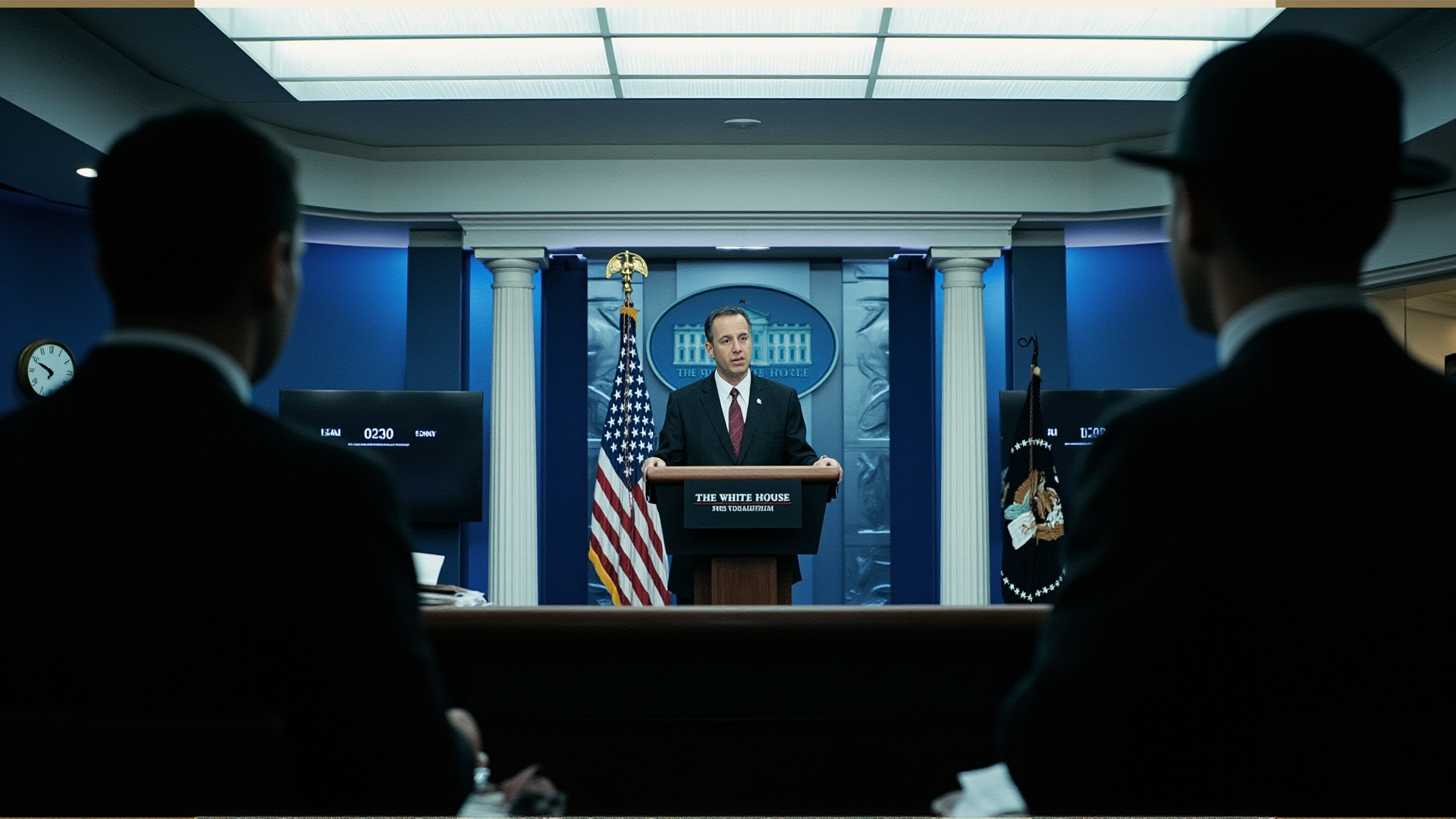
President Trump extended the Iran strike pause to April 6 on Friday morning, the second time he has pushed back a deadline he set himself. The first pause was five days. This one is ten. The market responded to the announcement by selling off — stocks fell, oil dipped, and Treasury yields climbed — a reaction that would make no sense if anyone still believed the deadline meant what deadlines are supposed to mean. [1]
Yesterday, Israel killed the man who closed the Strait — IRGC Naval Commander Alireza Tangsiri, the architect of the Hormuz blockade, the $2 million toll, and the 95 percent shipping collapse. The day before that, Iran named its price and it read like a capitulation demand: five conditions so sweeping they amounted to a declaration that America must accept defeat before the guns go silent. March 27 was supposed to be the day all of this came to a head — the pause expiring, 5,000 Marines arriving, the blockade's commander freshly dead, and Iran's counter-proposal unanswered on the table.
Instead, the president extended the deadline. Again.
The pattern is now more informative than any single event within it. On March 22, Trump announced a five-day pause on strikes against Iranian power plants, framing it as a gesture of restraint while diplomatic channels worked. The State Department described the pause as "creating space for productive engagement." Five days later, with no productive engagement to show for it, the pause was renewed — not for five more days but for ten, pushing the deadline to April 6. The original five-day window has now been extended by a factor of three, and the stated purpose of the pause — diplomacy — has produced nothing but Iran's counter-proposal, which Washington has not formally answered. [1] [2]
The market noticed. The S&P 500 fell 1.2 percent on Friday morning. Brent crude, which had bounced back above $100 after the paper corrected its position on Wednesday, dipped to $101.40. Gold climbed. The reaction is counterintuitive only if you believe the extension is de-escalation. If you believe the extension is a signal that the administration has no plan, the market reaction is entirely rational. [3]
What makes this particular extension significant is not its length but what it reveals about the mechanism itself. A deadline is a tool for compelling action. It works precisely because it expires. When it is extended once, it becomes a softer deadline. When it is extended twice, it becomes a suggestion. The administration's own rhetoric has tracked this decay. On March 22, Trump said the pause would give Iran "one last chance to come to the table." On March 27, the White House said the extension reflected "ongoing assessment of the evolving diplomatic landscape." The language degraded from ultimatum to bureaucratic weather report. [1] [2]
Thomas Schelling won a Nobel Prize for explaining why this decay is fatal rather than merely embarrassing. Commitment works by binding the committer: a public deadline is a hostage you hand your adversary, valuable only while you cannot afford to back down from it. Extend it once and the adversary learns your hostage is inflatable. Iran has now watched two extensions in five days, which means Tehran's strategists can model the third one — and every unit of American force that arrived during the pause, from Marines to paratroopers, reads in Tehran as proof that time favors Washington's positioning rather than its diplomacy.
Wall Street has already given the pattern a ticker. Trading floors spent 2025 coining the TACO trade — Trump Always Chickens Out — after successive tariff deadlines dissolved under their own announcement pressure; the phrase migrated into war coverage within days of the first extension. [3] The trade is rational at each step and corrosive in aggregate: buy the dip on every ultimatum, sell the rearmament, collect the volatility premium on a president whose threats have become a mean-reverting asset class. A financial market pricing your foreign policy as theater is not taking a side. It is declining to take your word.
The military reality underneath the diplomatic theater has not paused at all. The 31st Marine Expeditionary Unit aboard the USS Tripoli arrived in the Gulf on Friday morning, joining the 11th MEU that advanced from its Pacific deployment earlier in the week. Combined with the 82nd Airborne Division, which received written deployment orders on March 25, the total incoming ground-capable force now approaches 8,000 — none of them authorized by Congress. The troops keep arriving. The deadline keeps moving. The two facts are not in tension; they are the same policy viewed from different angles. [4] [5]
Iran has not responded to the extension. Araghchi, who delivered the five-point counter-proposal on Tuesday, has not spoken publicly since Wednesday. The silence may be strategic — why respond to a deadline your adversary has already demonstrated he will not enforce? — or it may reflect internal calculations that have nothing to do with American timetables. Tangsiri's death has left a command vacuum in the IRGC Navy, and the question of who controls the Hormuz blockade infrastructure is not a question Washington can answer by extending pauses. [6]
The five-point counter-proposal remains unanswered on the table. Its terms — halt all aggression, pay reparations, recognize Hormuz sovereignty, end Israeli operations in Lebanon, provide binding no-repeat guarantees — were designed to be unacceptable. They were a declaration, not an opening bid. The administration's decision to extend the pause rather than respond to the counter-proposal suggests that Washington has no counter-counter-proposal ready, or that the response being prepared is military rather than diplomatic and the pause is buying time for positioning, not for talks. [2] [6]
The Republican backlash that broke into the open on Thursday has not subsided. Armed Services Committee chairs Mike Rogers and Roger Wicker both said publicly that they were not receiving adequate briefings. Representative Nancy Mace said the justifications presented to the public "were not the same military objectives we were briefed on privately." By Friday afternoon, two additional Republican senators — Lisa Murkowski and Bill Cassidy — had called for public hearings on the war's scope and authorization. The administration's response was the deadline extension, which addresses the political problem (appearing to restrain the war) without addressing the substantive one (the war lacks congressional authorization and the briefings don't match the public statements). [5] [7]
The markets, the military, and the politics now all point in the same direction, and it is not toward resolution. The markets have stopped believing the deadline mechanism. The military continues to deploy as if the deadline does not exist. The congressional opposition is expanding because the gap between public statements and private briefings keeps widening. And Iran has no reason to respond to a deadline it correctly perceives as decorative.
This paper has tracked the war's stated aims shifting at least four times. On March 22, the aim was "disabling Iran's nuclear capacity." By March 24, it had become "restoring stability in the Gulf." By March 26, Secretary Bessent told Bloomberg the goal was "a comprehensive settlement that addresses the full range of Iranian destabilizing activities." Each formulation is broader than the last. Each makes the conditions for ending the war more demanding. And now the deadline that was supposed to create urgency for achieving those conditions has been extended for the second time, by a president who has set no new conditions for its expiration. [1] [2]
April 6 is ten days away. The Marines are in the Gulf. Tangsiri is dead but the blockade is running. Iran's counter-proposal sits unanswered. Congress is asking questions the administration won't answer. And the deadline — if that is still the right word for it — keeps moving.
The mechanism is the message. The message is that there is no mechanism.
-- YOSEF STERN, Jerusalem