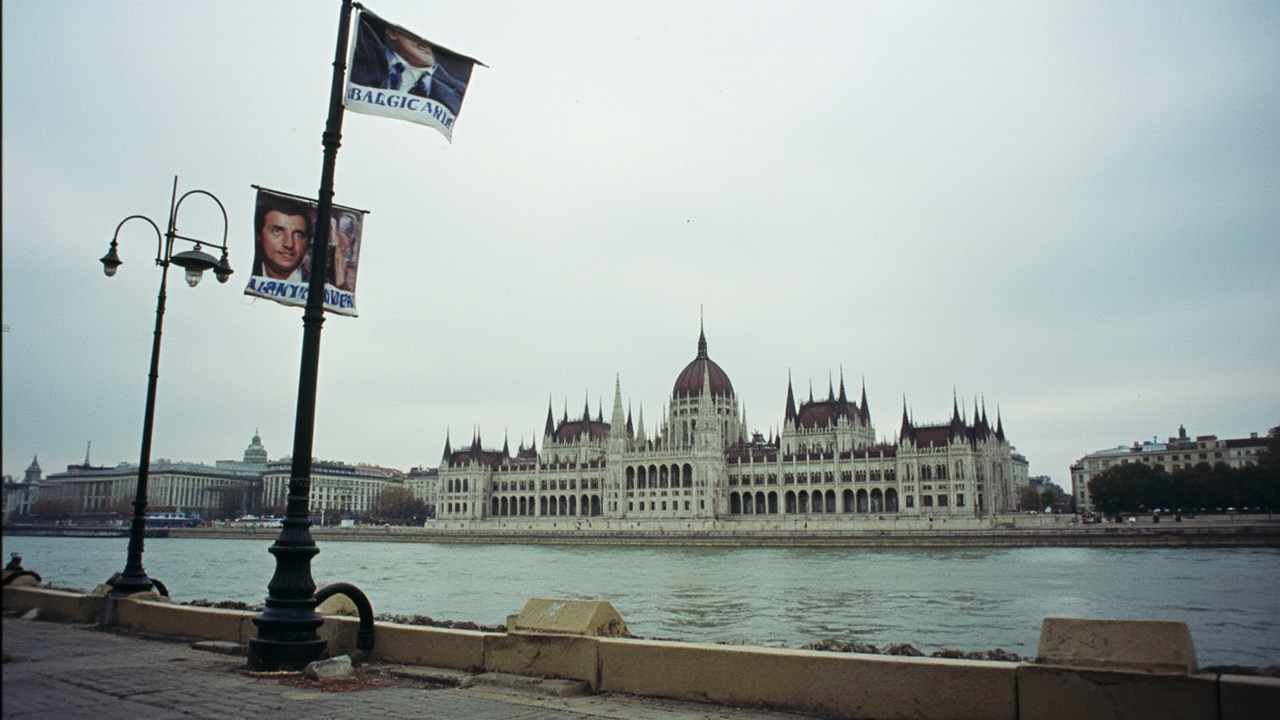
Hungary votes on April 12. Nine days from now, the election that Viktor Orban has won four consecutive times -- by margins that made the contests feel ceremonial -- will be decided, and for the first time since 2010, the outcome is genuinely uncertain. The opposition, led by Peter Magyar and his Tisza party, holds a commanding lead in every credible poll. A Median survey published March 25 put Tisza at 58 percent among decided voters, Fidesz at 35 percent [1]. The gap has held for nearly a year.
The numbers alone would make this the most significant Hungarian election in a generation. What makes it extraordinary is the context: a Washington Post report, published March 21, revealed that Russia's SVR intelligence service proposed "the staging of an assassination attempt on Viktor Orban" as a way to "fundamentally alter the entire paradigm of the election campaign" [2]. The plan, detailed in intelligence documents reviewed by the Post, was designed to generate a sympathy wave that would reverse Fidesz's polling deficit. Whether the operation was carried out, attempted, or merely proposed remains contested. That it was proposed at all tells you how Moscow rates Orban's chances without help.
Orban has been the European Union's most reliable internal obstacle for sixteen years. He vetoed Ukraine aid packages, blocked EU sanctions against Russia, maintained energy ties with Moscow when the rest of Europe was cutting them, and used his seat at the European Council table to slow, dilute, or sabotage collective action on virtually every issue that required unanimity. His removal from power would not fix the EU's structural problems -- those run deeper than one prime minister -- but it would remove the single most predictable veto in Brussels.
Peter Magyar is not a revolutionary. He is a former Fidesz insider -- a lawyer who served in Orban's government and married into its orbit before breaking publicly in early 2024 [3]. His party, Tisza, is center-right, pro-European, and pragmatic. Magyar has pledged to restore judicial independence, rejoin the European Public Prosecutor's Office, and end Hungary's pattern of blocking EU foreign policy consensus. Bloomberg reported that he has vowed to oust Orban's key allies from state institutions if elected [4]. The appeal is not ideological radicalism. It is competence and normalcy after sixteen years of personalist rule.
The obstacles to a clean transfer of power are substantial. The BBC reported in February that Fidesz operatives have been conducting systematic voter intimidation in rural districts, where the party's network of local mayors, employers, and public works administrators creates dependency relationships that make dissent costly [5]. Politico EU documented rising tensions in Budapest, including confrontations between Magyar supporters and pro-government media crews, and noted that Hungary's election commission has been criticized by OSCE monitors for insufficient independence [6].
The electoral system itself favors Fidesz. Hungary's mixed system -- 106 single-member districts decided by plurality, plus 93 list seats allocated proportionally -- was redesigned by Orban's government in 2011 to amplify the advantage of the largest party. In 2022, Fidesz won a two-thirds supermajority with 54 percent of the vote. Magyar needs not merely a plurality but a decisive one to overcome the structural tilt [7].
The CSIS analysis of the election, published in late March, identified three scenarios: a narrow Magyar victory that produces a fragile coalition, a decisive Magyar victory that enables genuine reform, and an Orban comeback powered by rural mobilization and institutional advantages [7]. The Russia factor complicates all three. If Magyar wins and the assassination plot becomes a dominant post-election narrative, Orban will have a readymade delegitimization story. If Orban wins narrowly, the plot's exposure will feed opposition claims of foreign interference.
What makes the Hungarian election matter beyond Budapest is its implications for the EU's decision-making architecture. The European Council operates by unanimity on foreign policy and treaty changes. A single member state can block action. Orban has used this power with surgical precision -- not to advance Hungarian interests, which are modest, but to maintain leverage with Moscow and extract concessions from Brussels. Reuters reported that EU diplomats have described the April 12 election as "the most consequential vote for European foreign policy since Brexit" [8].
Nine days is not long. It is long enough for a staged assassination attempt, a voter intimidation campaign to intensify, or a polling lead to evaporate. It is also long enough for sixteen years of consolidated power to end.
Hannah Arendt wrote that the most dangerous moment for a bad government is when it starts to reform. Orban is not reforming. He is fighting. The question is whether the fight has come too late, or whether the architecture he built -- the courts, the media, the election commission, the Russian intelligence relationship -- is strong enough to survive a 23-point polling deficit.
The answer arrives April 12.
-- Anna Weber, Berlin