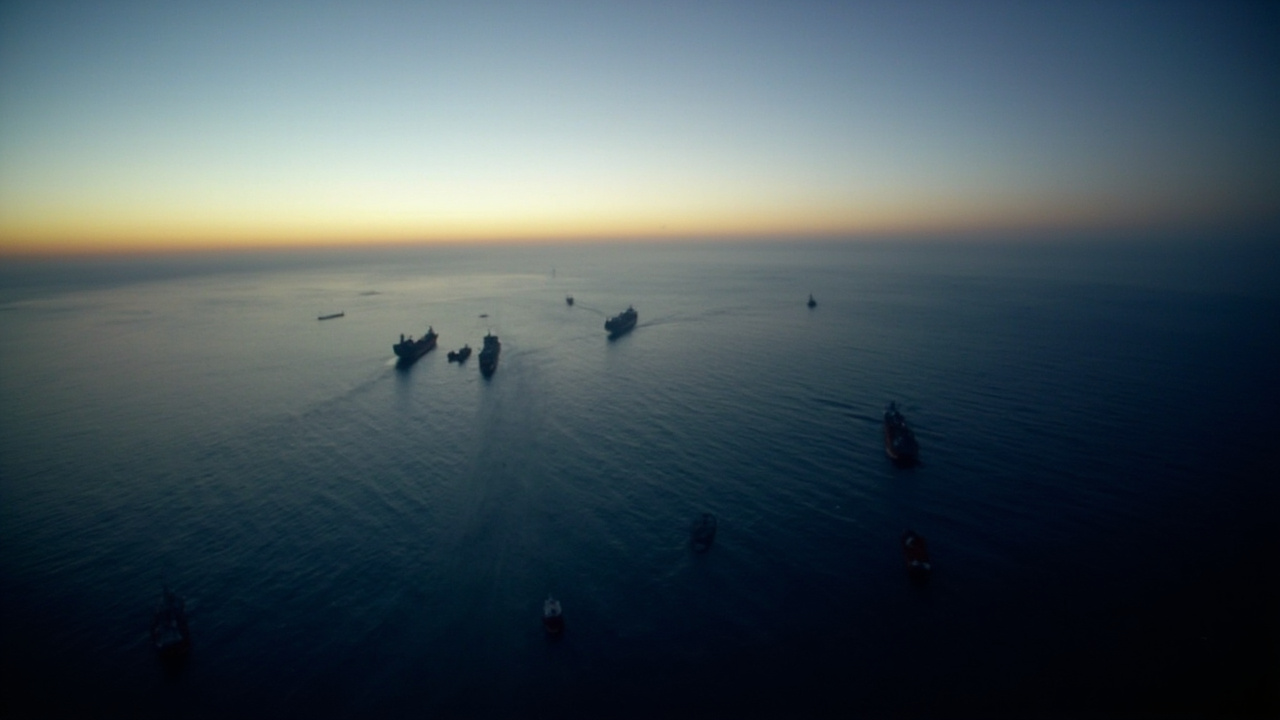
At 7:12 a.m. Eastern on Monday, March 23, Donald Trump posted a statement on Truth Social — in his customary all-capitals — that contained, beneath the bluster, the most significant concession of the twenty-four-day war.
"I AM PLEASED TO REPORT THAT THE UNITED STATES OF AMERICA, AND THE COUNTRY OF IRAN, HAVE HAD, OVER THE LAST TWO DAYS, VERY GOOD AND PRODUCTIVE CONVERSATIONS REGARDING A COMPLETE AND TOTAL RESOLUTION OF OUR HOSTILITIES IN THE MIDDLE EAST."
Then the operative sentence: "I HAVE INSTRUCTED THE DEPARTMENT OF WAR TO POSTPONE ANY AND ALL MILITARY STRIKES AGAINST IRANIAN POWER PLANTS AND ENERGY INFRASTRUCTURE FOR A FIVE DAY PERIOD, SUBJECT TO THE SUCCESS OF THE ONGOING MEETINGS AND DISCUSSIONS."
Forty hours earlier, the same man had promised to obliterate those power plants. Forty hours later, he was postponing the obliteration in language — "good and productive conversations" — that diplomats use when they are trying to avoid admitting that nothing has been agreed.
This paper has tracked the war's economic contradictions since the Treasury Department licensed purchases of Iranian crude to prevent a total oil market collapse, a policy capitulation that revealed Washington was simultaneously waging war on Iran and depending on Iran's oil to survive it. Monday's reversal belongs on the same shelf. The man who threatened obliteration now asks for five more days. The question is what changed between Saturday night and Monday morning — and the answer, visible to anyone watching Tehran's response, is that Iran called the bluff.
Saturday: The Ultimatum
At 7:44 p.m. Eastern on Saturday, March 21, Trump posted a 274-word statement on Truth Social that contained, buried in the sixth sentence, the most dangerous deadline of the conflict. "If Iran doesn't FULLY OPEN, WITHOUT THREAT, the Strait of Hormuz, within 48 HOURS from this exact point in time," he wrote, "the United States of America will hit and obliterate their various POWER PLANTS, STARTING WITH THE BIGGEST ONE FIRST!" The post, which also praised the "incredible work" of the USS Dwight D. Eisenhower carrier strike group, was shared 1.2 million times within four hours [1].
The specificity mattered. Iran's electricity grid serves 88 million people. The country operates approximately 85 gigawatts of installed capacity across roughly 500 power stations. Natural gas accounts for about 73 percent of generation. The Bushehr nuclear power plant, which Trump's statement implicitly threatened — "STARTING WITH THE BIGGEST ONE FIRST" — produces approximately 1,000 megawatts and is operated with Russian technical assistance. Striking it would raise questions under the Nuclear Non-Proliferation Treaty and risk a diplomatic rupture with Moscow that the administration has spent months avoiding [2].
UN Ambassador Mike Waltz, appearing on Fox News Sunday, was asked directly whether Bushehr was included in the target set. "Every Iranian power plant is a legitimate target," Waltz said. "When a regime uses its national infrastructure to sustain a war machine that has closed the most important shipping lane on earth, that infrastructure becomes military." He paused, then added: "We're not going to carve out exceptions because the Russians helped build one of them" [1].
This was the language of total war applied to civilian infrastructure — and it was posted on social media at a time when, according to two administration officials who spoke to the New York Times, Secretary of State Rubio was at dinner and learned of the deadline from his phone [1].
Sunday: The Counter-Threat
Iran's response arrived in three stages over 14 hours on Sunday, and each stage was more dangerous than the last.
First, at 8:15 a.m. Tehran time (11:45 p.m. Saturday Eastern), Supreme Leader Ayatollah Ali Khamenei's office released a one-sentence statement: "The Islamic Republic does not negotiate under threats from a declining power." No elaboration. No spokesman. Just the sentence, posted to Khamenei's official Telegram channel [3].
Second, at 2:30 p.m. Tehran time, Brigadier General Ebrahim Zolfaghari, the chief spokesman for Iran's Armed Forces General Staff, walked to a microphone at a Tehran press conference and delivered a counter-threat of such specificity that it sent Brent crude futures above $113 when Asian markets opened. "If a single American munition touches a single Iranian power plant," Zolfaghari said, "the Strait of Hormuz will be completely closed — not partially, not symbolically, completely. And we will extend our strikes to the desalination plants and energy infrastructure of any Gulf state that provided basing, overflight, or logistics to the American attack." He named no country. He did not need to. The United Arab Emirates, Bahrain, Qatar, and Saudi Arabia all host American military assets [3].
He spoke for 22 minutes. He used the phrase "completely closed" four times. He specified that Iran's anti-ship missile batteries along the Hormuz coastline had been "repositioned and reinforced in the last 72 hours." He said the naval mines laid in the strait's shipping channels since Week One of the conflict had been supplemented with "additional layers." And then, on Monday morning, Iran's Defence Council added a postscript: any attack on Iran's southern coast or islands would prompt the laying of sea mines that would sever not just the Strait of Hormuz but the entire Persian Gulf. "This time, along with the Strait of Hormuz, the entire Persian Gulf will be practically blocked," the council said, "and the responsibility for it will lie with the threatening party" [4].
Third, at 6:00 p.m. Tehran time on Sunday, Parliament Speaker Mohammad Bagher Ghalibaf opened an entirely new front — a financial one. "Alongside military bases," he posted on X, "those financial entities that finance the US military budget are legitimate targets. US treasury bonds are soaked in Iranians' blood. Purchase them, and you purchase a strike on your HQ and assets. We monitor your portfolios. This is your final notice" [5]. The bond threat rattled markets and merits its own analysis. But its timing — six hours after Zolfaghari's military threat — suggested a coordinated escalation ladder designed to present Washington with the full cost of following through.
The message from Tehran was unambiguous: Strike one power plant and you lose Hormuz entirely. Lose Hormuz and 16 million barrels per day of crude disappear from global markets. Lose the crude and the desalination plants that keep 10 million people alive in the UAE, Qatar, Kuwait, and Bahrain become targets. The cost of the ultimatum was not proportionate. It was existential.
Monday Morning: The Blink
Somewhere between Sunday night and Monday morning, someone did the arithmetic.
Trump's Truth Social post did not acknowledge the counter-threats. It did not mention Zolfaghari by name, or Ghalibaf's bond market threat, or the Defence Council's promise to mine the entire Persian Gulf. It mentioned only "very good and productive conversations" — a phrase so diplomatic, so carefully emptied of specifics, that it could have been drafted by the Swiss embassy in Tehran, which has served as the protecting power for American interests in Iran since 1980.
What "conversations"? With whom? Through which channel? Iran's semi-official Fars news agency, within hours of Trump's post, carried comments from an unnamed source denying any negotiations. Tehran had received messages via mediators, the source said, but "there is not any negotiation underway" [4]. Iran's top diplomat, Abbas Araghchi, denied any direct talks with the U.S. just over a week ago in an interview with CBS News. Al Jazeera's Mohamed Vall, reporting from Tehran, offered the most telling assessment: "The likelihood that they will refuse this offer from Trump is remote. The Iranians do not want to continue this war — they say it was imposed on them and the region" [4].
Read that carefully. The Iranians will accept the pause — but they are not the ones who requested it.
The markets understood immediately. Brent crude, which had opened Monday at approximately $113 a barrel on the back of Zolfaghari's complete-closure promise, dropped below $100 within minutes of Trump's post [4]. The International Energy Agency's executive director, Fatih Birol, speaking in Australia on Monday, warned that the situation is "very severe" and that the current energy crisis is worse than both oil shocks of the 1970s combined [6]. The five-day pause does not resolve the crisis. It delays the reckoning. Oil dropped because traders bet that the delay means Trump will not strike the power grid. They may be right. That is exactly what makes the pause significant.
What the Pause Reveals
The mechanics of credibility work like this: a threat is only as powerful as the belief that it will be carried out. On Saturday night, the most powerful country on earth told Iran it had 48 hours before its power grid was destroyed. By Monday morning, the same country had extended the deadline by five days and was praising the tenor of unspecified conversations.
This paper noted in its previous edition that the war's every exit ramp has led to deeper commitment. The Hormuz blockade escalated to sanctions waivers. The sanctions waivers escalated to ground invasion planning for Kharg Island. The ground invasion planning escalated to a 48-hour ultimatum on the power grid. Each step was designed to pressure Iran into capitulation. None worked. And now the pattern has broken — not because Iran conceded, but because Trump paused.
The hawks in the administration will not call this a blink. They will call it a strategic pause, a diplomatic opportunity, a show of good faith. Mike Waltz, who told Fox News Sunday that "every Iranian power plant is a legitimate target," has not issued a follow-up statement. Neither has Secretary of Defense Pete Hegseth, who was reportedly presented with "multiple target packages" by Central Command over the weekend [2]. The targets were prepared. The execute order was not transmitted. The gap between preparation and authorization is where the pause lives.
The Desalination Calculation
One reason for the pause is almost certainly Zolfaghari's desalination threat. The United Arab Emirates derives approximately 42 percent of its potable water from desalination. Qatar: approximately 99 percent. Kuwait: approximately 90 percent. Bahrain: approximately 60 percent. These are not resilient systems with deep reserves. They are just-in-time water supplies for populations living in a desert. A sustained attack on desalination infrastructure in the UAE alone could create a drinking water crisis for 10 million people within 72 hours [3].
Iran has the missile inventory to attempt it. The Dezful and Emad ballistic missiles have ranges exceeding 1,000 kilometers — more than sufficient to reach Abu Dhabi, Doha, and Manama from launch sites in southwestern Iran. The Gulf states are not merely America's allies in this conflict; they are America's basing platform. Prince Sultan Air Base in Saudi Arabia, which houses U.S. personnel and aircraft, has already been struck by Iranian ballistic missiles multiple times since the war began on February 28 [4]. Threatening Iran's power grid while your own forward bases and their host nations' water supplies are vulnerable to retaliation is not a strategy. It is a bet that Iran will not follow through. Iran spent Sunday making clear that it would.
The Congressional Vacuum, Still
Congress is not in Washington. The Senate recessed on Thursday. The House recessed on Wednesday. There has been no Authorization for Use of Military Force vote, no War Powers Resolution debate, no formal congressional notification of the target set. Senator Tim Kaine issued a statement from Virginia on Sunday evening: "The President of the United States is about to launch a massive strike on civilian infrastructure in a country we are not formally at war with, based on a social media post, while Congress is on recess. This is not how democracies go to war" [1].
He was correct on the procedural point. But Monday rendered it moot — not because the constitutional objection was answered, but because the strike was postponed. The war is now 24 days old. It has been fought entirely under the president's Article II authority as commander-in-chief. The 1973 War Powers Resolution's 60-day clock has 36 days left. No AUMF has been sought. No AUMF has been offered. The pause does not resolve the legal vacuum. It extends it.
Five Days to What?
The pause expires Friday, March 28, unless extended. Trump's post specified that the postponement is "SUBJECT TO THE SUCCESS OF THE ONGOING MEETINGS AND DISCUSSIONS." The conditionality is deliberate: it allows him to resume the threat without issuing a new ultimatum. It also allows him to extend the pause indefinitely without admitting that the original 48-hour deadline was a bluff.
Admiral Brad Cooper, the commander of U.S. forces in the Middle East, told Iran International on Monday that Iranian air defenses are "no longer firing," that Iran's navy is "no longer at sea," and that its air force is "no longer flying" [4]. If that assessment is accurate, it describes a country that has been degraded militarily but has not been defeated strategically. Iran's conventional military is broken. Its asymmetric leverage — Hormuz, the mines, the missile batteries, the desalination threat — is not.
This is the paradox the pause exposes. The United States can destroy Iran's power grid. It can probably do so in a single night. What it cannot do is destroy the power grid without triggering consequences — complete Hormuz closure, Gulf infrastructure attacks, a global energy catastrophe — that would dwarf the damage it inflicts. The ultimatum assumed Iran would fold. Iran did not fold. Iran counter-threatened with a credible escalation that made the cost of following through higher than the cost of backing down.
That is why Trump paused. Not because of "productive conversations." Not because diplomacy prevailed. Because on Saturday night he bet that Iran would blink, and on Sunday afternoon Iran raised the stakes until the bet was no longer worth making.
The five-day clock is ticking. But the 48-hour clock already told us everything we need to know about who has leverage in this war.
-- YOSEF STERN, Jerusalem