TL;DR
CNN reports MANPADs, mines, and layered defenses on Kharg Island as Gulf allies privately beg Washington not to land.
MSM Perspective
CNN exclusively reports Iran has been laying anti-personnel and anti-armor mines on Kharg shorelines in preparation for a US amphibious assault.
X Perspective
Iranian officials warned on X that any regional country supporting an island seizure would see its infrastructure targeted without restriction.
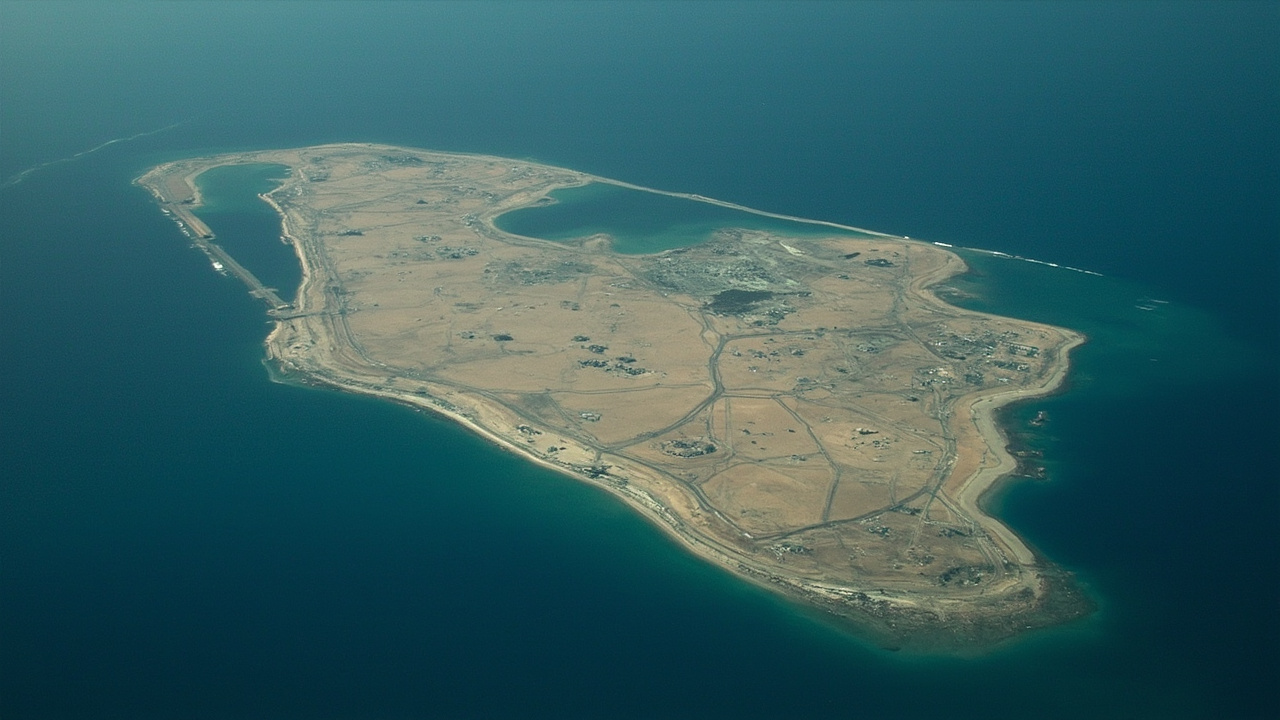
Iran has been laying anti-personnel mines, anti-armor mines, and man-portable air defense systems along the shorelines of Kharg Island in anticipation of an American amphibious assault, CNN reported Tuesday, citing multiple sources familiar with US intelligence [1]. The fortification effort is visible on overhead surveillance imagery that American military planners have been monitoring on a near-constant basis. What the imagery shows is an island being turned into a trap.
This paper has tracked the Kharg Island operation across three editions — from the Pentagon's deliberation over 82nd Airborne deployment, to the order that nobody would call a ground war, to the present moment, in which the question is no longer whether American forces will be sent but whether they will be sent ashore. Iran's answer to that question is now embedded in its beaches. The MANPADs — shoulder-fired surface-to-air missiles capable of downing helicopters and low-flying transport aircraft — are the detail that should concentrate minds at CENTCOM. Anti-personnel mines kill infantrymen. Anti-armor mines disable landing vehicles. MANPADs kill the aircraft that deliver both. Iran has prepared for every phase of an opposed landing.
Kharg Island is roughly a third the size of Manhattan. It sits at the northern end of the Persian Gulf, well away from the Strait of Hormuz, and handles approximately 90 percent of Iran's crude oil exports. On March 13, US forces struck the island in what CENTCOM described as an attack on more than 90 military targets, including "naval mine storage facilities" and "missile storage bunkers" [1]. President Trump said at the time that American forces had avoided the oil infrastructure "for reasons of decency" — a phrase that made the island sound like a military target the US had already conquered rather than one it had only bombed.
It had only bombed. What CNN's reporting makes clear is that the bombing did not pacify the island. It provoked a fortification campaign.
The Three Outcomes
Retired Admiral James Stavridis, former NATO Supreme Allied Commander Europe, told CNN that the Iranians "are clever and ruthless" and "will do everything they can to inflict maximum casualties" on any force that attempts to come ashore [1]. Stavridis's assessment is not speculative. It is a description of the defensive preparations now visible from space. He suggested an alternative: an offshore blockade that would strangle the island's export capacity without putting troops on the beach. "This could be done without actually putting troops ashore," he said [1].
The suggestion delineates three possible outcomes for the Kharg Island operation, each carrying its own escalatory logic.
The first is seizure — an opposed amphibious or airborne landing to physically take the island. Two Marine Expeditionary Units are now in the Gulf, and approximately 1,000 soldiers from the 82nd Airborne Division are expected in theater. That is a force capable of taking a small island. Whether it is a force capable of taking a fortified small island defended by mines, MANPADs, HAWK surface-to-air missiles, Oerlikon anti-aircraft guns, and whatever Iranian Revolutionary Guard Corps personnel remain after the March 13 strikes is a separate question — and the one the Pentagon is, or should be, asking itself.
The second outcome is blockade. Stavridis's proposal. A naval cordon around Kharg that prevents tanker traffic without requiring a single Marine to step onto a mined beach. It is the option that avoids the body bags. It is also the option that does not produce the telegenic victory of an American flag raised over Iran's oil jugular. Whether the current White House is capable of choosing the option that works over the option that photographs well is a question this paper cannot answer but is obligated to raise.
The third is deterrence success — the possibility that the military buildup itself forces Iran to capitulate without a shot fired on the island. The Pentagon briefed Gulf allies that a "large portion" of Iran's ballistic and cruise missile capability has been destroyed [1]. If that assessment is correct, the threat of seizure may be sufficient. If the assessment is optimistic — and Pentagon assessments of enemy degradation have historically tended toward optimism — then the deterrence theory is built on a foundation that Iran's fortification of Kharg suggests Tehran does not share.
The Gulf Says No
The most consequential detail in CNN's reporting is not about Iran. It is about America's allies. Gulf countries have been privately urging Washington against a ground operation on Kharg Island [1]. The reason is not humanitarian concern or legal principle. The reason is Mohammad Bagher Ghalibaf.
Iran's Parliament Speaker posted on X what amounted to a declaration of asymmetric deterrence. "Based on some data, Iran's enemies, with the support of one of the regional countries, are preparing to occupy one of the Iranian islands," Ghalibaf wrote. The next sentence was the one that mattered: "all vital infrastructure of that regional country will, without restriction, become the target of relentless attacks" [1].
He did not name the country. He did not need to. The Gulf states hosting American military operations — Bahrain's Fifth Fleet headquarters, Qatar's Al Udeid Air Base, the UAE's logistics nodes — understood the message. If an American ground force launches from your territory to take Kharg Island, your oil infrastructure, your desalination plants, your power grid become legitimate targets. Not proportional targets. Not military targets. Targets "without restriction."
The Pentagon's briefing to Gulf allies — that Iran's missile capability has been substantially degraded — was designed to neutralize precisely this fear. The briefing was, in effect, an assurance: Iran cannot follow through on Ghalibaf's threat because we have already destroyed the missiles that would carry it out. The Gulf allies, who live within range of whatever Iran has left, appear unconvinced.
What the Israelis See
An Israeli source told CNN of concern about the MANPADs and drones defending Kharg, adding that the "hope is they won't take that risk and will instead fire at the oil fields" [1]. The syntax is revealing. Israel's preferred outcome is not that America seizes the island but that America destroys the oil infrastructure from the air — the infrastructure Trump said he spared "for reasons of decency." Israel is hoping the ground defenses are forbidding enough to change the American calculus from seizure to destruction.
There is a strategic logic to this preference. A seized Kharg Island is an American occupation on Iranian sovereign territory — a political fact that complicates any future diplomatic settlement. A destroyed Kharg Island is a military fait accompli with no troops to extract, no perimeter to defend, and no hostage scenarios to manage. The difference between the two outcomes is measured in American bodies.
The Deny Scenario
CNN raised a possibility that the Pentagon must have considered but that no official has publicly acknowledged: Iran may have plans to destroy Kharg Island's oil infrastructure itself rather than allow it to be captured intact [1]. The US military maintains similar protocols — known as "deny" operations — for sensitive installations that might be overrun. The logic is scorched earth: if you cannot hold it, ensure the enemy cannot use it.
If Iran has prepared to destroy its own oil export terminal in the event of an American landing, then every operational outcome converges on the same result. Seizure triggers destruction. Blockade triggers slow economic death. Bombardment triggers destruction from the other direction. The only scenario in which the oil infrastructure survives intact is the one in which no operation takes place at all — the scenario the Gulf allies are reportedly urging and the one that the deployment of two Marine Expeditionary Units and a thousand paratroopers makes less likely by the day.
The United States has near-constant overhead surveillance of Kharg Island. American analysts can see the mines being laid, the MANPADs being positioned, the defensive preparations taking shape in real time. The question is not whether the Pentagon knows what awaits an American landing force. The question is whether that knowledge changes the decision, or whether the operation has acquired a momentum that intelligence cannot redirect.
Iran has fortified its most valuable island and dared America to come ashore. The dare is not rhetorical. It is explosive, it is buried in the sand, and it is pointed at the sky.
-- SAMUEL CRANE, Washington
Sources & X Posts
X Posts