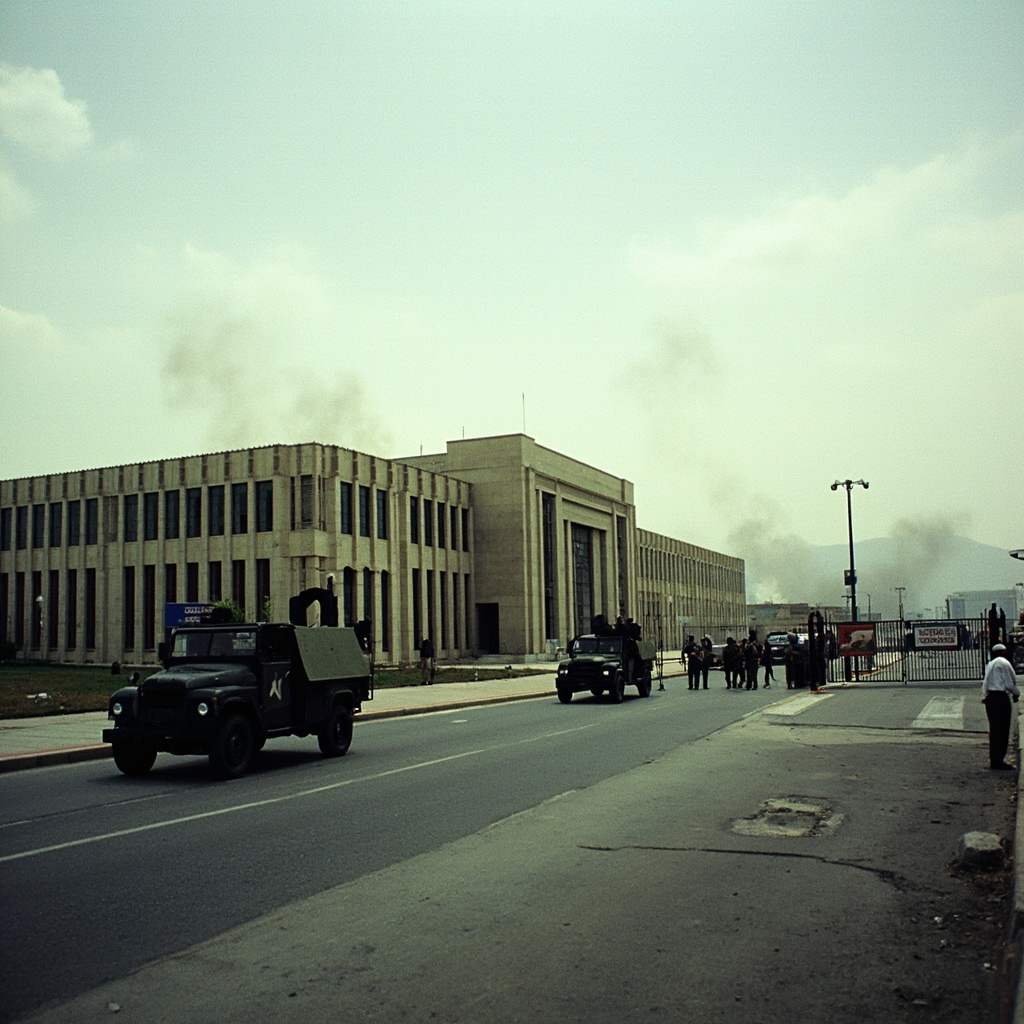
Mohammad-Bagher Ghalibaf, speaker of Iran's parliament, told state television on April 1 that Iranian forces are "waiting for the soldiers to enter so we can set them on fire," the most incendiary language yet from a senior official as the war enters its sixth week [1].
The statement came hours before Iran launched another salvo of ballistic missiles at Israeli targets, the latest in a pattern of attacks that has continued without pause since the conflict began on February 28 [2]. Tehran simultaneously denied having requested or accepted any ceasefire proposal, contradicting what American officials had described as indirect diplomatic channels opened via Pakistani intermediaries.
Ghalibaf's rhetoric landed against a backdrop of escalating tension. President Trump's primetime address on the evening of March 31 — in which he reiterated his demand that Iran accept terms within days or face devastating consequences — drew a response within hours. The Islamic Revolutionary Guard Corps launched what analysts counted as approximately a dozen ballistic missiles toward Israeli military installations in the Negev and Golan Heights, most of which were intercepted by the Arrow and David's Sling defense systems [3].
The parliament speaker's language was notable for its specificity. Where previous Iranian threats have been phrased in the abstract — "crushing response," "mother of all wars" — Ghalibaf described a tactical scenario: ground forces entering Iranian territory and being immolated. The remark appeared calibrated for two audiences simultaneously. Domestically, it signaled that the regime under new Supreme Leader Mojtaba Khamenei retains the will to fight despite weeks of sustained American and Israeli bombardment. Externally, it functioned as a warning that any ground invasion would meet organized, prepared resistance [4].
Iran's foreign ministry reinforced the message through separate channels. Spokesman Nasser Kanaani told reporters in Tehran that "no ceasefire has been requested, offered, or considered" by the Islamic Republic, dismissing reports that back-channel communications through Oman and Pakistan had produced preliminary terms [5]. This directly contradicted reporting by Axios, which last week cited three US officials saying Iran had signaled willingness to discuss a framework if the bombing campaign paused for 72 hours.
The disconnect between the two accounts is itself revealing. Either Iran communicated openness through intermediaries while publicly denying it — a classic diplomatic maneuver — or American officials exaggerated the state of negotiations to create the appearance of progress. Neither possibility inspires confidence that talks are advancing.
On the battlefield, the missile exchanges continued their now-familiar rhythm. Iran's missile production capacity, while degraded by weeks of Israeli strikes on launch sites and manufacturing facilities, remains sufficient to sustain low-rate attacks. The Institute for the Study of War noted on April 1 that Iran had fired "only a few missiles per salvo" since March 30, marking its lowest barrage rate since the conflict began [6]. Whether this reflects strategic restraint or depleted stockpiles is a question no analyst can confidently answer.
Israel's response has been to accelerate strikes on what the IDF describes as command-and-control infrastructure deep inside Iran. Prime Minister Netanyahu's office released a statement calling Ghalibaf's threat "the desperate words of a regime that knows its days are numbered." The statement did not address the ceasefire question.
The broader diplomatic picture remains frozen. The United Nations Security Council has failed to pass any resolution on the conflict, with Russia and China vetoing an American-backed text and the United States vetoing a Russian-drafted alternative. France's call for an emergency session this week produced no new movement. The fifteen-point ceasefire proposal that Iran rejected last week remains the only formal framework on the table, and it is dead.
What remains is a war sustained by momentum. Neither side has articulated conditions under which it would stop fighting. Iran's parliament speaker promises fire. America's president promises departure in "two to three weeks." The missiles fly in the gap between the two promises.
-- Yosef Stern, Jerusalem