TL;DR
The Islamabad talks produced nothing — Iran rejected the US plan as humiliation, Ghalibaf called it theater, and Trump's FT oil quote killed whatever credibility remained.
MSM Perspective
MSM treats the Islamabad collapse as a setback in an ongoing diplomatic process, framing both sides as equally intransigent.
X Perspective
X sees the Islamabad collapse as confirmation that Washington never wanted diplomacy — the FT oil quote arrived in perfect synchrony with the talks' failure.
Pakistan offered a door. The United States bolted it shut with an interview published the same morning the talks collapsed.
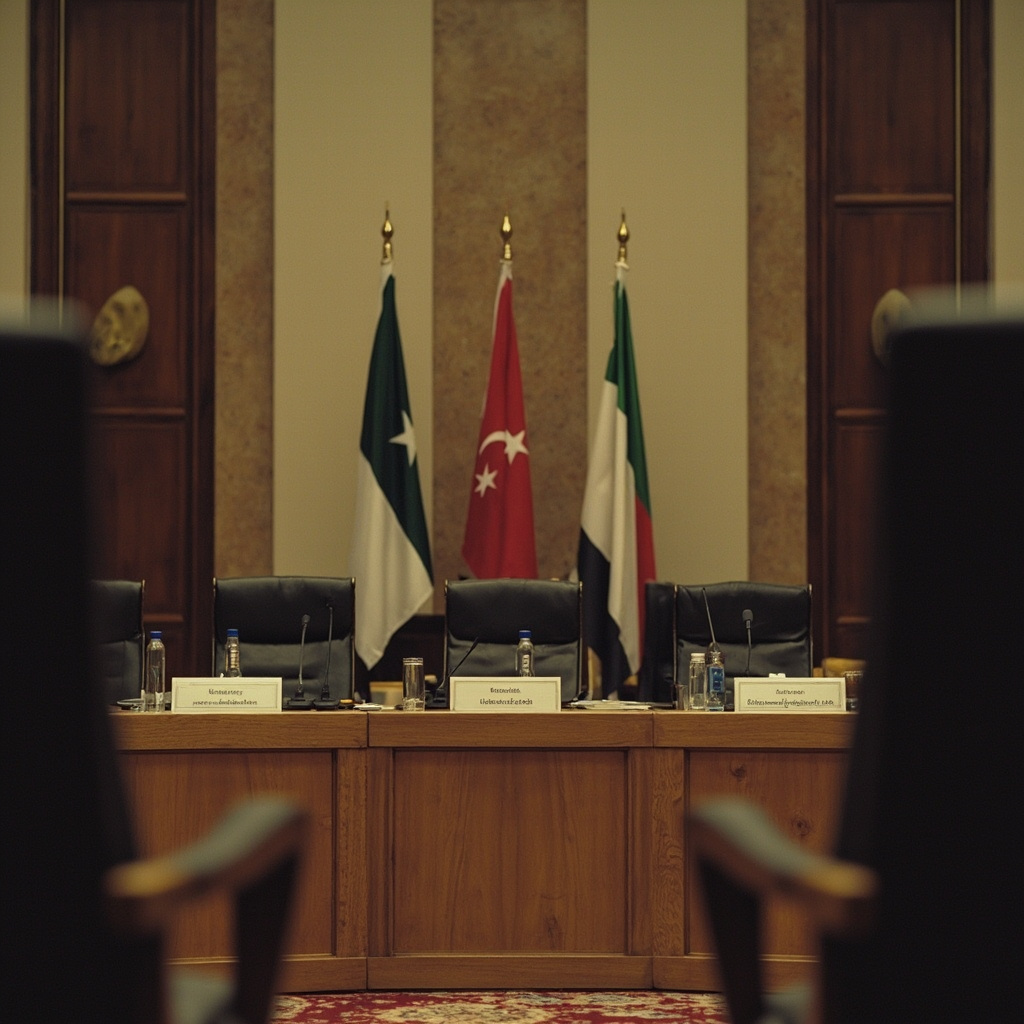
The quadrilateral talks in Islamabad ended Sunday without a ceasefire framework, without a timeline for resumed negotiations, and without the one thing Pakistan's foreign ministry needed to justify the diplomatic effort it had invested: a face-saving communiqué. Instead, Pakistan issued a statement calling the discussions "frank and constructive" — the diplomatic language that, in the vocabulary of professional failure, means nothing was agreed and no one is coming back.
The paper's March 29 account of how the Muslim world convened without Washington raised the question of whether the Islamabad format was diplomacy or theater. That question has its answer. [1]
Iran's parliament speaker Mohammad-Bagher Ghalibaf, who attended the Islamabad session as Tehran's senior representative, did not leave the question open. In remarks to journalists outside the talks, he described the process as "cover for continued American aggression" and said the 15-point US peace framework — which Pakistan had conveyed to Tehran as recently as March 25 — constituted not a peace proposal but "the terms of a humiliation." The framework demanded the dismantling of Iran's enrichment infrastructure, the withdrawal of all IRGC-aligned forces from Syria, Lebanon, and Yemen, and the permanent cessation of ballistic missile development. Iran's five-point counter-proposal, floated through Pakistan in the days before the talks, asked for a ceasefire in place, the lifting of all sanctions imposed since February, and US withdrawal from the Persian Gulf within 90 days. The distance between the two positions was not a negotiating gap. It was a chasm. [2]
Turkey's role drew the sharpest analysis. Ankara sent both its foreign minister and its intelligence chief to Islamabad — a dual-track deployment that experienced observers recognized as something other than good-faith mediation. Turkey has positioned itself throughout this conflict as the indispensable bridge, a broker acceptable to both Washington and Tehran. But a broker cannot be indispensable if the parties reach a deal without him. Erdogan's calculation — visible in every Turkish statement since the war began — has been to keep the process alive long enough to extract strategic concessions from both sides. The Islamabad talks were, in part, a Turkish product. Their failure is, in part, a Turkish failure. [3]
Saudi Arabia's position was quieter and more consequential. Riyadh sent its foreign minister but said almost nothing publicly. The Saudis have oil revenues to protect, a regional order to manage, and a relationship with Washington that predates every current leader in every country at the table. Saudi silence at Islamabad was not neutrality. It was a calculation that the US would win this war, and that being seen to have pushed hard for a deal that Washington didn't want would cost more than it gained.
Egypt brought the one element the talks most needed and least used: legitimacy with the Arab street. Egyptian foreign minister Badr Abdelatty was photographed arriving, photographed in bilateral meetings, and photographed departing. He produced no statement of consequence. Cairo has spent three weeks threading an impossible needle: maintaining its relationship with Washington while not alienating the Arab public watching Iranian cities absorb American bombs. The Islamabad format was Egypt's compromise — visible presence, minimal exposure.
The 15-point US framework, as Al Jazeera's reconstruction showed, bore a strong resemblance to the demands Washington tabled in February, before the February 28 strikes. Those demands were rejected then. They were rejected again now. The repackaging was not subtle enough to pass as a new proposal, and Iranian officials said so. "We have seen this document," Iranian Foreign Ministry spokesman Esmail Baghai told reporters in Tehran. "It was presented before the war began. It was rejected before the war began. Presenting it again after a month of bombing does not improve it." [4]
That framing — that the US had gone to war to enforce demands Iran had already refused through negotiation — is the frame Tehran has deployed consistently since March 1. It is also, structurally, accurate. The sequence of events does not contradict the Iranian account.
Then, at approximately 6 AM Eastern time on Monday, the Financial Times published its interview with Donald Trump. The president said his preference was to "take the oil in Iran." He named Kharg Island. He said the United States could seize it "easily." He said people who objected to taking Iranian oil were "stupid."
The interview landed in Islamabad like a court exhibit presented mid-trial. Pakistani officials, who had spent weeks constructing the diplomatic infrastructure that gave the United States a face-saving path to indirect talks, learned the same way everyone else did: from a newspaper. The foreign ministry's carefully worded statement about "frank and constructive" talks had been filed hours earlier. It was overtaken by events before anyone read it. [5]
Ghalibaf did not need to update his statement. He had already called the process cover. He was right, and a Financial Times interview confirmed it.
The United States did not send a principal to Islamabad. Washington was represented, through Pakistan, by a 15-point document that Iran had previously rejected, accompanied by the president's stated preference for seizing Iranian oil infrastructure. This is not diplomacy. It is a bureaucratic process attached to a military operation that has its own stated purpose.
The collapse matters for what comes next. Pakistan's foreign ministry has invested significant political capital in the mediator role — foreign minister Ishaq Dar has made multiple trips, including to Tehran and Washington, to sustain the format. That capital is not unlimited. Dar cannot return to Islamabad for a second quadrilateral session if the first produced nothing and the United States simultaneously published an interview describing its war aims as resource seizure. The Pakistani government faces its own domestic pressures: public opinion in Pakistan has been strongly opposed to the war since it began, and being seen as Washington's diplomatic cover story is not a position Islamabad can sustain indefinitely. [6]
Iran's counter-position, floated through Pakistan, included one element that Pakistani officials found genuinely workable: a 72-hour humanitarian ceasefire to allow the Red Cross access to civilian areas in Khuzestan province, where the heaviest fighting has occurred. That proposal was not taken up in the formal talks. It was not publicly endorsed by Washington. It died the quietest death, overshadowed by the president's interview.
The NPR reconstruction of the Islamabad dynamics, drawing on sources from three of the four delegations, was unsparing: the talks had no mandate from either principal, were staffed below the level required for real negotiation, and were convened as much for international audiences as for the parties themselves. "This is what diplomacy looks like when neither side wants diplomacy," one participant told NPR's correspondent on condition of anonymity. "You go to Islamabad and you be photographed and you return home." [7]
The next diplomatic opportunity is unclear. The United Nations Security Council resolution calling for a ceasefire, vetoed by the United States in the second week of the war, remains unavailable as a vehicle. The Islamabad format has produced one failure. Turkey's intelligence channels remain open, but the FT interview has poisoned even those — a president who says he wants the oil is not a president whose intermediaries can credibly carry a peace offer.
V.S. Naipaul, writing about failed negotiations in another era, observed that the most revealing moment in any diplomatic process is not when talks break down but when it becomes clear they were never real. Islamabad was that moment. The timing, the FT interview arriving as the joint communiqué was being drafted and discarded, was not unfortunate. It was clarifying.
-- PRIYA SHARMA, Delhi
Sources & X Posts
News Sources