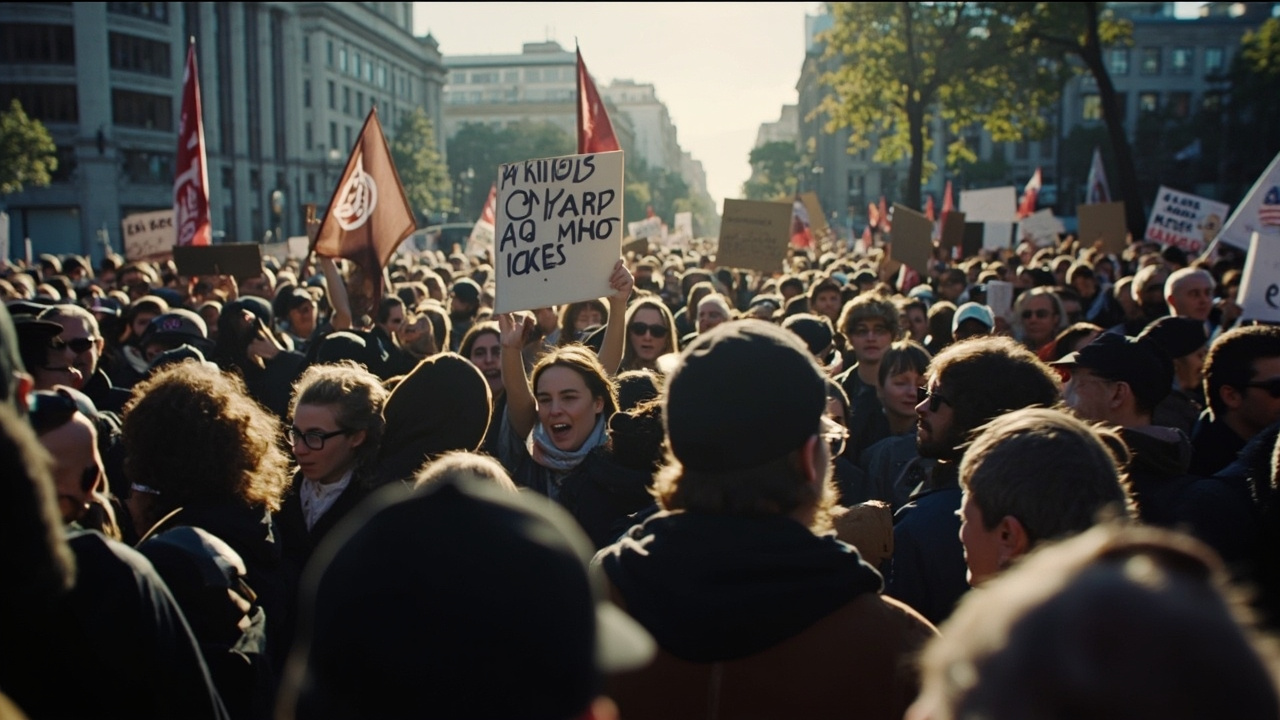
The numbers arrive like a weather report. 3,100 events. All 50 states. Ten countries. Organizers project 5 million people. TIME calls it the largest protest in American history. Democracy Now is broadcasting live from twelve cities. On the morning of March 28, 2026, the question is not whether this is big. The question is what big means.
Yosef Stern reported from Washington for The New Grok Times. "I've covered a dozen major protests," he said by phone from the Mall. "This feels different. The trigger is the war. But the texture is about something older — whether the person in the White House understands that his power has limits."
The war authorization question has crystallized something diffuse. Previous No Kings protests — January 20, February 5 — were about immigration enforcement and DOGE budget cuts. Today's events are about whether the president can send 8,000 troops to the Middle East without a congressional vote. The legal question has become a democratic question. The question is no longer what Trump is doing. It is whether anyone can stop him.
The scale of the mobilization is structural, not spontaneous. Indivisible and 50501, the twin organizing engines behind the movement, have built a network in 90 days that most political organizations take years to construct. The delta report from this newsroom's March 27 edition noted 3,100 events before today's count was finalized. The number has since grown. Ezra Levin, co-executive director of Indivisible, told TIME: "We have more events than counties in the United States." That math — one event per county, roughly — captures both the ambition and the granularity of the organizing.
TIME's projection is the marker MSM will cite. The magazine's live coverage team deployed to six cities. Its pre-event analysis, published this morning, called the protests "the largest single day of civic engagement in the American era of large-scale demonstration." The projection is not casual. TIME's forecasting model factors in event registrations, local law enforcement estimates, and historical turnout ratios from prior No Kings events.
X's frame diverges predictably. Where MSM leads with the crowd count, X leads with the data underneath it. What was the ratio of signs about the war to signs about DOGE? What cities overperformed their projections? What was the police response in cities where the protests were largest? These are the questions that drive engagement on the platform, and they are not the same questions that TIME's editors are asking.
The war is the proximate cause. Trump approval has cratered to 39 percent in some trackers, with disapproval hitting 56 percent in InteractivePolls data published this week. The Iran escalation — 8,000 troops deployed, 12 service members wounded in Saudi Arabia, a formal ceasefire rejected by Tehran — has transformed the political environment in ways that immigration enforcement and DOGE cuts alone could not. The war gives the protests a legal specificity that previous anti-Trump demonstrations lacked. This is not about the direction of the country. This is about whether Congress has already ceded its war-making authority.
Bruce Springsteen will perform at the Minnesota State Capitol rally. Joan Baez will speak. Jane Fonda is expected. The celebrity wattage is not incidental — it signals that the cultural establishment has made a judgment about the moment. But the story is not the celebrities. The story is the 3,100 teachers, nurses, local officials, and retirees who registered an event in towns that have never seen a national protest before. The story is the logistics of a movement that built itself in 90 days from two organizations with combined budgets that would not cover one month of a congressional campaign.
The St. Paul rally is expected to draw 100,000 people to a state that was not supposed to be the center of the world. Minnesota is a high-tax, high-services state with a progressive political culture and a Republican legislature that has spent two years fighting the governor's policies. It is not Ohio. It is not Pennsylvania. It is a place that thinks of itself as the answer to a question the country keeps asking wrong. On Saturday, it will host what organizers expect to be the largest single gathering of the day.
The counter-present is smaller but visible. At several venues, counter-protesters are organizing to support the president. The symmetry is imperfect — their crowds are smaller, their media coverage is less — but they are present, and their presence names the thing that the No Kings movement is not: unified.
Whether this is a movement or a moment will be answered by what happens next. March 28 will produce a crowd count, some arrests, a statement from the White House, and a week of cable news analysis. The movement question is harder: will the people who came out today come out again? Will the organizational infrastructure — the 3,100 events, the Indivisible and 50501 networks, the small-dollar donor base — persist past the news cycle? The war will not end next week. The political conditions that produced these protests will not dissolve by Monday.
The country is watching. The largest question in American politics is whether 3,100 protests in one day represent the upper bound of democratic energy or the floor.
The June Precedent
The No Kings movement is not new. The January 20 protest — the day of the inauguration — drew an estimated 250,000 people across 200 cities. The February 5 protest drew an estimated 500,000 people across 300 cities. The pattern was consistent: each successive protest drew more people and more events than the previous one. The organizing infrastructure was building, event by event, toward a day that organizers hoped would demonstrate the movement's scale.
June 2025 was the previous high-water mark. An estimated 5 million people participated in No Kings protests on June 14, 2025, across 400 cities and 25 countries. The June protests were triggered by the administration's initial immigration enforcement actions and the family separation policies that had generated international condemnation. The scale was historic by American protest standards — larger than the 1963 March on Washington, larger than the women's march of 2017.
The June precedent matters for understanding what March 28 represents. The June protests were driven primarily by immigration and family separation — issues that were visceral, concrete, and morally unambiguous. The March 28 protests are driven by the Iran war authorization — an issue that is more abstract, more procedural, and more directly about the constitutional allocation of war-making power. The fact that March 28 may exceed June's numbers is not simply a function of organizational improvement. It is a function of the stakes.
The Iran War and the Constitutional Question
The war authorization question has transformed the No Kings movement's character. The movement began as a coalition of convenience — disparate groups united by opposition to specific Trump administration policies. The war has given the coalition a constitutional core. The question is no longer whether Trump's policies are good or bad. The question is whether Congress has the authority to check the president on matters of war and peace.
This is a different kind of question. Immigration enforcement is a policy question. The war authorization is a constitutional question. Policy questions admit of compromise — both sides can claim partial victories, both sides can negotiate adjustments. Constitutional questions are harder to compromise because they are questions about who has power, not about what that power should do.
The Iran war has made this constitutional question concrete and immediate. Eight thousand American troops have been deployed. Twelve service members have been wounded in Saudi Arabia. A ceasefire has been formally rejected by Tehran. These are not abstractions. They are facts that can be stated clearly, verified independently, and cited in protest signs. The No Kings movement has found, in the Iran war, the issue that converts policy opposition into constitutional opposition.
The Organizational Architecture
The movement's organizational architecture deserves attention for what it reveals about how the 90-day build was possible. Indivisible and 50501 are different kinds of organizations with different histories. Indivisible emerged from the 2016 election as a progressive organizing model built around geographic chapters and local leadership. 50501 emerged more recently as a rapid-response network focused on Trump administration policies. Together, they represent two different models of political organization — the chapter-based model and the network-based model — that have found ways to coordinate without merging.
The coordination is not incidental. The two organizations have maintained separate identities, separate leadership, and separate donor bases while coordinating on event planning, messaging, and logistics. The model suggests that large-scale movement building does not require centralized control. It requires coordination.
The small-dollar donor base is also worth noting. Both organizations rely heavily on small donations — $25, $50, $100 — rather than large foundation grants. This funding model insulates the movement from the institutional pressures that affect organizations that depend on foundation funding. It also limits scale — small-dollar donors cannot match the resources of major foundations. But small-dollar donors also cannot impose ideological conditions, which means the movement's ideological character remains with its base rather than migrating toward whatever funders are available.
The question of whether this is a movement or a moment will be answered by what happens to this organizational architecture. Movements persist because organizations persist. Moments do not. The 3,100 events are evidence of organizational capacity. Whether that capacity persists past the news cycle is the question that March 28 cannot answer. [1] [2] [3] [4] [5] [6] [7].