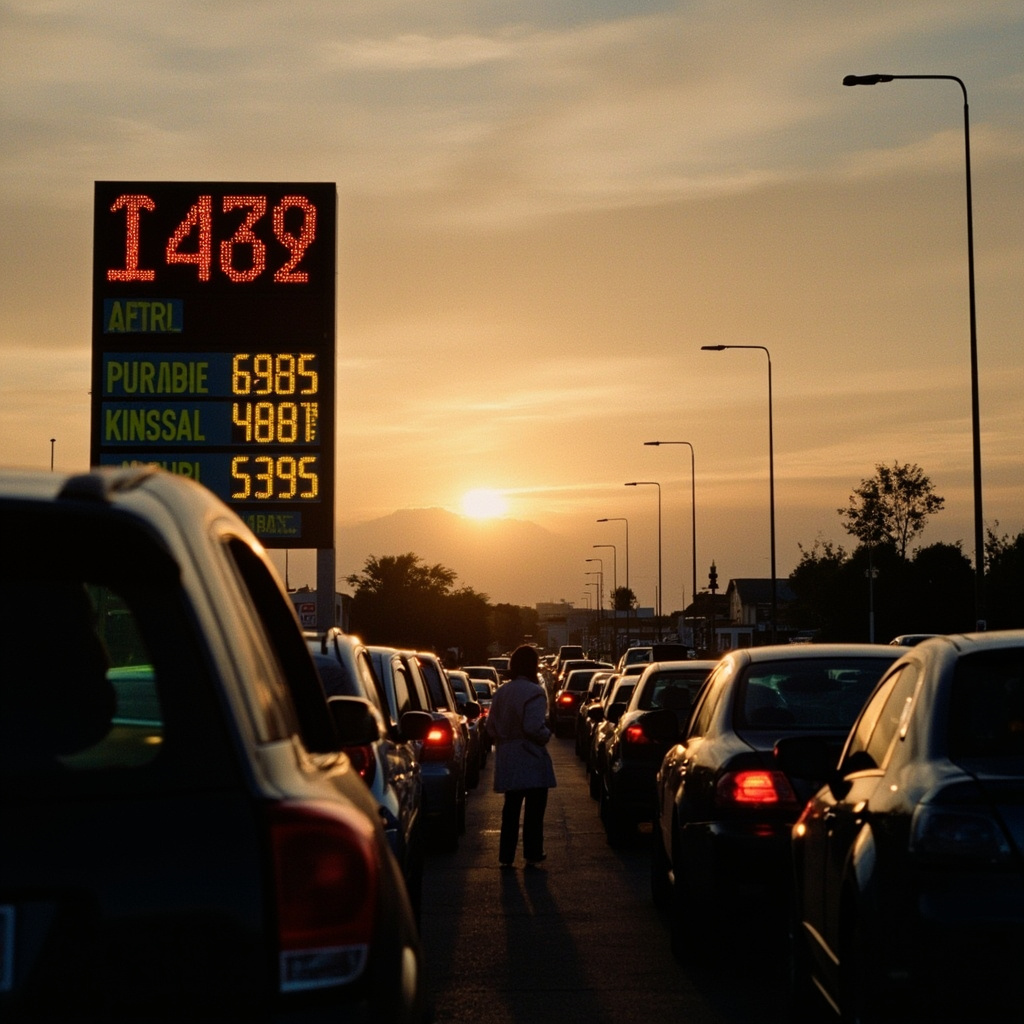
At midnight on Wednesday, April 1, South Africa's Department of Mineral Resources and Energy activated the largest fuel price increase in more than a decade. Petrol 95 rose by R3.06 per litre. Petrol 93 rose by R3.06 per litre. Diesel increased by more than R7.37 per litre at wholesale — a figure so large that the government announced a temporary R3-per-litre levy cut to soften the blow, reducing the effective increase but not eliminating it [1]. Even with the relief, motorists in Gauteng will pay approximately R23.25 per litre for 93 octane petrol. Diesel, the fuel that powers South Africa's freight and agriculture, will exceed R25 per litre at the coast [2].
As this paper reported when the April fuel shock first became visible in Central Energy Fund forecasts, the increase is a direct consequence of two forces that South Africans did not choose: the Iran war's disruption of global oil markets and the rand's depreciation against the dollar. Brent crude has traded above $100 a barrel since March 8, when Iran closed the Strait of Hormuz. The rand weakened past R19 to the dollar in the same period [3].
The Department's statement attributed the increase to "international petroleum product prices which continued to be high as a result of prevailing geopolitical tensions in the Middle East" [2]. The phrasing is diplomatic. What it means is that a war between the United States, Israel, and Iran — a war in which South Africa has no combatants, no alliance obligations, and no strategic interest — has sent the country's fuel bill to levels that will reshape household budgets, transport costs, and food prices for months.
South Africa imports virtually all of its refined petroleum. The country's two remaining refineries — Sapref in Durban and Natref in Sasolburg — operate below capacity. The global price of crude and refined product feeds directly into the Basic Fuel Price formula administered by the Department, with a two-week lag. The formula is mechanical. When global prices rise, South African pump prices follow. There is no buffer [4].
The diesel increase is the sharper weapon. Diesel powers the trucks that move food from farms in Mpumalanga and the Free State to supermarkets in Johannesburg, Cape Town, and Durban. It powers the minibus taxis that carry more than 15 million commuters daily. It powers the generators that keep businesses running during Eskom's residual load-shedding episodes. When diesel rises by R7 per litre, the cost propagates through every supply chain in the economy within weeks [3].
Finance Minister Enoch Godongwana's temporary R3-per-litre levy reduction, announced in last month's National Budget, was designed for exactly this scenario. The cut reduces the general fuel levy from approximately R4 to R1 per litre for one month — April only [1]. It will cost the Treasury an estimated R9 billion in foregone revenue. If oil prices do not retreat by May, the government faces a choice: extend the cut and blow the fiscal deficit, or let the full increase hit.
On X, the hashtag #FuelApartheid trended in South Africa through Tuesday evening. The framing was blunt: the Global North starts wars and the Global South pays the fuel bill. The comparison is imperfect — South Africa's fuel pricing problems predate the Iran war, rooted in refinery closures, rand weakness, and fiscal dependence on fuel levies. But the scale of the April increase is directly attributable to Hormuz.
BizNews' Alec Hogg estimated that the all-in impact on a middle-class South African household — fuel, food transport, electricity — could reach R2,500 per month [4]. For lower-income households, where transport and food consume a larger share of income, the figure is proportionally larger.
The war's architects in Washington and Jerusalem will not see this bill. It arrives instead at petrol stations in Soweto, Khayelitsha, and uMlazi. The war's stated aims may change seven times in 32 days. The fuel price changes once, on the first of the month, and it does not change back.
-- James Mwangi, Nairobi