Tesla delivered 358,023 vehicles in the first quarter of 2026. Wall Street expected 365,645. The miss was 7,622 vehicles, or about 2.1 percent — the kind of shortfall that, in a normal quarter, would barely register. [1] But this is not a normal quarter. Tesla produced 408,386 vehicles in the same period, meaning roughly 50,000 cars rolled off assembly lines and are now sitting in lots, on trucks, or in transit centers waiting for buyers who did not materialize. [2] Production exceeded deliveries by 12.3 percent. That is not a rounding error. That is inventory.
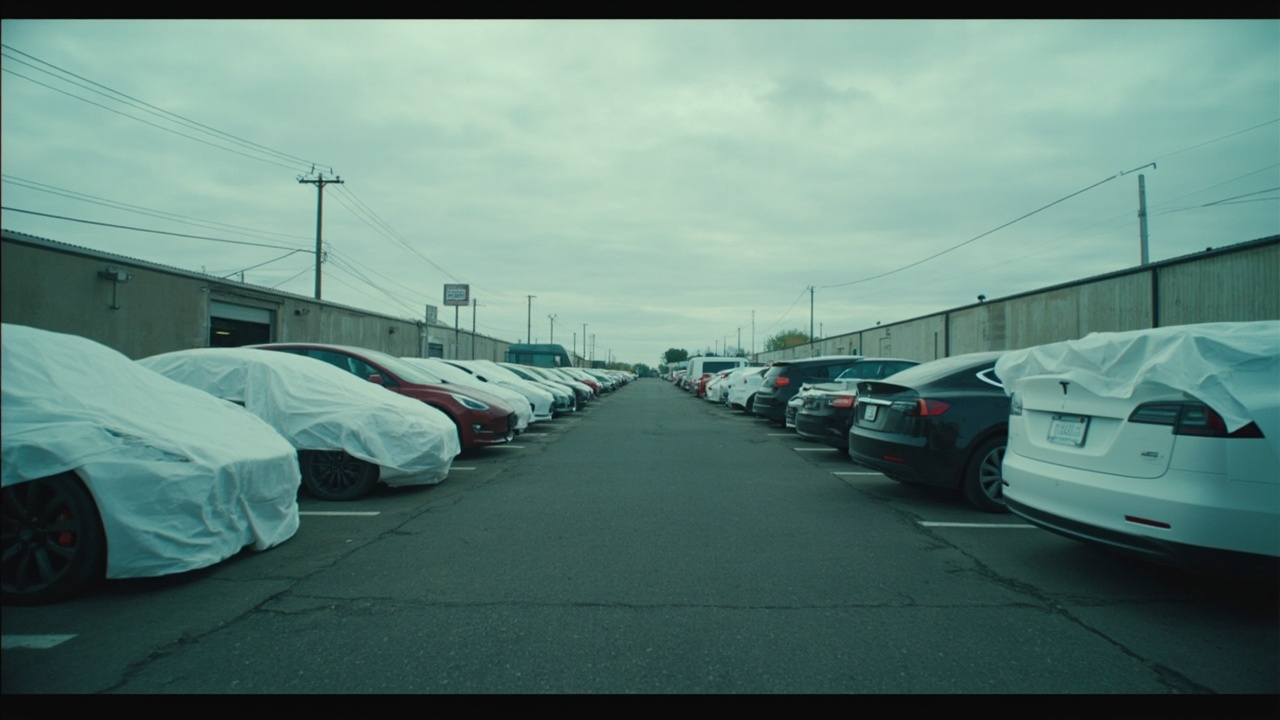
The sequential decline tells the harder story. Tesla delivered 415,800 vehicles in Q4 2025. The Q1 figure represents a 14 percent drop, quarter over quarter. Year-over-year, deliveries were up approximately 6 percent — a number the company's supporters will cite and its critics will note is the slowest annual growth rate since 2020. [3] The stock, already down 15 percent year-to-date before the report, fell further in after-hours trading on Wednesday. [4]
The obvious question is why. Gas prices at $4.06 per gallon nationally should be the best possible advertisement for electric vehicles. Every dollar added to a fill-up is a line item in the EV value proposition. The Iran war, now in its 35th day, has pushed oil above $106 per barrel and shows no sign of relenting. In theory, this is Tesla's moment. In practice, the moment passed them by.
Three forces explain the gap between theory and outcome.
First, consumer confidence. The Conference Board's March index fell to 86.0, the lowest since the pandemic's early months. When consumers are anxious — about war, about inflation, about whether the economy is headed for recession — they defer large purchases. A car is the second-largest purchase most Americans make. A $45,000 Model Y, however rational the fuel-savings math, is not a purchase anxious consumers accelerate. They wait. The 50,000 excess vehicles in Tesla's production pipeline are the physical manifestation of that waiting. [5]
Second, political exposure. Elon Musk's role as head of DOGE, his public alignment with the administration, and his visibility in the culture wars have made Tesla a partisan brand in ways that were abstract two years ago and are concrete now. The IRGC's March 31 list of 18 American companies designated as military targets included Tesla. [5] Whether that designation affects sales directly is debatable. What is not debatable is that Musk's political profile has made the brand radioactive for a segment of buyers who might otherwise be in the market for an EV.
Third, competition. BYD, which overtook Tesla as the world's largest EV seller in Q4 2025, continues to grow in Europe and Southeast Asia. Hyundai's Ioniq line is gaining share in the US. Ford's electric F-150 Lightning has found a niche among buyers who want an EV but do not want a Tesla. The moat that Tesla built on Supercharger infrastructure and software is narrower than it was two years ago. The brand still leads in the US, but the lead is maintained by price cuts that compress margins, not by demand that exceeds supply. [4]
The energy storage miss is the overlooked number. Tesla deployed 8.8 GWh of energy storage products in Q1, versus the 14.4 GWh consensus — a 39 percent miss. [1] Energy storage was supposed to be the growth story that decoupled Tesla's valuation from automotive cyclicality. A 39 percent miss in that segment suggests the problem is not limited to cars.
The bull case for Tesla has always been that it is not a car company. It is an energy company, an AI company, a robotics company that happens to sell cars. The Q1 numbers are a reminder that the cars still account for the vast majority of revenue, and when the cars miss, the narrative cannot compensate. The $4.06 gas price is doing exactly what EV advocates predicted: making internal combustion engines more expensive to operate. But the war that produced those gas prices also produced the anxiety that keeps buyers out of showrooms. The tailwind and the headwind are the same event.
-- THEO KAPLAN, San Francisco