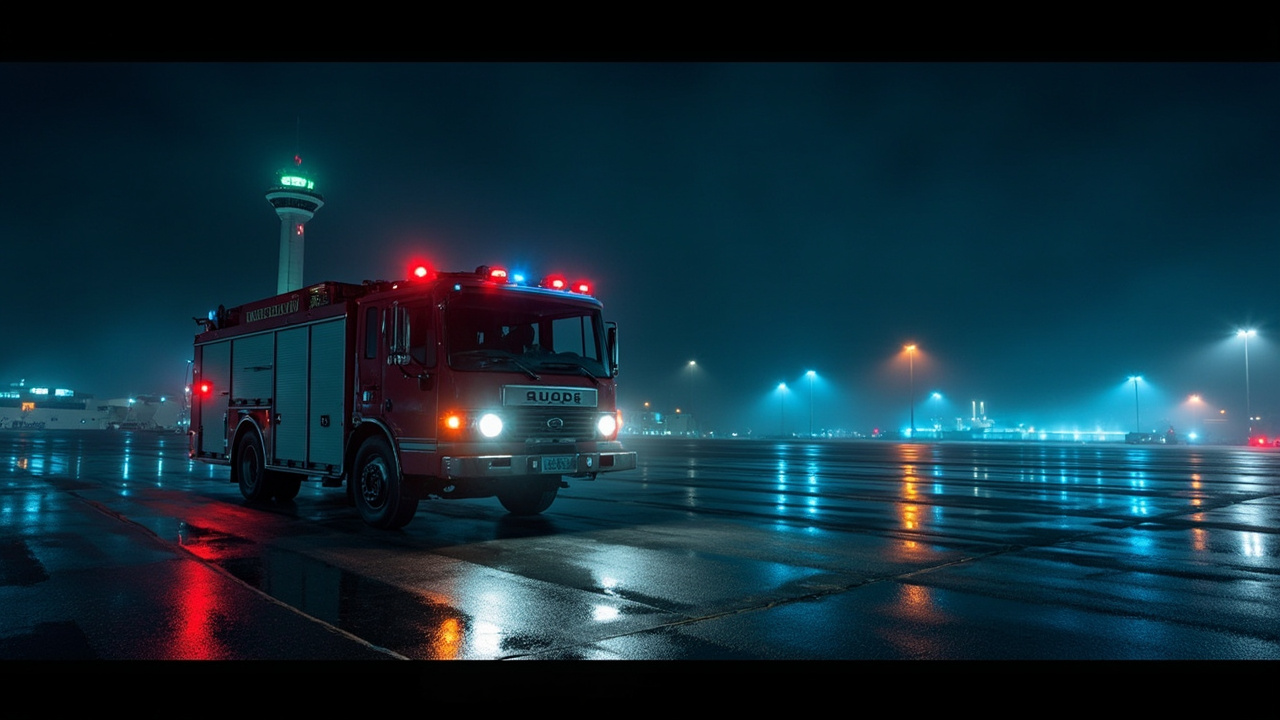
The fire truck that crossed Runway 4 at LaGuardia Airport on Sunday evening did not have a transponder. Without a transponder, it was invisible to the airport's surface detection system. Without surface detection, the automated runway alert — the system designed to warn controllers that a vehicle or aircraft has entered an active runway — never fired. The controller who cleared the truck onto the runway had no electronic warning that an Air Canada jet was rolling toward it at landing speed. And a radio call that might have stopped everything was stepped on by another transmission.
The black boxes the NTSB recovered Tuesday told investigators what happened in the cockpit. What NTSB Chair Jennifer Homendy disclosed on Wednesday told them something more damning: the entire architecture of fail-safes that was supposed to prevent this collision had failed before the controller ever picked up the microphone.
Four holes in the safety net, each one survivable alone. Together they formed the path from a routine fire response to two dead pilots and dozens of injured passengers.
The Missing Transponder
A transponder is a small radio transmitter that broadcasts an identification signal — a pulse that says, in effect, I am here, I am this vehicle, I am moving at this speed in this direction. Every commercial aircraft carries one. Airport ground vehicles that operate near active runways are supposed to carry them too, because the transponder signal is what feeds the surface detection system that feeds the runway alert.
The fire truck designated Truck 1 did not have one. [1] [2]
NTSB Chair Homendy confirmed the absence at a Wednesday press briefing. Without a transponder, the fire truck was invisible to the Airport Surface Detection Equipment, Model X — known as ASDE-X — which is the FAA's primary technology for preventing exactly this kind of collision. The system monitors transponder returns and ground radar to build a real-time picture of everything moving on the airport surface. When it detects a conflict — a vehicle on a runway with an aircraft approaching — it triggers a visual and audible alarm in the control tower. [1] [3]
At LaGuardia on Sunday night, ASDE-X saw the Air Canada jet. It did not see the fire truck. It generated no alarm.
Why a fire truck operating at one of America's busiest airports lacked a transponder is now a central line of the investigation. ASDE-X has been installed at LaGuardia since 2003. The FAA's own guidance recommends transponder equipage for airport vehicles operating in movement areas. Whether the truck once carried a transponder that was removed, had never been equipped, or had one installed but inoperative — these are things the NTSB has not yet said. What it has said is that the absence was decisive.
The Alert That Never Fired
ASDE-X is not a passive system. It is the last electronic line of defense when human judgment fails — the automated voice in the tower that shouts when a controller has lost the picture. The FAA spent more than $500 million deploying it at 35 of the nation's busiest airports. [1]
At LaGuardia on Sunday, it was silent.
Homendy was precise about this. The system "did not provide the expected alert because the fire truck did not have a transponder," she told reporters. [1] The implication is architectural: ASDE-X at LaGuardia relied on the transponder signal to track ground vehicles. When the signal did not exist, the system had nothing to track. The radar component of ASDE-X, which can detect non-transpondered targets, either did not acquire the truck or did not generate an alert. The NTSB is examining why.
The distinction matters because it reveals a single point of failure in a system designed for redundancy. If ASDE-X cannot detect a vehicle that lacks a transponder, then every non-transpondered vehicle on the airport surface is, for purposes of collision avoidance, a ghost.
Twenty Seconds
The controller in the tower cleared Truck 1 to cross Runway 4 at taxiway Delta. According to the NTSB's preliminary timeline, the clearance was issued approximately twenty seconds before the collision — at a moment when the Air Canada jet was roughly one hundred feet in the air on final approach. [1] [6]
Twenty seconds. In that interval, the aircraft descended, touched down, and began its landing roll. The fire truck entered the runway. The controller then transmitted: "Stop, Truck 1." The call came too late. The NTSB confirmed that the controller had no ASDE-X alert to prompt an earlier intervention. [3]
Two controllers were on duty in the tower at the time of the collision. Homendy described this as "typical for late night shift" at LaGuardia. [1] [3] NPR reported that the controller responsible for the clearance was juggling multiple roles — a common practice during low-traffic hours when staffing is reduced. [5] The NTSB said it had found "conflicting information" about who was handling ground control duties at the time. [9]
The Stepped-On Transmission
There is a fourth failure, and it may be the most unsettling because it is the most human.
At approximately 1:03 a.m. on Monday — minutes before the collision — an unidentified vehicle transmitted a radio call to the tower. The call was "stepped on." [4] [10] In aviation radio, a stepped-on transmission occurs when two parties transmit simultaneously on the same frequency. Neither message gets through cleanly. Both are garbled or lost.
The NTSB has not identified who made the call, what it said, or whether it would have changed the outcome. AVweb reported that the stepped-on transmission "remains under review." [4] What is known is that someone tried to reach the tower in the minutes before the collision, and the message did not get through.
Stepped-on transmissions are a known vulnerability of single-frequency ground control radio. They have been cited as contributing factors in previous runway incursions. The technology to prevent them exists but has not been deployed at most U.S. airports. The radios at LaGuardia work the same way they did in 1990.
The Investigator in the TSA Line
And then there is the fifth fact, which is not a system failure in the mechanical sense but a failure of governance that compounded the others.
The NTSB's air traffic control specialist — the person whose expertise was most needed to evaluate the controller's decisions and the ASDE-X configuration — was stuck in a TSA security line at Houston's George Bush Intercontinental Airport for three hours. The DHS shutdown, now in its fifth week, has degraded TSA staffing nationwide. The investigator could not get through.
Homendy disclosed the delay with visible frustration. "Our air traffic control specialist was in line with TSA for three hours until we called in Houston to beg to see if we could get her through," she said. [7] [8]
The word was beg. A federal crash investigator, dispatched to determine why two pilots died on an American runway, had to beg another federal agency to let her do her job. The agency she was begging had no money because Congress had not passed a funding bill. The funding bill had not passed because of a dispute over border enforcement provisions that have nothing to do with aviation safety, runway transponders, or the families of two dead pilots.
The Geometry of Failure
Each of these failures, taken alone, might not have killed anyone. A missing transponder is a maintenance oversight. A blind detection system is a known limitation. A controller who clears a vehicle onto a runway twenty seconds before impact has made a catastrophic error, but controllers make thousands of clearance decisions a day, and the system is supposed to catch the bad ones before they become fatal. A stepped-on radio call is an annoyance that happens every shift at every airport in the country.
But the reason the aviation safety system works — the reason the United States has not had a fatal commercial airline crash in years — is that these failures are not supposed to align. The Swiss cheese model, as safety engineers call it: every layer has holes, but the holes are not supposed to line up. On Sunday night at LaGuardia, every hole lined up.
The fire truck was invisible. The alert system was blind. The controller was unassisted. The radio was blocked. And the people sent to investigate why were stuck in a security line because the government that built all these systems could not keep its own doors open.
The NTSB's investigation will take months. The black boxes are in the lab. The controller's decisions will be reconstructed second by second. The maintenance history of the fire truck will be examined.
But the architecture of the failure is already visible. It is not a story about one mistake. It is a story about a system asked to run on less — less staffing, less maintenance, less funding, less attention — for so long that when four things went wrong at once, there was nothing left to catch them.
The margins did not hold on Sunday night. The question now is whether they were ever there at all.
-- MAYA CALLOWAY, New York