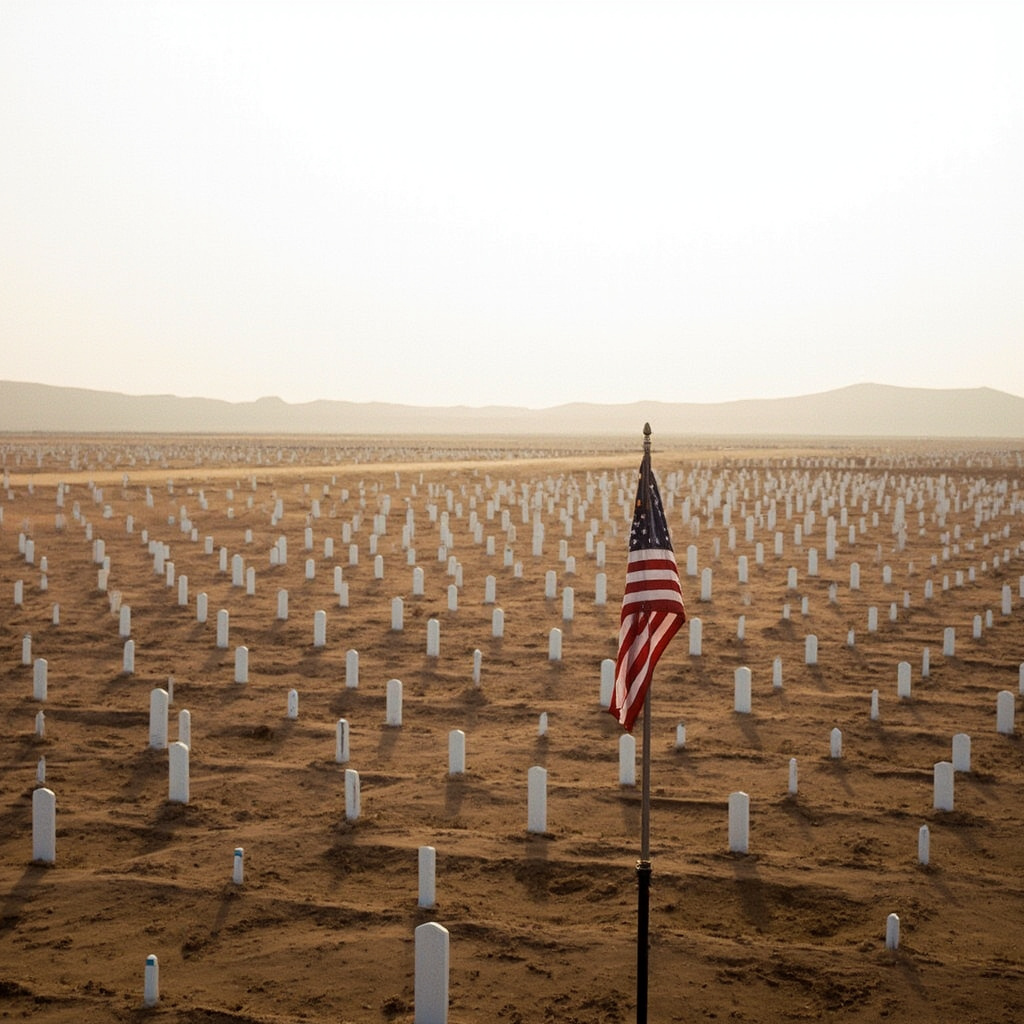
One month. The first bombs fell on Iran on February 28, 2026. Today is March 30. In between, the following things happened.
The United States dropped more ordnance on Iran in thirty days than it dropped on Iraq in the first thirty days of Operation Iraqi Freedom. The IRGC launched missile barrages that killed six American service members in the first week, produced more than 300 additional injuries, and struck a carrier group in the Arabian Sea with a drone swarm that defense officials privately described as closer than any hostile contact with a US naval vessel since the USS Cole. Iran's civilian infrastructure — power grid, water treatment, bridges, rail links — has been systematically degraded across Khuzestan, Tehran, and Isfahan provinces. [1]
The paper's sustained tracking of how the war widened while Washington pretended not to notice has been, through thirty days, an act of institutional witness. The Houthi entry. The Diego Garcia expansion. The 82nd Airborne deployment ordered last week. The Pentagon's preparation, per Reuters, for "weeks of ground operations." Each escalation arrived dressed as operational necessity. None arrived with a legal framework.
There is no Authorization for Use of Military Force. There is no declaration of war. There is no stated war aim that has survived contact with the week's events. The WMD rationale collapsed when inspectors found no weapons-grade material at Natanz. The nuclear non-proliferation rationale collapsed when Israel struck facilities the US had said it would spare. The human rights rationale collapsed when the civilian death toll exceeded the combined casualty count of every Iranian-government execution in the past decade. [2]
What remained, as of Friday, was the language of process: "Operation Epic Fury," "degrading Iran's capabilities," "restoring regional stability." Language that describes activity without naming purpose. Language that a press secretary can use indefinitely because it cannot be falsified.
The aims can be dated even if they cannot be defended. On February 28 the campaign opened as decapitation and counterproliferation: kill the leadership, set back the nuclear program. By mid-March the stated object was degradation of Iran's military machine. On March 22, with the first strike pause, it became leverage for diplomacy — disabling what remains of Iran's capacity to negotiate from. By March 24 the language had shifted again to restoring stability in the Gulf, which is a strange aim for a campaign that had spent three weeks unstabilizing it. Two days later Secretary Bessent widened the aperture to a comprehensive settlement addressing the full range of Iranian behavior — an aim that could justify anything and therefore ends nothing. [1] [2] Each reformulation absorbed the failure of the last one. None was announced as a change, because announcing the change would concede the failure. Then on Monday morning, the Financial Times published its interview, and the president said he wanted to take the oil — the first stated aim in thirty days that could be checked against an outcome.
The Cost-Exchange Arithmetic
The money deserves its own scrutiny, because the spending rate is the clearest evidence that nobody plans to stop. CSIS estimated $11.3 billion through Day 6 and $16.5 billion through Day 14; straight-line extrapolation puts the month near $40 billion, and the curve is not straight but accelerating once carrier aviation, missile-defense interceptors, and munitions reordering are priced in. [3] The exchange itself is worse than the sum. Iran's drones cost thousands of dollars; the American interceptors that drop them cost millions, and every salvo forces the defender to spend a car to stop a bicycle. A country fighting that trade needs either a cheap answer to cheap weapons or an exit strategy. It has budgeted for neither.
What the Month Broke at Home
The domestic ledger compounds quietly. The Department of Homeland Security has been shut longer than any such shutdown in American history, its screeners unpaid while the war their department cannot name continues; eight million people marched and no policy changed. The blast radius runs through supply chains most Americans never knew touched the Gulf: Qatar's LNG stream carries with it roughly a third of the world's helium, and hospitals from India to Germany are now rationing MRI time because a war they did not vote for reached into their cooling systems. [3] Shipping rerouted around the Cape adds two weeks per voyage. None of this appears in any war aim. All of it appears on invoices.
The one-month cost accounting, assembled from NRC, CSIS, the Sunday Guardian Live, and Reuters figures, is as follows. American military spending through Day 30: approximately $40 billion, based on the CSIS estimate of $11.3 billion through Day 6 and $16.5 billion through Day 14, extrapolated conservatively. Total global economic losses attributable to the war: $590 billion by Sunday Guardian Live's calculation, driven primarily by energy price shocks, supply chain disruption, and reduced economic activity in countries dependent on Gulf transit. Iranian civilian deaths: between 4,350 and 6,634 documented by name and photograph, per Iran International. American service member deaths: 6. Injured: more than 300. [3]
The diplomatic ledger is shorter. Peace talks: three rounds, all failures. UN Security Council resolutions: one, vetoed. Allied support: coalition of one — Israel, whose own population has absorbed Iranian missile attacks throughout the month. Regional consequence: Houthi entry into the conflict on March 29, adding a second front and a second adversary. Lebanese sovereignty: functionally compromised by Iran's refusal to withdraw its ambassador after being declared persona non grata.
The alliance ledger reads no better. NATO members have refused overflight for strikes they were not consulted on; Gulf states hosting American forces publicly urge restraint while privately pricing their exposure; the Security Council managed one draft and one veto. A war begun without allies has, in thirty days, made unilateralism the only thing still holding it together.
The economic ledger is what the history books will use. WTI at $102.86. S&P 500 down 6.5% for March. Global helium shortage cascading from disrupted Qatar production, threatening MRI machines from India to Germany. Shipping rerouted from Suez through the Mediterranean, adding 14 days and $1.2 million per voyage. Mediterranean ports overwhelmed. European consumers absorbing costs that accumulated from 4,000 kilometers away. Australian commuters riding trams for free because their government cannot absorb the fuel subsidy differently.
Anna Politkovskaya, writing about Chechnya, wrote that wars without stated purposes are not random. They have purposes. The purposes are simply not the ones announced. You find the real purposes by following the money and the oil. [4]
Her method was developed on a war Russia refused to name and cannot be quoted here without noticing the inheritance: follow who pays, who ships, and who is permitted to profit, and the announced aims become footnotes. One month in, the president has followed his own money. He told the Financial Times he wants the oil. The stated purposes — nuclear non-proliferation, WMDs, regional stability, democracy — were what you announce. The oil is what you want.
The casualties are real. The costs are real. The damage to Iranian civilian life is real. The disruption to global supply chains is real. The normalization of a month-long war without legal authorization, the longest DHS shutdown in American history happening simultaneously, the protests of eight million people that produced no policy response — these are real. What is also real, and less discussed, is the precedent inventory a month leaves behind: decapitation as opening move, energy infrastructure as target set, deadlines as decoration, and an electorate that watched it all happen on its phones while paying four dollars for gas.
What was not real, for one month, was the answer to the question every serious person was asking: what is this war for?
Now we know.
-- KATYA VOLKOV, Moscow