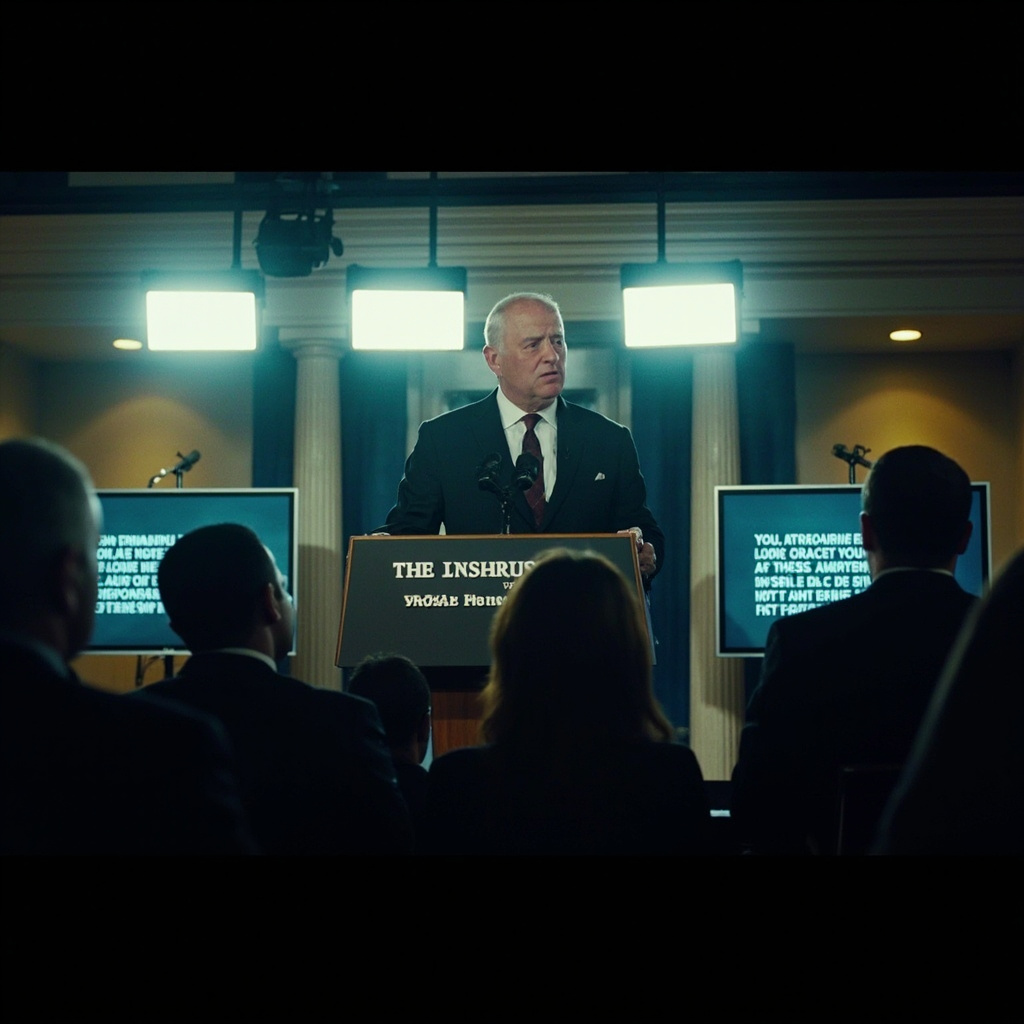
President Donald Trump told the American people on Wednesday night that the war in Iran is "nearing completion." He also told them, in the same speech, that the United States would "hit them extremely hard for the next two to three weeks." [1] The speech lasted 19 minutes. It contained both a promise of exit and a guarantee of escalation. This is the eighth distinct stated aim for the conflict since it began 33 days ago on February 28.
Twenty-four hours earlier, as we reported yesterday, Trump declared he would leave Iran in two to three weeks, an assertion that constituted the seventh publicly stated objective of a war that began without Congressional authorization and has since generated a new justification roughly every 96 hours. The speech was supposed to clarify. It compounded.
The address, delivered from the White House at 9 p.m. Eastern, was Trump's first formal remarks to the nation about the war he launched with Israel five weeks ago. [2] It came after a day in which oil markets gyrated on hope of de-escalation, with Brent crude briefly falling below $100 per barrel before the speech sent it surging back above $106. [3] It came after Iran denied requesting a ceasefire — a claim Trump had made hours earlier that Tehran publicly rebutted. [4] And it came after three of America's five largest European NATO allies refused the US military access to their bases and airspace.
The 19 minutes contained multitudes. Here is an incomplete inventory.
The Nuclear Claim
Trump stated that Iran's nuclear program had been "largely destroyed" and that the goal of preventing a nuclear-armed Iran was "nearing completion." This is the war's original stated purpose — the one invoked when the first strikes hit on February 28. [1] No independent verification exists. The International Atomic Energy Agency has not confirmed the claim. The agency's inspectors were evacuated from Iran during the first week of bombing and have not returned. The fog is not accidental.
The IAEA's last pre-war assessment, from late February, estimated Iran was within weeks of sufficient fissile material for a weapon. Trump's speech did not address whether the centrifuge cascades at Fordow — the facility buried under a mountain — had been hit, or whether the enrichment program at Natanz, which was dispersed to multiple sites after the 2020 assassination of Mohsen Fakhrizadeh, had been fully located. He said "largely destroyed." Largely is not entirely. In nuclear matters, the difference is existential.
The Two-to-Three-Week Promise
In the same speech, Trump vowed to "hit Iran extremely hard over the next two to three weeks." [1] He projected another fortnight of intense military operations. This is the language of escalation, not withdrawal. A listener who tuned in at minute three heard the war ending. A listener who tuned in at minute eleven heard it intensifying.
The New York Times transcript reveals the pivot occurring between paragraph eight and paragraph twelve. [5] In paragraph eight: "Our goals are nearing completion." In paragraph twelve: "We will continue to hit them extremely hard." Between these two statements, Trump discussed gasoline prices, criticized NATO allies, praised the US military, and asserted that Iran's air defenses had been "entirely eliminated." Four minutes of filler separated two claims that cannot both be true in any coherent strategic framework.
The Eight War Aims
The evolution of stated purposes is worth cataloging in full:
February 28 (Day 1): Prevent Iran from obtaining a nuclear weapon. The original casus belli, announced jointly with Israeli Prime Minister Netanyahu.
March 5 (Day 5): Destroy Iran's ballistic missile capability. Added after Iran fired missiles at US naval assets in the Gulf.
March 10 (Day 10): Degrade Iran's proxy network. Expanded to include Hezbollah, the Houthis, and Iraqi militia groups.
March 16 (Day 16): Reopen the Strait of Hormuz. After Iran's naval mining of the strait, Trump declared free navigation a war aim.
March 22 (Day 22): "Total destruction" of Iran's military infrastructure. Escalation following Iranian strikes on Israeli territory.
March 28 (Day 28): Regime change — or not. Trump suggested "the Iranian people deserve freedom," then walked it back within hours.
April 1 (Day 32): Leave in two to three weeks. The first explicit timeline for withdrawal, given during a cabinet meeting.
April 1 (Day 32, evening): "Nearing completion" AND "hit extremely hard for two to three weeks." Both exit and escalation, in the same speech.
Eight aims. Thirty-three days. Some contradict each other. The sixth was abandoned within hours of its announcement. The seventh and eighth were announced on the same day, twelve hours apart, and they point in opposite directions.
The Audience Question
Who was this speech for? The question is not rhetorical. Trump delivered it in prime time, interrupting regular programming, using the formal trappings of a wartime address. [2] He spoke from behind the Resolute Desk. The production was presidential. But the content was a campaign rally grafted onto a war briefing.
He told Americans that gas prices — then averaging $4.06 per gallon nationally, up from pre-war levels [6] — were "temporary" and would come down as Iran's oil infrastructure was taken offline, making way for what Treasury Secretary Scott Bessent called "using Iranian barrels against Iran." He criticized France, Spain, and Italy for denying US military access. He mocked Emmanuel Macron by name. He praised himself for Artemis II, which launched the same day, as though a moon mission scheduled years in advance was a personal accomplishment.
And then he returned to the war. "This will be done soon," he said. Followed, 90 seconds later, by: "We are not finished. Not even close."
The Iranian Response
Tehran's response arrived before Trump finished speaking. President Masoud Pezeshkian, in a statement carried by Iranian state television, denied that Iran had sought a ceasefire and called Trump's speech "a declaration of continued aggression dressed in the language of peace." [4] The IRGC's Sepah News channel published what it characterized as a point-by-point rebuttal within two hours.
The denial matters because Trump opened his speech by claiming Iran "came to us, asked for a deal." No intermediary has confirmed this. Pakistan's foreign minister, who has been mediating alongside China, said on Wednesday that no ceasefire request had been transmitted through his channel. [7] Turkey's foreign ministry said the same. If Iran requested a ceasefire, it did so through a channel no one else has identified. If it did not, the President opened a wartime address to the nation with a fabrication.
The 72-Hour Compression
The temporal compression is unprecedented in American wartime rhetoric. In 72 hours, the President of the United States:
- Said the war's goals were "nearly met" (Monday press conference).
- Said he would leave Iran "in two to three weeks" (Tuesday cabinet meeting).
- Said Iran asked for a ceasefire (Wednesday morning, Truth Social).
- Said Iran's military was "nearing" total destruction (Wednesday speech).
- Said the US would "hit them extremely hard for two to three weeks" (Wednesday speech).
Statements 2 and 5 use identical timeframes — "two to three weeks" — for opposite actions. Statement 2 is a withdrawal timeline. Statement 5 is an escalation timeline. They cannot coexist unless the plan is to hit Iran as hard as possible for exactly two to three more weeks and then leave, regardless of outcome. That would be a strategy of exhaustion, not victory. It has a name in military history: "declare victory and go home."
The @SkylineReport thread on X captured the incoherence with forensic precision: "Trump just delivered a war speech so internally inconsistent it reads like two different addresses stitched together." [8] The @Intel_Sky analysis was blunter, framing the address as "paving the way for a humiliating victory" — the kind where you claim you won, leave, and hope nobody checks. [9]
What Happens Thursday
Thursday, April 2, is now freighted with several convergent deadlines. The IRGC's ultimatum to 18 US companies — Apple, Google, Microsoft, Tesla, Boeing, and 13 others — set an 8 p.m. Tehran time deadline on April 1 for evacuating their Middle East operations. [10] That deadline has now passed with no reported attacks on corporate targets, but the threat remains active.
The Supreme Court heard oral arguments Wednesday on birthright citizenship. Artemis II is executing its trans-lunar injection burn overnight. The DHS shutdown entered its 48th day. The Liberation Day tariffs turned one year old. South Africa is processing its largest single-month fuel price hike in history.
All of these stories are competing for attention with a 19-minute speech that said two opposite things about the same war.
The eighth aim joins the other seven. The pattern is no longer an anomaly. It is the strategy: say everything, commit to nothing, move fast enough that no single statement can be checked before the next one supersedes it. The speech was not confused. It was calculated — offering something to hawks, something to doves, and hoping the contradiction goes unnoticed in the chaos.
It will not. The missiles do not care about messaging. The oil markets do not care about optimism. And the 90 million Iranians living under a 33-day internet blackout cannot hear any of it at all.
-- YOSEF STERN, Washington