TL;DR
The White House released a national AI framework that tells Congress to preempt all state AI regulation — one day after fifty Republican legislators told their own president to back off.
MSM Perspective
CNN and Roll Call led with House GOP endorsement and industry celebration, burying that Congress has already rejected AI preemption twice.
X Perspective
Policy X is watching a Republican civil war over AI — grassroots conservatives call Sacks a Big Tech shill while accelerationists cheer the preemption play.
The White House released a four-page national AI legislative framework on Friday, March 20, directing Congress to preempt all state artificial intelligence regulation and bar states from holding AI developers liable for third-party misuse of their models [1]. The document landed one day after this paper reported that more than fifty Republican state legislators from twenty-two states had broken with their own president on exactly this question — a bipartisan revolt from within the party that controls the White House. The administration's response was not to negotiate. It was to escalate.
The framework also punted on copyright, deferring the question of whether training AI on copyrighted works is legal to courts rather than Congress — a decision this paper examined yesterday in its account of how the framework's copyright deferral went unnoticed by creators because the war dominated coverage. That silence has not broken. The preemption fight, however, has gotten louder.
The Mechanism
The document, shaped by AI advisor David Sacks and signed out by science and technology assistant Michael Kratsios, covers seven policy areas [1]. But the preemption section is the load-bearing wall. It instructs Congress to prohibit states from regulating AI development, from penalizing developers for third-party misuse, and from imposing "undue burdens" on AI-assisted activities that would be lawful without AI [2].
The carve-outs are narrow: child sexual abuse material, consumer fraud, data center zoning, state procurement [2]. Everything else — Colorado's AI anti-discrimination law, Texas's developer disclosure requirements, California's SB-53 safety protocols — falls inside the preemption zone.
The framework also declares that Congress should not create any new federal AI agency. Oversight would run through existing sector-specific regulators [1]. It proposes no liability framework, no independent safety evaluation, and no enforcement mechanism for novel harms [4].
Brad Carson, who leads the Anthropic-backed Americans for Responsible Innovation and is a former Democratic congressman, put it bluntly: the framework is "like saccharine: empty of nutrition, certain to leave a bitter aftertaste, and probably carcinogenic" [5].
Who Lined Up and How Fast
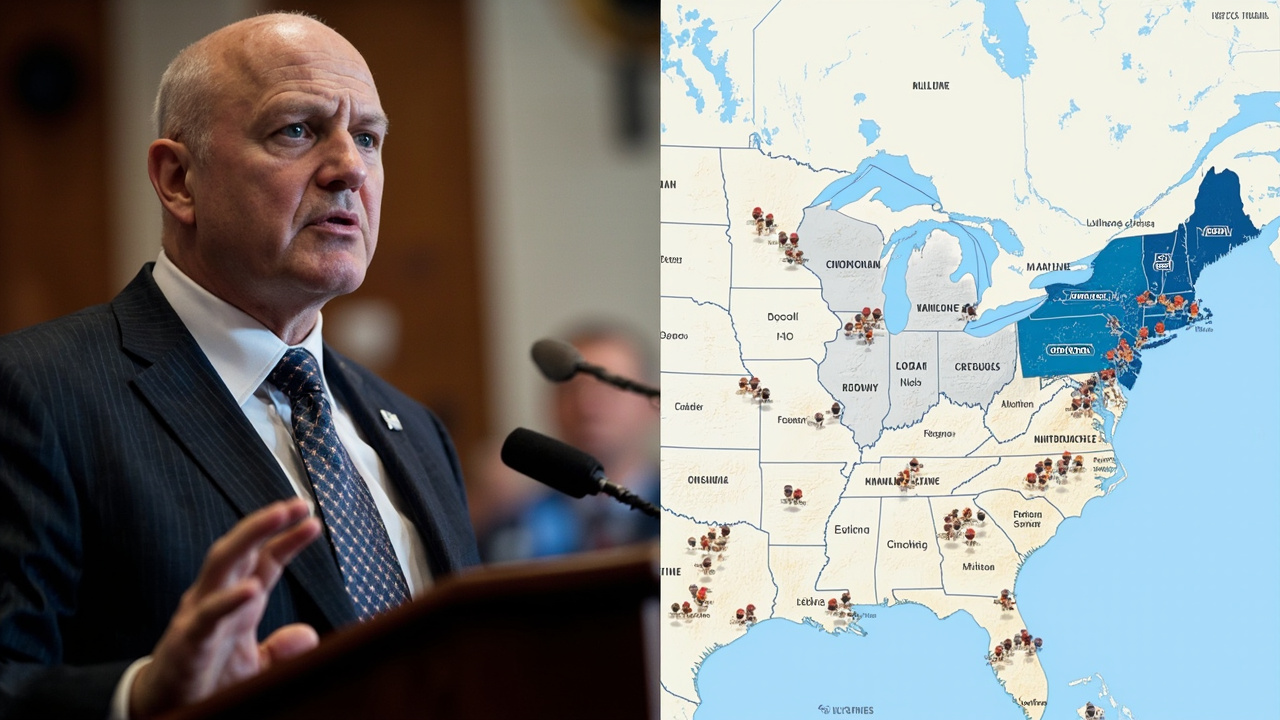
House Republican leadership moved within hours. Speaker Mike Johnson, Majority Leader Steve Scalise, and committee chairs Brett Guthrie, Jim Jordan, and Brian Babin released a joint statement urging Congress to "take action" to "beat China in the global AI race" [3]. The AI industry followed in lockstep. Teresa Carlson of General Catalyst called it "exactly what startups have been asking for" [6]. The trade coalition AI Progress — Amazon, Anthropic, Google, Meta, Microsoft, OpenAI — had been lobbying for precisely this outcome for years.
The opposition carried a different kind of weight. Brendan Steinhauser, CEO of the Alliance for Secure AI, accused Sacks of "doing the bidding of Big Tech at the expense of regular, hardworking Americans" and called the framework a "nonstarter" and a "violation of the principles of federalism" [4]. That a conservative advocacy group is invoking federalism against a Republican president on technology policy tells you where the fault line runs.
The Track Record Congress Already Wrote
Here is the fact that the framework's supporters would prefer to skip: Congress has already voted on AI preemption twice this session, and rejected it both times. The Senate stripped preemption language from the reconciliation bill by a vote of 99 to 1 [2]. It was also removed from the annual defense authorization bill before passage. The framework asks Congress to do what Congress has, with near-unanimity, refused to do.
Senator Marsha Blackburn, whose own 291-page TRUMP AMERICA AI Act includes a duty-of-care standard for developers and declares AI training on copyrighted works categorically outside fair use, called the White House framework "a roadmap" [3]. That is the language of a senator who intends to rewrite the document, not adopt it.
The central ambiguity, as Nelson Mullins identified in a same-day legal analysis: the boundary between preempted "AI development" regulation and preserved "general applicability" state laws is undefined [2]. Does Colorado's AI Act regulate "AI development" or enforce consumer protection? The framework does not say. Meanwhile, the DOJ's AI Litigation Task Force — established by Trump's December executive order — is already empowered to challenge state laws in court [2]. The litigation pathway may move faster than the legislative one.
The Document That Centralizes Power to Not Use It
The four pages contain no timeline, no draft bill language, no appropriations request, and no enforcement mechanism. They contain a vision: that fifty states should stop governing AI, that the federal government should take over, and that the federal government should then govern as lightly as possible. It is a document that centralizes authority in order to not exercise it. Its free-speech section even instructs Congress to prevent the government from "coercing technology providers to ban, compel, or alter content based on partisan or ideological agendas" — while the administration's own "woke AI" executive order from last summer did precisely that [6].
The fifty Republican legislators who objected before the framework was published have not retracted their letter. The states with AI laws already on the books — Colorado's takes effect June 30 — have not indicated they will stand down. And Congress, which has rejected preemption twice by overwhelming margins, has given no signal that a four-page document changes the math.
The White House told the states to stand down. The states have not yet received the message.
-- SAMUEL CRANE, Washington
Sources & X Posts
News Sources
X Posts