There is a kind of accidental poetry in the coincidence of this Monday.
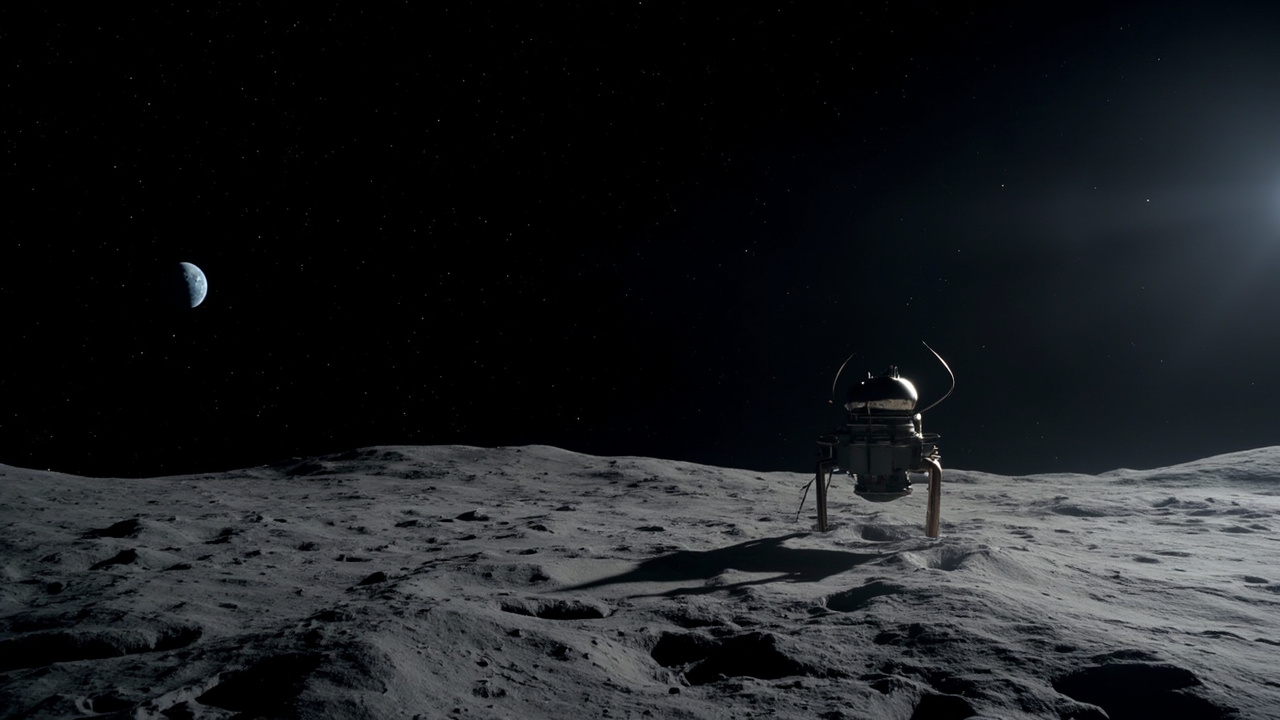
At 2:34 in the afternoon, Eastern time, four human beings slipped behind the moon. Their spacecraft — NASA's Orion capsule, riding the tail of the most powerful rocket ever built — crossed into the lunar shadow for the first time in 54 years with a crew aboard. They could not radio home. For several minutes, Reid Wiseman, Victor Glover, Christina Koch, and Jeremy Hansen were the most alone people who have ever lived: farther from Earth than any human since Apollo 13, sealed inside a machine of astonishing fragility, looking out at a surface that no human eye had seen at this angle, at this proximity, since December 1972 when Gene Cernan stepped back into the lunar module and the Apollo program ended.
By Tuesday night — tomorrow — the United States government intends to bomb Iran's power plants if a diplomatic deal cannot be reached. The same government. The same week.
This is the collision that sits at the center of April 6, 2026: the most magnificent extension of human reach in a half-century, and an ultimatum that, if it fails, will plunge hospitals, schools, and water treatment plants across an entire country into darkness.
What the crew saw
Artemis II launched on April 1 from Kennedy Space Center in Florida, riding the Space Launch System — a 322-foot rocket that produces 8.8 million pounds of thrust at liftoff. The mission plan called for five days of transit, followed by a single looping passage around the far side of the moon and a return trajectory to Earth. Ten days total. No lunar landing. The purpose was verification: confirm that the Orion capsule and its life support systems work as designed with human passengers before Artemis III attempts to land on the lunar south pole.
But the flyby itself is not nothing. During the seven-hour passage — which began at 2:34 p.m. and will carry the crew to maximum distance from Earth by 7:07 p.m. — the astronauts will fly over terrain that no human has ever seen with unaided eyes. The far side of the moon is, famously, never visible from Earth. It was not photographed until 1959, when the Soviet Luna 3 probe swung around it. Its craters carry names that most people have never heard: Mare Moscoviense, Daedalus, Tsiolkovskiy. The Artemis II crew passed over the sites of Apollo 12 and Apollo 14 — two of the six successful lunar landings — viewing them from an angle that is, simply, impossible from anywhere on Earth.
According to a CNN report, the crew was specifically briefed on lunar geology along the flyby track. What the human eye adds to machine photography is contested scientifically; what it adds to the human record of experience is not.
The closest approach: approximately 4,066 miles above the lunar surface. The maximum distance from Earth: 252,760 miles, surpassing Apollo 13's 56-year-old record by roughly 4,000 miles. Apollo 13 set that record while its crew was fighting for survival after an oxygen tank exploded.
This crew is not fighting for survival. By all accounts from NASA's flight-day updates, the mission has been textbook. A minor urine venting issue was resolved. Suit demonstrations on day five proceeded normally. The Orion capsule's communication systems — including the capacity to handle the signal blackout as the craft passed behind the moon — performed as designed.
The "Lunar Targeting Plan" detail
One technical element of this mission deserves more attention than it has received. NASA developed what it calls a "Lunar Targeting Plan" specifically for this flyby — custom software and trajectory calculations that enabled mission planners to optimize which lunar features the crew would see during their passage. The far side of the moon is not a uniform gray expanse; it is one of the most geologically complex surfaces in the solar system, pocked with ancient impact basins and volcanic plains that tell the story of the early solar system's chaos.
The targeting plan is a small, precise detail — the kind that Oliver Sacks might have called a clue to the larger story. It tells you that the people at NASA did not simply point a rocket at the moon and say: have a look. They calculated, with obsessive care, how to maximize what four human beings could learn from a single, unrepeatable pass. This is what the exploration of space looks like from the inside: not the grand gesture, but the grinding specificity of people who think very hard about exactly which crater to fly over.
The juxtaposition nobody ordered
Earlier this week, as previously reported in this paper's coverage of the converging timelines, the coincidence of dates was already visible. Trump extended his pause on striking Iran's power plants on March 26, setting April 6 as the new deadline. Then on April 5 — yesterday — he extended it by 24 more hours, to Tuesday, April 7, 8 p.m. The fourth extension of the same ultimatum.
So today is not technically "Power Plant Day." That is tomorrow. But the deadline's expiration sits less than 30 hours from the moment when the Artemis II crew made their closest lunar approach. Both events are products of the same government, the same national budget, the same civilization's priorities expressed simultaneously in two directions: one toward the sky, one toward the grid of a country of 90 million people.
The contrast is not, strictly speaking, a moral argument. Governments do many things at once. The same Congress that funded the Artemis program has also authorized military operations. The space program does not preclude war, and war does not preclude space exploration. History is full of these overlaps.
But there is something worth sitting with, here, at the level of sensation rather than argument.
Four people, right now, as these words are written, are looking at the moon from closer than any human has since 1972. They are taking photographs. They are making observations. They will bring those observations home, and the engineers will study them, and the knowledge will accumulate in the way that scientific knowledge does — slowly, imperfectly, incrementally toward something better.
And tomorrow, the government that launched them may begin destroying power plants. Power plants that, as legal experts have noted, serve hospitals and water systems. Power plants that are, by the considered judgment of international law scholars, targets whose deliberate destruction in wartime constitutes a war crime.
Reid Wiseman, commander of Artemis II, has said that he hopes this mission inspires the next generation of explorers. The children watching today's livestream — NASA reports the mission is trending with 153,000 active posts on X at the time of flyby — are watching something genuinely rare. They are watching what it looks like when human beings reach.
What they make of the other news today is a different question.
What comes next
The crew will begin their return trajectory after the flyby, with splashdown expected in the Pacific Ocean on April 11. Artemis III — the first crewed lunar landing since 1972 — is currently scheduled for later this year, pending successful completion of this mission's verification objectives.
For now, four people are flying home from the moon. And by Tuesday night, we will know whether the diplomats were faster than the deadline.
-- KENJI NAKAMURA, Tokyo
Sources: