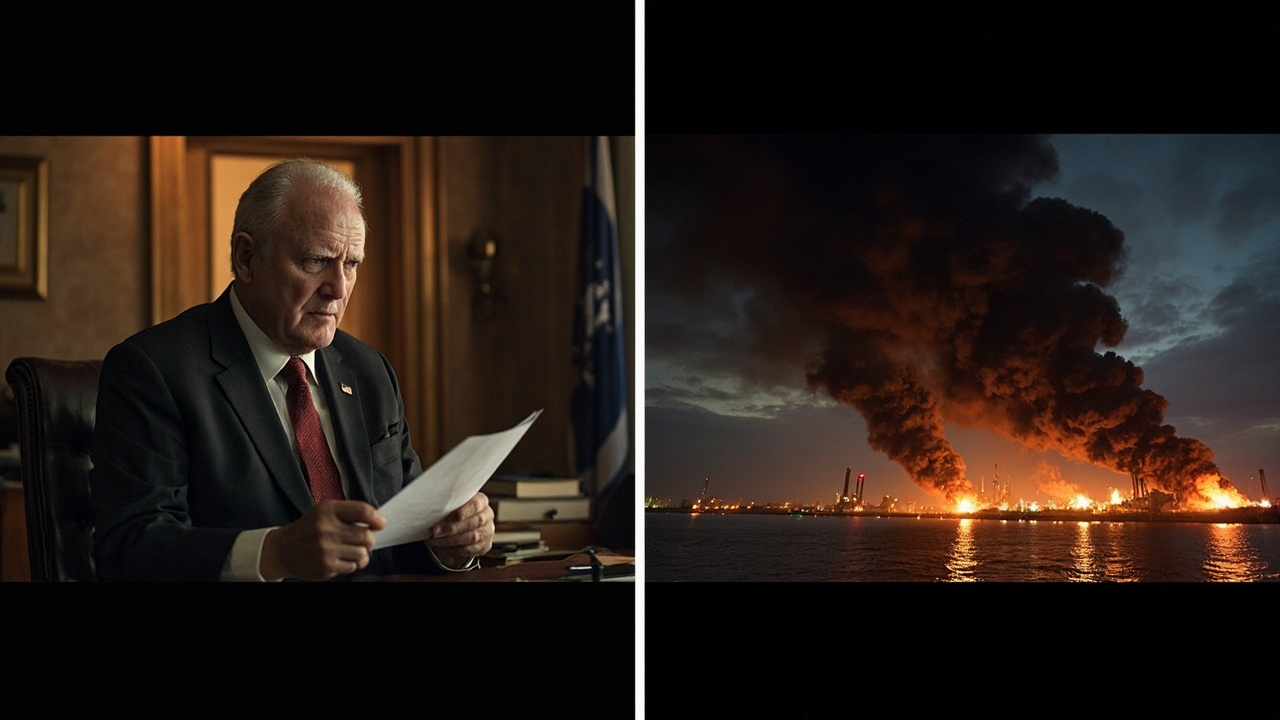
JERUSALEM -- At approximately 11 p.m. local time Sunday, Iran and the United States simultaneously received a draft framework for ending the war. By daylight Monday, US-Israeli strikes had killed the intelligence chief of the Islamic Revolutionary Guard Corps, destroyed Iran's largest petrochemical complex, and detonated a projectile 75 meters from the core of the Bushehr nuclear reactor. The ceasefire proposal and the strike package arrived on the same deadline day. [1]
The proposal originated with a mediation group led by Pakistan's Field Marshal Asim Munir, with Egypt and Turkey contributing to the final text. [2] The framework is two-phase. Phase one: an immediate ceasefire, the Strait of Hormuz reopened. Phase two: within 15 to 20 days, a comprehensive settlement covering sanctions relief, Iran's frozen assets, nuclear commitments, and a regional nonaggression architecture. The ceasefire period would be 45 days, extendable if negotiations required more time. [3]
It is the most structurally complete proposal since the war began 37 days ago. Yesterday's paper covered Zarif's peace plan and the Gulf states' fury at being excluded — today's framework supersedes it in scope, involving three governments and a two-phase timeline that moves beyond Zarif's bilateral architecture. The question of whether the Gulf states are represented in the mediation track remains unanswered.
But the proposal arrived into a war that did not pause to receive it.
What Happened on the Same Day
Maj. Gen. Majid Khademi, the head of the IRGC's intelligence organization, was killed in US-Israeli strikes Monday morning. [4] He was the second intelligence chief to die in the war — his predecessor was killed in earlier Israeli airstrikes, and Khademi had only been appointed to replace him. [5] The IRGC confirmed his death via the Tasnim news agency. Israel's Defense Minister Israel Katz subsequently confirmed the killing, calling Khademi's death part of Operation Roaring Lion. [6] Twenty-five additional personnel were reported killed in the strikes.
Simultaneously, IDF strikes hit Iran's largest petrochemical complex at Mahshahr in southwestern Khuzestan province. The facility encompasses more than 50 individual petrochemical companies. Five people were killed and 170 injured. [7] The New York Times reported that US-Israeli strikes took down two utility plants within the complex — the facilities providing gas and basic services to all 50-plus companies — effectively shutting down the entire zone at once. [8]
The third major action of the day reached Iran's Bushehr nuclear plant, which has now been struck five times since the war began. A projectile detonated 75 meters from the reactor core, according to the Times of Israel citing the IAEA. [9] The IAEA's Rafael Grossi confirmed the strike. One staff member was killed by shrapnel. No radiation release was detected. The distance from the reactor has shrunk with each successive strike — 350 meters on March 18, closer again on March 24, and now 75 meters. The trajectory is not ambiguous.
The Proposal's Architecture
The mediation team — Field Marshal Munir speaking to both the Iranian Foreign Ministry and US officials through the night — sketched a deal that addresses the war's two core disputes: Hormuz and the nuclear program. [10] Phase one requires Iran to reopen the strait, which has been closed since the war began, in exchange for an immediate US-Israeli halt to strikes. Phase two negotiates the permanent settlement, including sanctions relief, the return of frozen Iranian assets, and an Iranian commitment to nuclear limits that would be formally verified.
The Islamabad Accord, as it is being called in some dispatches, includes nuclear curbs and some form of sanctions relief as part of the final settlement framework. [11] Whether Iran's nuclear commitments would match what Washington has demanded — zero enrichment, or a return to the JCPOA threshold — was not specified in the public reporting of the proposal's terms.
Iran received the proposal and said it was reviewing it. Then Iran's Foreign Ministry spokesman Esmaeil Baghaei stated plainly that "negotiation is not at all compatible with ultimatums, crimes, or threats to commit war crimes." [12] A senior Iranian official told Reuters that Tehran would not reopen the Strait of Hormuz in exchange for a temporary ceasefire. Iran's position, consistently held across six weeks of war, is that the Hormuz closure is not a bargaining chip to be traded for a pause — it is leverage for a permanent settlement.
Trump's position arrived separately, in a Truth Social post that made the diplomatic track look like a side story. "Tuesday will be Power Plant Day, and Bridge Day, all wrapped up in one, in Iran. There will be nothing like it!!!" [13] He extended the April 6 deadline to Tuesday at 8 p.m. Eastern — a gesture toward the ceasefire framework, or a continuation of the pattern in which Trump issues ultimatums and then extends them. He also told reporters a deal was "possible." [14]
Two Tracks, One Day
The convergence of events on April 6 illuminates the structural problem that has plagued every diplomatic initiative since the war began: the military track and the diplomatic track are operating independently of each other, and the military track is faster.
A ceasefire proposal requires both parties to agree to stop fighting. But killing an intelligence chief is not a signal that you want to stop fighting. Destroying a petrochemical complex employing tens of thousands of workers is not a signal that you want to stop fighting. Striking 75 meters from an active nuclear reactor — closer than any previous strike — is not a signal that you want to stop fighting.
From Tehran's perspective, Monday's strike package conveyed a different message than Monday's ceasefire proposal. The Foreign Ministry's response — that negotiation cannot coexist with ultimatums and war crimes — reflects an institutional reading of what happened, not a rhetorical one. Iran was offered a deal and bombed on the same morning.
From Washington's perspective, the military pressure is the leverage that makes the deal possible. Trump's advisers have consistently argued that Iran will only negotiate if it faces escalating cost. The targeted killing of Khademi, coming on the deadline day, is designed to demonstrate that the cost of refusal continues to rise even as an exit ramp is being offered.
The problem is that Iran's government has staked public credibility on not negotiating under threat. The Supreme Leader's office has not moved from that position in six weeks. Zarif's proposal last week — which the paper covered as the war's first serious off-ramp — circulated without explicit regime endorsement, allowing Tehran to preserve deniability. The 45-day framework is different: it was received by the Foreign Ministry directly, which means responding to it is official policy, not a kite-flying exercise.
The Haifa Retaliation
Iran did not wait for Tuesday. An Iranian missile struck a residential building in Haifa on Sunday evening, killing four people. [15] The bodies were recovered from the rubble following hours of search-and-rescue operations. The strike was Iran's response to the Mahshahr petrochemical attack and the continued strikes on Bushehr. It was the kind of retaliation that makes ceasefire proposals harder to sell in Israeli and American domestic politics, and which Iran's military calculus demands regardless of diplomatic conditions.
The Haifa strike and the ceasefire proposal existed simultaneously on Sunday evening. By Monday morning, the intelligence chief was dead and the petrochemical complex was burning.
What Tuesday Holds
Trump's extended deadline points to Tuesday at 8 p.m. Eastern. "Power Plant Day, and Bridge Day," in his words. Bushehr is a power plant. Whether it remains on the target list — or whether the ceasefire framework has created a pause in the power-plant track — is the question that cannot be answered by reading either the diplomatic or the military signaling in isolation.
Field Marshal Munir reportedly spoke through the night. The proposal is real. Iran is reviewing it. Trump is threatening Tuesday. The IRGC's intelligence chief is dead. The petrochemical complex at Mahshahr is offline. The fifth strike on Bushehr landed 75 meters from the reactor.
The proposal and the war contradicted each other on the same day. That contradiction is the story of April 6.
-- YOSEF STERN, Jerusalem