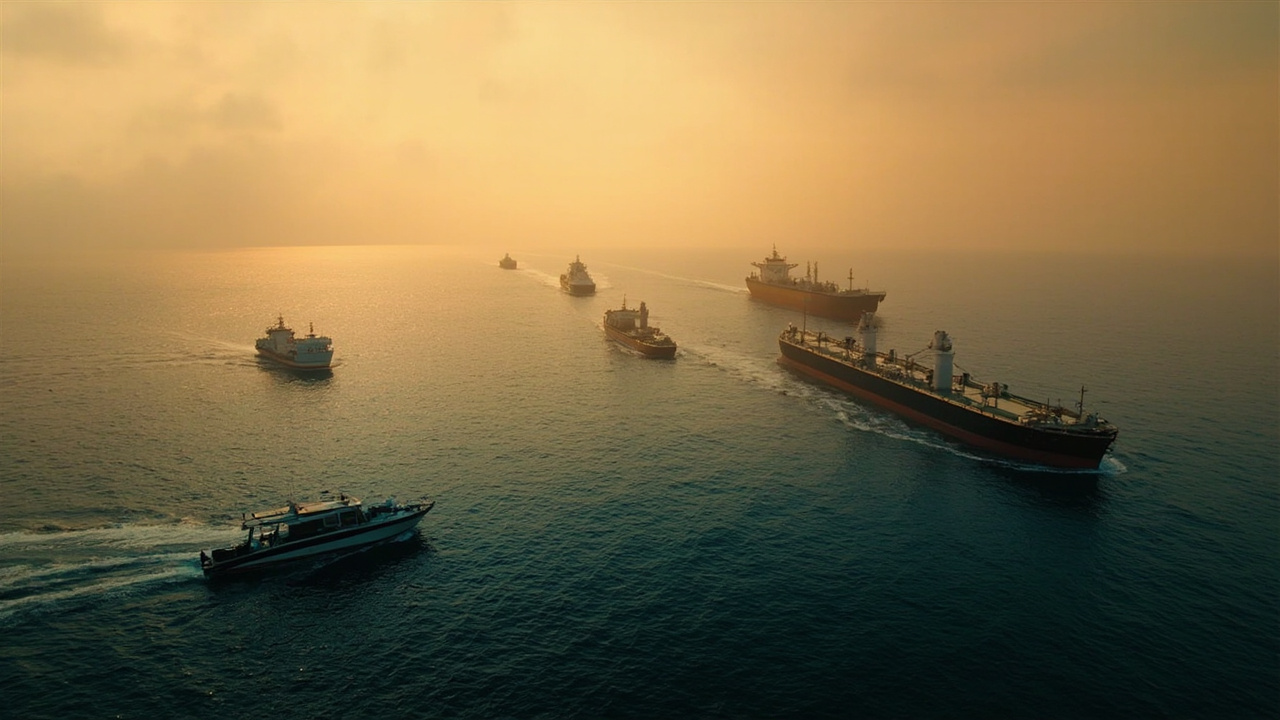
JERUSALEM — The ceasefire between the United States and Iran lasted approximately thirty-one hours before it collapsed under the weight of its own architecture. On Wednesday evening, Iran's Supreme National Security Council announced the re-closure of the Strait of Hormuz, citing Israel's killing of 254 people across Lebanon as a material breach of the truce. [1] By Thursday morning, the IRGC Navy had published mine-avoidance maps — a remarkable document that simultaneously guided shipping and confirmed the existence of the mines it was routing them around. [2]
The ceasefire, announced by President Trump on Tuesday evening and welcomed by Tehran's negotiators within hours, was supposed to buy fourteen days of breathing room. Its centerpiece was the reopening of Hormuz, the 21-mile chokepoint through which a fifth of the world's oil passes. But the agreement contained a fault line visible from the moment ink touched paper: Lebanon was carved out. [3]
This paper wrote yesterday that the ceasefire was a pause, not a peace, and that Lebanon's exemption was its buried landmine. That landmine detonated in under two days. The Lebanon carveout was the ceasefire's fatal flaw, and now both sides are pointing at the other across the rubble.
Two Readings, Both Correct
The disagreement is not about the facts. It is about the text.
Iran's position, articulated by Foreign Minister Abbas Araghchi and echoed by the Supreme National Security Council, is that the ceasefire was understood to cover all theaters of the broader conflict — including Lebanon, where Hezbollah had voluntarily paused its operations in good faith. [4] From Tehran's vantage, Israel's massive strikes on Wednesday — the deadliest single day of the Lebanon campaign, killing 254 and wounding 1,165 — constituted a breach so flagrant that continued restraint on Hormuz was untenable. [1]
Washington's reading is different but equally defensible. Senior U.S. and Israeli officials stated on April 7 and 8 that the Israeli campaign in Lebanon was never part of the bilateral U.S.-Iran framework. [5] Vice President JD Vance, speaking from Budapest before departing for Islamabad, called it "dumb" for Iran to "derail the ceasefire over Lebanon." [6] White House spokesman Karoline Leavitt insisted the ceasefire's terms required a "free" reopening of the strait, with no tolls, and that Lebanon was a separate matter. [7]
Both readings are technically correct. The ceasefire text, as published, addresses the bilateral U.S.-Iran conflict. It does not explicitly include Lebanon. But the war that produced the ceasefire is not bilateral. It spans six theaters: Iran proper, the Strait of Hormuz, Lebanon, Yemen, Iraq, and Syria. A ceasefire that addresses one chokepoint while the deadliest theater burns is not a ceasefire in any meaningful operational sense. It is a shipping agreement with diplomatic aspirations.
The Mine Map as Confession
The most extraordinary document to emerge Thursday was not a diplomatic cable but a nautical chart. Iran's IRGC Navy published a map showing alternative transit routes through the Strait of Hormuz, explicitly instructing ships to use designated corridors to avoid sea mines. [2] The Times of Israel reported that the map, distributed through Iranian state media, showed entry and exit routes designed to guide vessels around mined areas. [8]
In any other context, this would be classified as a weapon disclosure. A sovereign nation published a diagram showing where it placed explosive ordnance in an international waterway. The legal implications under the UN Convention on the Law of the Sea are severe. But the document was covered primarily as a logistics advisory — a helpful note for shipping companies, rather than confirmation that Iran had mined one of the world's most critical trade arteries.
The BBC's analysis confirmed what the map implied: despite the ceasefire announcement, only a handful of vessels had crossed the strait. [9] Traffic remained at a fraction of normal levels. Shipping companies, insurance underwriters, and flag states were not waiting for diplomatic clarification. They were reading the mine map.
Oil Reads the Fine Print
Markets responded with the speed they always do when Hormuz is involved. Brent crude, which had plunged 14.3 percent on Tuesday's ceasefire announcement to roughly $93.60 per barrel, reversed course. By early Thursday trading, Brent had climbed back to $97.35, a gain of 2.74 percent, with West Texas Intermediate following in parallel. [10]
The pattern is now familiar. On April 6, this paper documented how markets traded the ceasefire headline, not the underlying reality. The cycle has repeated: announcement drives prices down; operational facts drive them back up. Oil traders, whatever their sophistication, cannot resist the initial headline. But within 24 to 48 hours, the physical market — the ships that won't sail, the insurers who won't underwrite, the refiners who can't source — reasserts itself.
The re-closure means that the approximately twelve daily transits Iran had reportedly offered as a concession are now back to zero. For the global energy system, the difference between a closed strait and a partially open one is the difference between a crisis and a catastrophe. Both are bad. But the partial opening at least permitted some planning. Re-closure returns the system to full uncertainty.
254 Dead in a Ceasefire's Shadow
What triggered Iran's reversal was not a minor infraction. Lebanon's Civil Defence reported 254 killed and 1,165 wounded across the country on Wednesday — the deadliest single day since Israel's renewed campaign. [1] Strikes hit targets in Beirut, Tyre, and the Bekaa Valley. The ICRC issued a statement saying it was "outraged" by strikes in densely populated areas. [11]
Hezbollah had paused its operations as a gesture of compliance with the spirit of the U.S.-Iran ceasefire. Israel, operating under the stated understanding that Lebanon was not covered, did not reciprocate. The result was a one-sided killing day in which the party that showed restraint absorbed the worst casualties.
For Iran's domestic audience, the optics were devastating. The Revolutionary Guard could not credibly maintain a ceasefire posture while Lebanese allies were being killed at rates exceeding any previous single day. The re-closure of Hormuz was, from Tehran's perspective, not escalation but restoration of the status quo ante: the ceasefire had been violated, so its benefits were withdrawn.
Islamabad Tomorrow
Against this backdrop, the diplomatic calendar continues. Pakistan's Prime Minister Shehbaz Sharif has invited both delegations to Islamabad for Friday, April 10. Vice President Vance, fresh from campaigning for Viktor Orbán in Budapest, will lead the U.S. delegation. Iran's Parliament Speaker Mohammad Baqer Qalibaf will head Tehran's team. [12]
Iran's 10-point plan, published ahead of the talks, calls for the acceptance of Iran's right to enrich uranium, the lifting of all primary and secondary sanctions, compensation for war damages, and — critically — a permanent end to hostilities that includes Lebanon. [13] Trump called the plan "a workable basis on which to negotiate." The White House subsequently clarified that the president's "red line" against Iranian nuclear enrichment remains. [14]
The enrichment gap is irreconcilable within any 14-day window. Iran insists on enrichment as a sovereign right. The United States insists on denuclearization as a prerequisite. These positions have been incompatible since 2003. No Islamabad summit will resolve what two decades of negotiation could not.
The Architecture of Failure
What failed this week is not diplomacy per se, but the architecture of partial agreements applied to total wars. The ceasefire tried to isolate Hormuz from Lebanon, as if energy flows and ground wars operate on separate circuits. They do not. Iran's strategic logic has always linked the strait to the broader conflict: Hormuz is Tehran's asymmetric leverage, exercised precisely because it cannot match American or Israeli conventional power.
To separate Hormuz from Lebanon in a ceasefire framework is to misunderstand why Iran closed Hormuz in the first place. The strait was never closed because of a bilateral U.S.-Iran dispute over shipping lanes. It was closed because Iran was being bombed, its allies were being killed, and the blockade was the one card Tehran could play that the world could not ignore.
The mine map makes this explicit. Iran is not pretending the mines do not exist. It is showing you where they are and telling you to steer around them. This is not the behavior of a nation that has accepted a ceasefire. It is the behavior of a nation that has placed its weapons on a published grid and is daring you to sail through anyway.
Vance arrives in Islamabad tomorrow with a ceasefire that has already broken, a strait that is re-closed, a mine map that functions as both navigation aid and threat, and an enrichment gap that no two-week pause can bridge. Qalibaf arrives with 254 dead Lebanese as his opening argument.
The ceasefire did not fail because one side cheated. It failed because it was designed to succeed only if the deadliest part of the war stopped happening. It did not stop. It accelerated. And the architecture, which had no load-bearing wall for Lebanon, collapsed under a weight it was explicitly built to ignore.
Late update: Trump posted on Truth Social Thursday morning that all US ships, aircraft, and military personnel would remain deployed around Iran "until such time as the REAL AGREEMENT reached is fully complied with." He warned the shooting would be "bigger" and "better" if the deal is violated. The word "real" — in capitals — suggests even the president does not consider the current ceasefire the final product. Hezbollah, separately, broke its pause in the early hours of Thursday, firing rockets at northern Israel for the first time since the ceasefire announcement.
-- YOSEF STERN, Jerusalem