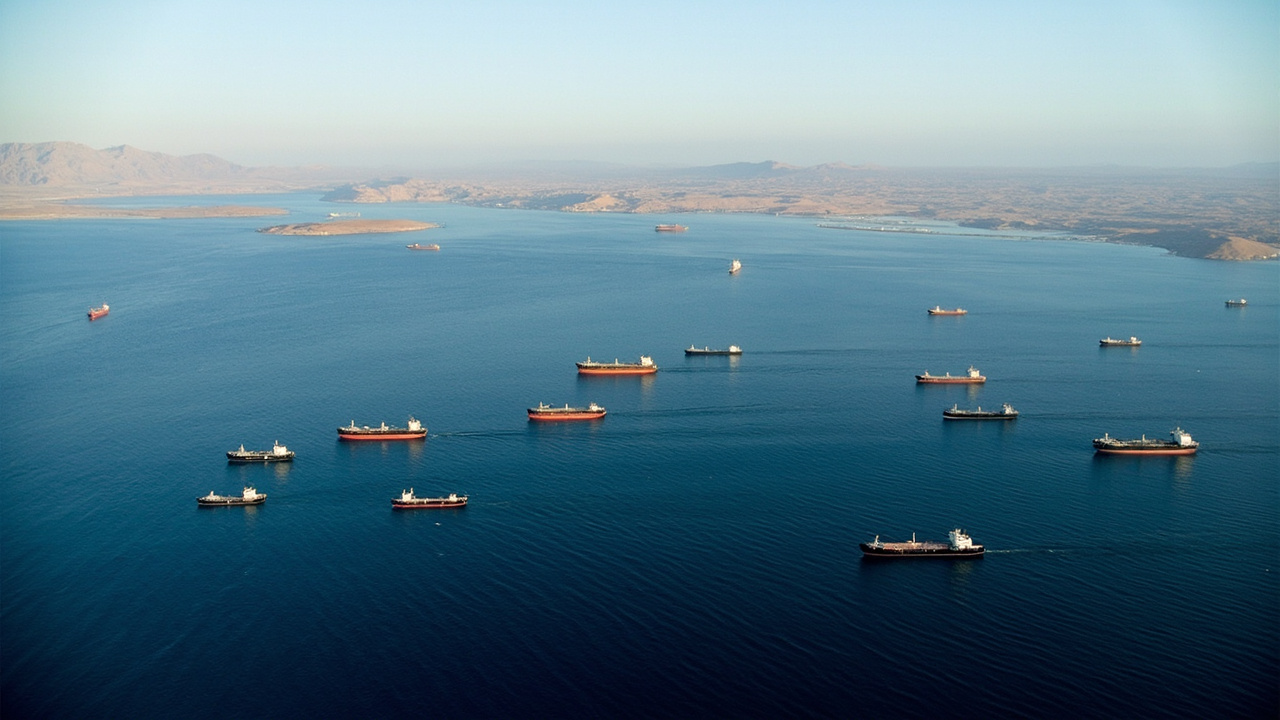
The ceasefire was announced six days ago. Brent crude futures fell eleven dollars in forty-eight hours. Headlines declared the energy crisis easing. And yet, as of Friday morning, the Strait of Hormuz is processing roughly seven commercial vessels per day against a pre-crisis baseline of approximately 140 [1]. The ceasefire created a futures market event that has no physical supply chain counterpart.
As we reported yesterday, the strait remains functionally closed. Today the story has evolved from a shipping crisis into a pricing crisis — one that exposes how disconnected the financial instruments that set global energy prices have become from the physical infrastructure that actually moves oil.
The number that matters most right now is not the price of Brent futures, which sits between $95 and $97. It is the price of dated physical Brent — actual barrels available for actual delivery — which trades at $131 to $132 [1][2]. The gap between those two numbers is approximately $36. In normal markets, that spread is measured in single digits. A $36 differential is not a market anomaly. It is a market telling two different stories at once.
Why the Strait Is Still Closed
Understanding the gap requires understanding what the ceasefire actually changed on the water. The answer, by any operational measure, is very little.
Iran's Islamic Revolutionary Guard Corps continues to direct vessel traffic through what it calls the Northern Corridor, a routing that takes ships around Larak Island under IRGC supervision [3]. Iran charges a toll of approximately $2 million per transit, payable in advance, with no guarantee of safe passage beyond the immediate corridor [5]. The mines that were laid during the conflict remain uncleared [1]. Insurance premiums for Hormuz transit have risen to 35 to 50 times their pre-crisis levels [2].
To understand how extraordinary that insurance number is, consider what it means in practice. A standard war-risk premium for a VLCC — a Very Large Crude Carrier — transiting contested waters might run to $50,000 in a moderately elevated threat environment. At 35 to 50 times normal, that figure becomes $1.75 million to $2.5 million for a single transit. Add the $2 million toll and the ship owner is paying roughly $4 million in surcharges before the vessel even enters the corridor. For a cargo of two million barrels, that works out to an additional $2 per barrel just for passage rights — a cost that flows directly into the physical price of crude and widens the gap with futures.
The result is a strait that is technically open in the diplomatic sense and effectively closed in the operational sense. Fewer than ten percent of normal traffic volume is moving through [1][4]. The ships that are transiting fall into two categories — sanctioned tankers with little to lose and Chinese-origin vessels operating under bilateral security arrangements that predate the ceasefire [3]. Western-flagged commercial shipping has not returned.
Maersk, the world's second-largest container shipping company, has publicly refused to resume Hormuz transits [2]. ADNOC's chief executive has stated plainly that the strait is "not open" in any commercially meaningful way [6]. These are not cautious hedges from risk-averse bureaucrats. They are operational assessments from companies whose business depends on moving cargo through that waterway. When the people who move oil for a living say the waterway is closed, the futures market's disagreement is not a signal of superior information. It is a signal of detachment from operational reality.
426 Tankers Going Nowhere
The scale of the physical bottleneck is staggering. According to shipping data compiled this week, 426 oil tankers and 34 LPG carriers remain anchored or drifting in holding patterns near the strait's approaches [3][7]. These vessels represent millions of barrels of crude and liquefied petroleum gas that exist in the physical world but have been subtracted from the supply chain.
Each day those ships sit idle, they accumulate demurrage charges — fees paid to vessel owners for delays beyond contracted delivery windows. Those charges compound. They ripple into refinery scheduling, into product delivery timelines, into the price consumers eventually pay for gasoline and heating oil and jet fuel. The 426 tankers are not an abstraction. They are a cost center that the futures market has chosen to ignore.
The backlog will take months to clear even under optimistic assumptions about reopening [7]. Ports on both sides of the strait lack the berth capacity to process a surge of delayed vessels simultaneously. Pilotage services through the corridor are bottlenecked. Inspection protocols for mine-risk transit add hours to each passage. The logistics of reopening a strait are not the logistics of flipping a switch.
Consider the arithmetic of the queue. If the strait returned to full capacity tomorrow — all 140 transits per day — it would still take weeks to process the backlog of 460 vessels waiting their turn on top of normal traffic. But the strait will not return to full capacity tomorrow. It will ramp up gradually, if it ramps up at all, as mine clearance proceeds, insurance markets adjust, and shipping companies individually assess whether the risk profile has genuinely changed. Each of those processes operates on its own timeline. Mine clearance is measured in months. Insurance repricing takes weeks. Corporate risk assessments happen vessel by vessel, route by route, cargo by cargo [7].
The Futures Market's Convenient Fiction
Financial markets, however, operate on different inputs than shipping lanes. When the ceasefire was announced, algorithmic trading systems responded to the headline. Brent futures dropped because the word "ceasefire" activates a set of assumptions — that hostilities have ended, that commerce will resume, that supply will normalize. Those assumptions are encoded into models that move billions of dollars in positions within seconds.
The physical oil market does not move in seconds. It moves in weeks and months, on the decks of ships that travel at fourteen knots through contested waters. The $36 spread between paper Brent and physical Brent is the distance between a financial model's assumption and a ship captain's reality.
JP Morgan's commodity desk warned this week that if the current stalemate extends through April, Brent crude will reach $120 on the futures side as the physical reality forces a convergence [2]. That convergence can only happen in one direction. Paper cannot make ships move. But stranded ships can eventually make paper move.
The mechanism of convergence is well understood by commodity traders even if it is invisible to headline writers. As futures contracts approach their delivery dates, they must settle against actual barrels. A June Brent contract priced at $97 is a promise that someone will deliver physical oil at $97 in June. If the physical market is pricing that oil at $132, no rational seller will deliver at $97. They will sell on the physical market instead. The futures price must rise to meet the physical price, or the contract will fail to attract sellers. This is not theory. It is the basic mechanics of commodity settlement, and it means the $36 gap has an expiration date — the only question is how violently it closes.
The Institutional Lie
The deeper problem is what the gap reveals about how ceasefire narratives function in energy markets. The ceasefire between the United States and Iran was a diplomatic achievement in the narrow sense — it stopped active military strikes on commercial vessels. But it did not address the IRGC's toll system, the uncleared mines, the insurance market's risk assessment, or the physical infrastructure damage to port facilities along the Iranian coast [5][6].
What the ceasefire did accomplish, with remarkable efficiency, was the creation of a political talking point. Officials in Washington and Tehran can both claim that the strait is open. The futures market can price in that claim. And for a few days, the headline price of oil can fall, providing the appearance of crisis resolution.
But appearances have a half-life. Every day that 426 tankers remain anchored, the gap between narrative and reality becomes harder to sustain. Every cargo that arrives late, every refinery that adjusts its run rate downward, every insurance premium that remains elevated — these are data points that accumulate beneath the headline.
The physical oil market is an accounting system that does not accept diplomatic press releases as payment. Barrels must move from where they are extracted to where they are refined, on ships, through straits, past mines, under insurance coverage that someone is willing to underwrite. When the infrastructure for that movement is disrupted, no amount of paper trading can substitute for it.
What Happens Next
The coming week will test whether the futures market corrects toward physical reality or whether physical conditions improve enough to justify the current paper price. The indicators to watch are straightforward — daily transit counts through the strait, insurance premium trends, and the rate at which the anchored fleet begins to move [1][7].
If transit volumes remain below ten percent of normal, the $36 gap will widen. Refineries in Asia and Europe that depend on Gulf crude will begin drawing down strategic reserves or seeking alternative supply from West Africa and the Americas at premium prices. Those substitution costs will eventually surface in consumer fuel prices regardless of what the Brent futures screen says.
The geographically concentrated nature of the disruption compounds the problem. The Strait of Hormuz handles roughly twenty percent of the world's oil supply under normal conditions [4]. There is no alternative route for Gulf producers — Saudi Arabia, the UAE, Kuwait, Iraq, and Qatar — that does not add thousands of miles and weeks of transit time. The East-West Pipeline across Saudi Arabia has limited spare capacity. Rerouting around the Cape of Good Hope adds thirty days of sailing time and proportional fuel and crew costs. These are not solutions. They are expensive palliatives that confirm the scale of the problem [6].
For consumers in importing nations — Japan, South Korea, India, much of Europe — the gap between the futures screen and the physical market is not an abstraction. It is the distance between the price their governments cite and the price their refineries actually pay. When a government points to $97 Brent as evidence of stability, and a refinery pays $132 for actual delivery, the difference becomes a subsidy that someone must absorb. In nations without subsidy budgets, it becomes a fuel price increase that arrives without political warning.
The ceasefire stopped a shooting war. It did not restart an oil market. And until the shipping data matches the diplomatic language, the $36 gap will remain the most honest number in the global energy system — a measure of the distance between what governments say and what the ocean knows.